Ahaha hey…

I’ve been selling some patterns, or at least trying to, on eBay. The first one, a Santeenie, just sold, and the cash arrived straightaway. Hoorah!

But.

It’s bought by someone in Spain. A man. Who has no record of purchasing anything knit-related.

And even though the listing states very clearly off the bat that it’s a pattern, not a knitted item, I am concerned. Concerned enough to butcher the listing through Google Translate, which tells me that he may be under the impression that I am auctioning off my nephew, Reilly. Though, to be fair, this guy has no record of buying babies either, not even creepy reborn dollies like Reilly. The bit about the printed out pattern does survive the GT transmogrification, though, so I am hopeful that he’s at least read that bit.

But but but. I’ve a smidge of experience at translating knitting patterns (including those supposedly already translated – ~cough~ DROPS). It’s not easy. Am I going to be getting emails in Spanish about my estupida patruna?

Is Santa Claus even a Spanish thing??

Are the shops going to be full of Hispanic Santeenie knock-offs this Christmas (well, let’s be realistic, by the August Bank Holiday Weekend)???

Well! Time for my annual post!

This slideshow requires JavaScript.

And the big news is (1) I’m a qualified teacher – but no job yet because (2) I’ve moved back to Ireland; and (3) I’m re-branding myself as Thorn Maiden Designs, (4) have opened an Etsy shop, and (5) I have finally got a pattern for sale!!! I’ve also (6) begun self-publishing via Kindle Direct Publishing, but only have a couple of test patterns up atm.

The pattern is Santeenie, ab0ve. It’s a fully-featured snowsuit, also known as a onesie or all-in-one, for a 19″ reborn doll. It is constructed as one piece, except for the hood trim which is picked up, with raglan/saddled shoulders. It has the proper babywear pleating and buttoning down the legs, the little pouchy back for the nappy, attached scratch-mitts (which look HUGE, just as they should), and a long hood featuring icord embellished with a pompom. There’s a smidge of intarsia in creating a buckle on the ‘boots’, which are created as toe-up socks with a short-row heel.

I hope to resize it for real babies in time for next Christmas, and I have a range of other outfits planned.

Heck, I’m doing a tension square right now for my next pattern!

More Gloves…

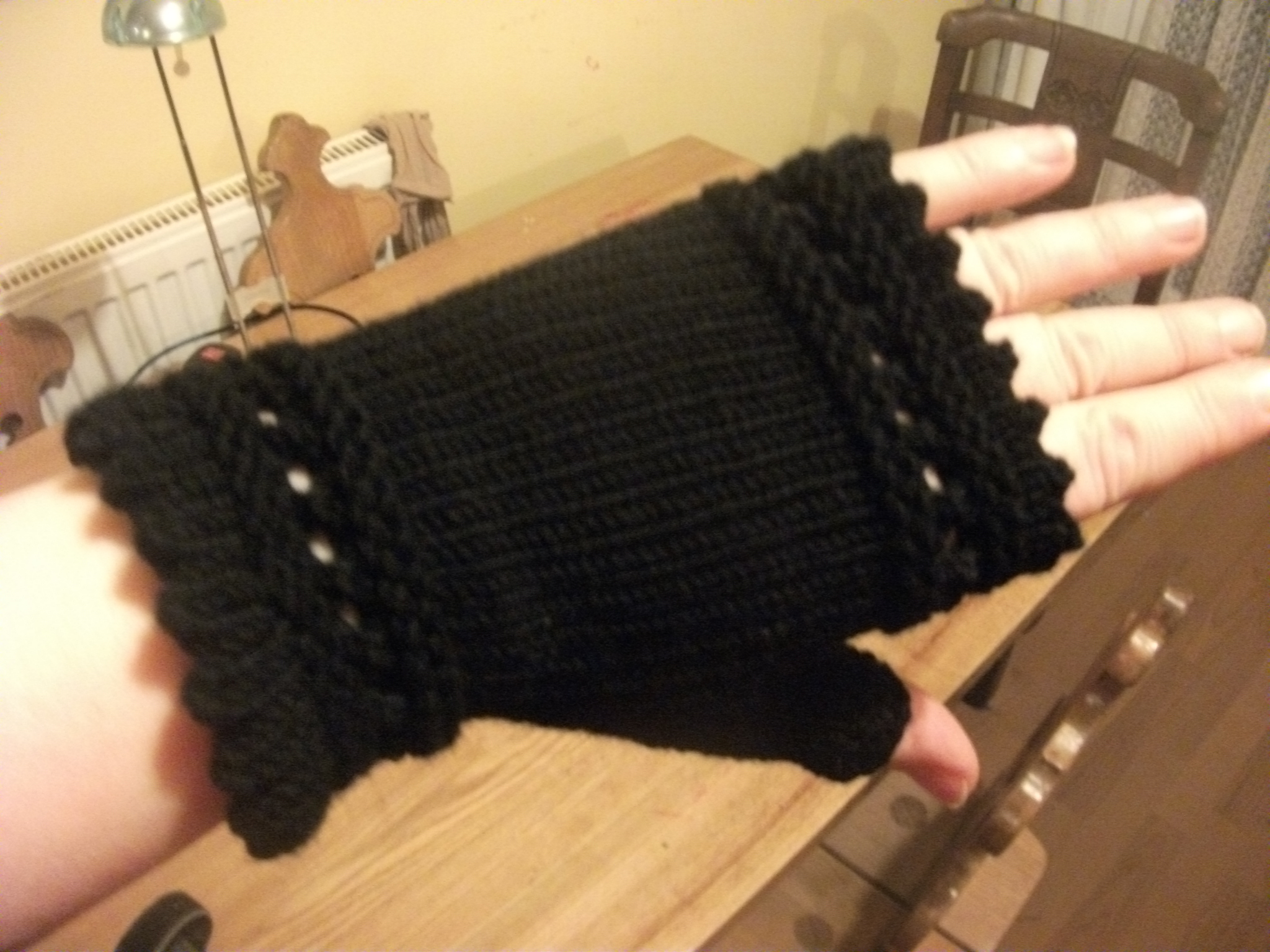
The black gloves are a pair I made for my teaching placement mentor. The pattern is Susie’s Reading Mitts from Dancing Ewe Yarns, and I used one skein of Katia Merino 100%.  Looks great, and can be used for wiping a whiteboard at a pinch.

The Pi Mitts I made for Pi Day – 14th of March, or 3/14 in American. As in 3.14? Because I have a bit of an obsession with π, as the numerati will deduce from the quote under my avatar. Utterly wasted on the little darlings at school, who are largely unaware of the symbol, and the fact that the decimal places continue beyond .14. But I like them. I started with green as the main colour, but found it didn’t quite ‘pop’ enough for my liking, so the second glove uses the red. It’s Teddy DK, wholly acrylic. They’re a little tight on my hands, but I was in a hurry. The pattern is a free Ravelry download.

Because I am a sucker, I made the skully convertible gloves and the Tam of Rassilon for X at Christmas. He has somehow become totally unequipped for winter, no jumpers, coats, gloves, anything to keep warm. I’d always intended to make both for him anyway, but the separation got in the way. The tam had to be blocked on a pizza dish! It is vast – though doesn’t look it worn. It’s now March, and I think he’s probably lost them already, doubtless on a binge. Certainly haven’t seen him wearing or carrying them since January.

I have deleted all the patterns I had favourited for him on Rav. That’s all, folks. I’m done.

On the right is a Drops shawl pattern, a basic garter-stitch domino specifically for long-repeat yarn, somewhat enlarged by m’self. The yarn is Teksrena 4-ply 100% wool, a Lithuanian yarn I got off eBay. The photo doesn’t do justice to the glowy colours. I call this Burning Embers.

It’s not a pretty-pretty shawl, but what I wanted was a big blankie that I could wrap around myself. It’s been very useful in the late and bitter winter weather we’ve had. It’s big enough to wear like a Faroese shawl, tied at the back. People like it a lot: I always get compliments when I wear it.

And finally for this post, Mickey Mouse. The Mighty Offspring has developed a real fondness for Mickey’s Playhouse, to the point where I am actually prepared to take him to Disneyland Paris for a few days this summer. Not going mad and considering a fortnight in Orlando, just 3 or 4 days. I… do not share his enthusiasm. Never have, even as a child. That squeaky voice just infuriates me. At least he’s dumb at Disneyland.

The pattern is Leisure Arts #3293, Disney Home: Mickey and Minnie Dolls, which I scored off eBay. I want to make it in Sirdar Snowflake, but while collecting the necessary colours, I made this in Teddy Vanguard DK, Spectrum Strata, and Robin Bonny Babe which I had to hand. The shorts come off, and I have an order for pyjamas already…
T’ra!

Accessorise This!

Gloves… I love gloves. Since Kim’s Sockotta Fingerless Gloves pattern went viral in my brain while knitting a pair of fingerless gloves, I’ve been able to pick up needles, wool and produce them with no trouble. In fact, that’s pretty much what I did one day when a friend’s daughter admired a pair my son was wearing – I even did an impromptu cable down the back. Unfortunately, I didn’t get a picture, but I was very pleased with them. I also have a pair of Cotillion Half Gloves to finish off, using some Twilleys of Stamford Freedom Spirit yarn that I received in a swap.

Last summer, we went on our first (and as it transpires, last) family holiday. I had been pushing this for – well, ever, but there was either not enough money, holiday time, or something, and it never happened. However, Summer 2009 I decreed to be the year we would finally go to Sweden. X’s friend emigrated there – well, I told him to go. Sounds good, yes? I scare X’s best friend into leaving the country! But in reality, his girlfriend lived there and their long distance relationship was wearing on them. On his way home from one visit, he bemoaned that he couldn’t just stay there – so I pointed out that he had every right, as an EU citizen, to move to another EU country and sent him some websites on the issue. Six months later… The relationship has since foundered, but he has friends there, a job, and he speaks the language and is even going to university now. All good.

Naturally, I wanted to take some knitting with me to Sweden. We flew out from Stansted at silly o’clock in the morning, necessitating taking a train down the previous evening, and sleeping in the airport until check-in. Then the flight, the bus to Göteborg, the holiday itself, and the return journey – lots of knitting time. Because I can never seem to get any sensible information about flying with needles, and had a steel crochet hook in my check-in luggage confiscated by airport security/customs on another flight before the current terrorist panic, I decided not take anything I would care about losing. So I made a couple of sets of dpns out of bamboo skewers!   There was another motivation: I’d been seeing short dpns mentioned around and about – 5″ and 6″. Never having used anything shorter than 8″, I wondered if these would be useful – after all, I’m fine with circs, and the needle part of them is about 4″-6″. However, I didn’t want to spend money on what might turn out to be nothing more than a multi-pack of cable needles. Like I don’t have enough of them!

I cut the skewers to size and started off using a pencil sharpener to create the points, but this just caused splitting no matter how careful I was. An emery board turned out to be just perfect. Afterwards, I painted them with nail varnish as a quickie way of smoothing the surface. As it happens, the skewers are exactly 2.5mm, spot on. The first set, the 6″ dpns, I painted in gloss colours which only afterwards I realised were Rastafarian. The 5″ set were in more subdued frosted purple, gold and white varnishes. As an aside, the gloss lacquer held up well at first, and stitches passed smoothly over it. However, over time, it seemed to get sticky, and wore away on the points, leading to splits. The frosted varnish, initially grabby because, you know, it’s got slivers of glitter in it, has held up better, and did not wear as badly.

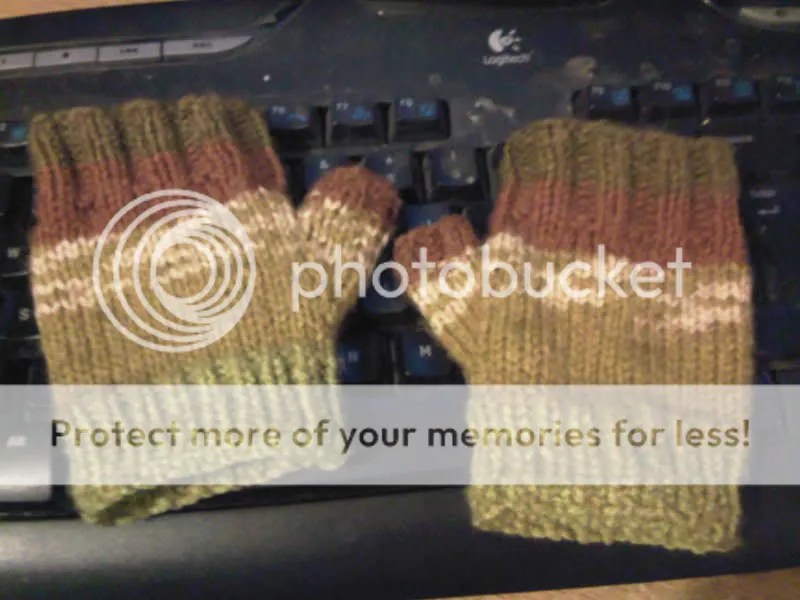
After this, I was on the hunt for a pattern that I could use them on, and decided I deserved some gloves. The yarn is Teddy Picasso Colour-keyed, a DK acrylic: I’ve used the chunky version before for a much-loved jacket.  Due to the colours of the 6″ dpns and the DIY nature of their construction, I dubbed the gloves Jamaica? Why, yes I did! Go on, laugh. I know you want to. The Mighty Offspring noticed me making the gloves and demanded a pair as well, just like mine. This is my own free pattern, the Mitts-to-Mittens – linky on the right.  It took some fiddling to get my own pair to match (sorry about the swirling on the right-hand pic, I think it’s because of shrinking down too much), but you can imagine what it was like with his. The single ball could have made a few more pairs, but not after I’d hacked it to bits. It was worth it. They are Ben 10 gloves. They are Humungasaur hands. He can shoot lasers out of them, and absorb sunlight that turns in to BLOOD. Good value for 69p.

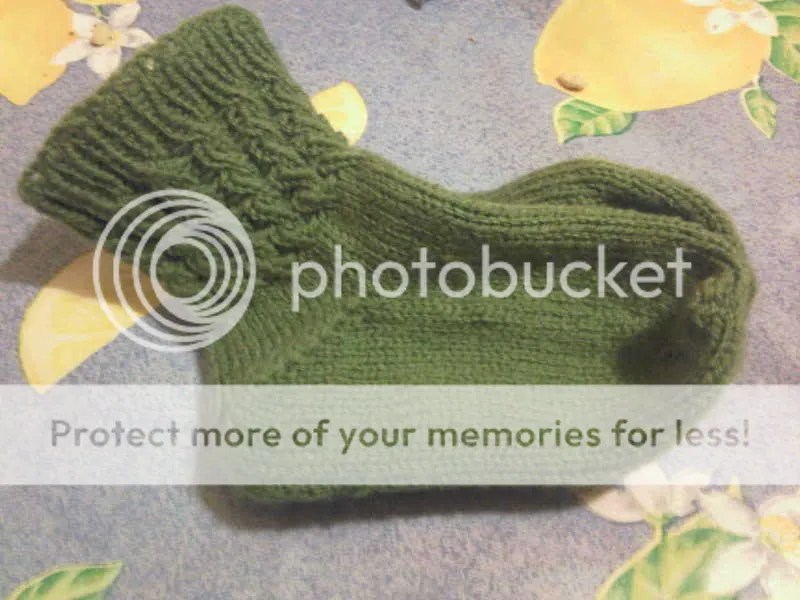
The next pair I made from some Teddy Vanguard chunky in a green so light it is practically fluorescent. I think I got it with the intention of teaching someone to knit. It just happens to be nephew Ben’s favourite colour, and he was thrilled to receive these an hour or so after admiring the MO’s pair. These, naturally, were knit with 8″ 8mm plastic dpns from under the counter in a charity shop, where such shameful items are kept. Why? Don’t be daft. Chunky on 2.5mm? As handy as the DIYdpns were at the time, I’ll be sticking with 8″ plus in future. The 6″ set were okay, but doing the MO’s gloves on the 5″ set nearly ruined me. It might have been the 10 days of knitting with shorter needles, or just the 5″ set, but for the first time ever I got hand pain. I was not knitting much more than usual, possibly slightly less, but my hands, both of them, felt like someone had taken a hatchet to the palms. Varying my hold didn’t help, and even now, over a year later, I still get twinges.

Never again…

T’ra fn

K

Dive In!

Well, let’s pile through this, starting with …socks!

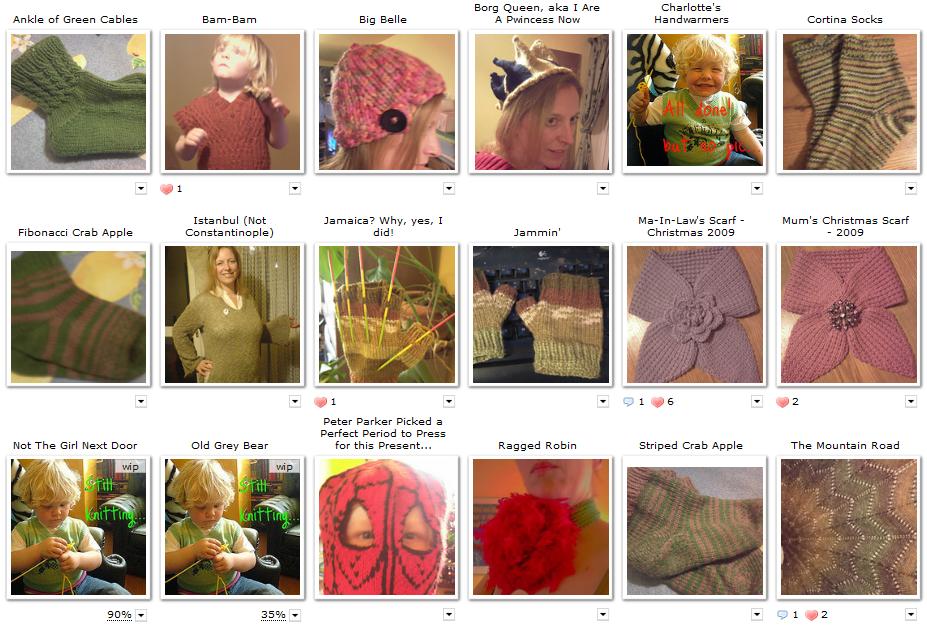
Top left is a self-striping yarn from LIDL, Zettl Sockenwolle Cortina. Just after I finished them, the word on Rav was that Cortina was being pulled and buyers refunded because the stuff felted! These are about a year old, getting tight, and have felted slightly through wear, not washing – so I’m happy enough. Another pair, recently finished, will appear soon. Well, soon for me…

The blue pair is in Katia Merino Baby, a wonderfully soft yarn I picked up in Christine’s of Bournville (a wee treasure house – go there if you can). I did a slipstitch pattern on them, but the wool is so soft and fuzzy that the definition has all but vanished. I also picked up Katia Merino DK for socks for myself – haven’t got round to trying it though. The remaining socks are with the good old Teddy sock yarn from the Bull Ring. The one with the cabled ankles (Ankle of Green Cables, ho ho ho!) has never been on the offspring – the cables draw in too much to fit over his chunky wee limbs – nonetheless, they make a fetching phone sock. The others are my usual negative stripe and Fibonacci in what I poshly call my Crab Apple colours.

Heading north, to Hats!

The pink cloche, Big Belle, is a last-minute, no-pattern knit for Pink Day at school – a fundraiser for breast cancer. I don’t have much pink, apart from a too-small PVC jacket, so I cast on top-down in my one remaining ball of Sirdar Bigga, increasing and trying on as I went. The last few rows were done ‘flat’ in reverse stocking stitch, with a couple of stitches cast on to make the tab that the button is sewn to. It’s a tight fit and maybe a bit too pointy, but looks okay.

The jester’s hat (Borg Queen) is Fool’s Gold, but in gold Hjertegarn Natur Uld that I picked up on hols in Gothenburg, and some leftover Sirdar Big Softie from Begotha. There were some mods for using superbulky. Also, I didn’t bother knitting the 5-stitch hat band. Instead, I picked up stitches afterwards, 2×2 rib for 5 rows, and then did a knitted Picot edging, which l think looks better… I then crocheted chains and sewed them in place on the opposing colours of the crown (no pun intended). I love this hat, though it really only sits on my head. I may have to make another, maybe with more tentacley peaks.

The Spiderman balaclava (Peter Parker Picked a Perfect Period to Press for this Present) is my 100th project!

The Mighty Offspring asked me to tell Santa to buy him a Spiderman mask for Christmas – on 22nd December! I had no idea where to buy one now that Woolies is gone, and no desire to spend time trekking through the shops in the run-up to Christmas, so I decided to cobble something together. The pattern is based loosely on Jackyll and Hide and We Call Him Spidey.  It was finished with a couple of hours to spare – HANDS LIKE CLAWS!!! I went off-chart with exhaustion, eye-fuddle and any other excuse about the eyehole area, but it looks okay for all that. It IS too big, though it would be probably be fine if I sewed some shirring elastic into the collar. MO was speechless when he saw it hanging on the Christmas tree! On recovering the power of speech though, he put in a request for a Venom mask… He’s making do with his father’s BSJ hat in the meantime, pulled down over his face.

The remaining two are a Drops pattern, made with the recommended yarn, Drops Eskimo! I must have come over peculiar to actually use the yarn for the pattern, it’s just not like me at all. I even bought the yarn (from Scandinavian Knitting Design, good value and fast delivery) with the pattern in mind! However, I saved myself by not using the recommended Drops Puddel for the trim. Instead I used some Patons Lush fancy yarn that I picked up on eBay a couple of years ago. It’s a little sparkly and adds some girliness to the hats, which do get compliments. There was only just enough yarn in the balls to complete them, but they do run a bit large – even with my tight knitting. I lightly felted them a few weeks ago and the fit is much better.  The jumper I’m wearing in the photos is a handknit that I liberated from a charity shop. It’s a chunky yarn, 100% wool, with big hairy guard hairs through it. Itchy as all get out, but I don’t mind. £4! I also liberated an off-white fishermans rib crewneck and a blue and white marl 4×4 rib turtleneck, both too large for me so given to X, and a soft and fuzzy Shetland wool jumper with an Aztec-look Fair-Isle design, all for similar prices.

So, lowering the tone to the neck region – scarves!

The first two were last Christmas’s gifts to Mum and Ma-In-Law – Debbie Bliss Cashmerino Aran and DK respectively. The pattern is a Rav-only download, Anthro-Inspired Scarflet. I got lucky and picked up exactly the right brooch the church Christmas Fayre for Mum’s pink scarf, but couldn’t find anything for the lavendar one, so instead I crocheted a rose using the same pattern I used for the Mighty Offspring’s Christening Shawl. Looks effective, no? My own version is an iron grey yarn from eBay, Knitwitz Camel – 30% camel, 30% alpaca, 40% wool. Very resistant to blocking, as you can see. The brooch is a vintage bone daisy, picked up at the same Fayre along with a matching necklace.

The scarf on the left is Ragged Robin, a reverse-engineering of Annie Modesitt’s Ruffled Roses which is available only through LYS in the US, hence the reverse engineering. The green is Teddy 4ply, but the ‘rose’ is Jaeger Fur, a super-chunky wool-mohair blend that I stumbled across in Northfield’s Pins & Needles. The yardage is tiny – 22yds – but I still have about half the ball left! It’s a bit pouffy and OTT, but livens up a dull suit and is surprisingly warm.

The bobbly purple scarf below left is not a triumph of Aran bobbles, but a very simple scarf made with Teddy Pom-Tiddly-Om-Pom. At £2 in the Bullring, it was 75% off – you couldn’t be bad to it. The yarn came in a great tangled mass, and I wound up cutting it 4 times – yes, me, the master untangler of mohair and laceweight, defeated by novelty yarn. While knitting I just tied the ends together, cutting off any inconvenient bobbles on the way. The bobbles are big enough to hide the ends of the knots! I cast on 5 stitches, one between each bobble. On the second row, I knit into the front and back of each stitch (10sts). Then continued till I ran out of yarn. It really looks like it’s going horribly wrong for the first 6 rows or so, when the bobbles lie down and start behaving themselves. Be patient.

The lacy little number is another Christine’s of Bournville find, Katia Tobago. The colours really are that vivid. Okay maybe not – the camera was playing up at the time. The pattern is Queen Anne’s Lace, which, though really quite simple, manages to be oddly tricky. You need to do EXACTLY what the pattern says, even if it seems a bit odd at first. I made this for Ma-In-Law for what I thought might possibly her birthday – I only have a rough idea of when this is, as X had no idea of the date at all. Unfortunately, this was around the time things came to a head between us, so I have no idea what she thinks of it, or indeed if she even received it.

I think that will do for now. I do have a few more scarves to include, but they are either not quite finished or I have no photos as yet. Only the finished product will appear, m’dears.

T’ra fn!

K

New blog, new life!

I’ve moved to WordPress!

My old blog is still there – I may move stuff, or not. Unfortunately Blogger was making me crazy over image handling, and the blog itself was too full of old memories, as a quick look at the last couple of updates will prove.

So here is what I’ve been up to for the last year:

What a difference a year makes.

AKA Tiny Husband is getting the chop…

It’s been almost exactly a year since my last post – more than that if we go back to my last crafting post. And life has changed.

For a start, I’m now half way through my teacher training, and a single mother. TH and I separated in July, initially to give ourselves a break while he sorted out some issues. Now, however, it looks like we won’t be getting back together, as TH – must find a more suitable acronym – has decided, in effect, that his problems are actually personality flaws on my part. But he doesn’t want a divorce, unless one of us wants to remarry.

We’ll be getting a divorce. It’s either over, or it’s not. I’m not having this hanging over me. I’m already pissed that I’m in this halfway house of being ‘unofficially’ separated. There is no way that I could put up with having to explain my whacko living arrangements and non-divorcee status for the rest of my life. And while we’re at it, I’ll be going back to my maiden name.

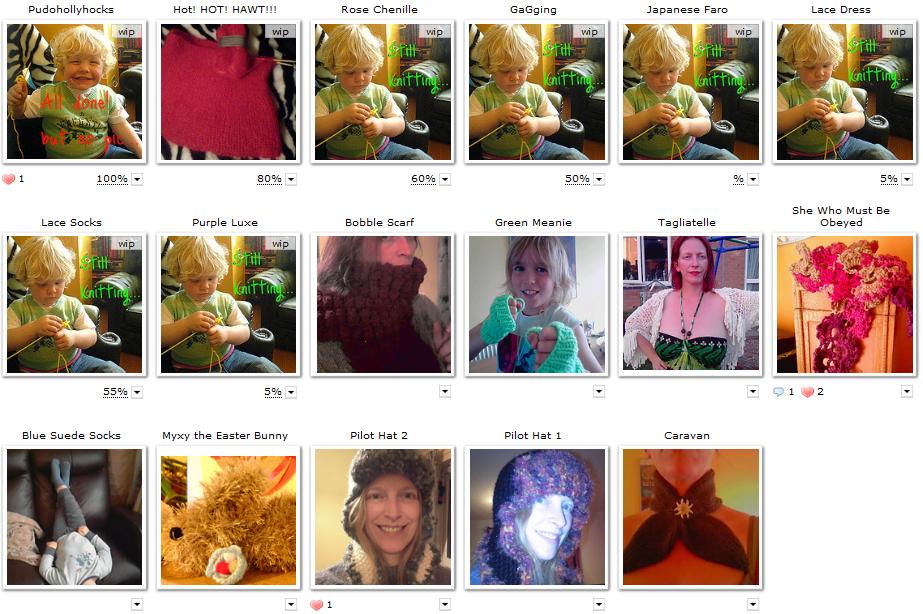
And so to our normal schedule: the remaining creations from 2009 –

And 2010 so far:

More later…

A detailed mathematical and historical analysis of four of the challenges encountered in the game L – A Mathemagical Adventure

Introduction

L – A Mathemagical Adventure (hereinafter referred to as L) is a text-based single-player role-play computer game produced in 1984 by the Association of Teachers of Mathematics (ATM, no date), aimed at Key Stages 2 to 4. Originally designed to run on the BBC platform then more or less common in schools, the game is similar in format to other text-based games, such as Zork (Barton, 2007): the player has a quest – in this instance, to rescue a fair maiden named Runia; to achieve this objective, the player must overcome obstacles, defeat fearsome enemies, solve puzzles, and so forth; and the play is controlled by means of a set of relatively simple commands. Despite its single-player setup, there are opportunities for shared gameplay, discussion and co-operation in solving the puzzles presented.

The scenario contains references throughout to the literary works of Lewis Carroll, who – as Charles Dodgson – was an eminent Victorian mathematician with a predilection for games and puzzles. The puzzles are, naturally, mathematical. Some are relatively easy, others less so; and a few seemingly innocent tasks conceal problems of considerable depth and antiquity.  This paper will explore the solution and pertinent history of four of the tasks: the telephone; the bat room; the code room; and baking a cake.

My route through the palace was fairly systematic. In each room or area, I initially travelled east, then explored other routes in an anticlockwise direction. Having selected a direction, I explored it as far as possible, retracing my path backwards in stages to the first room after attempting all the tasks.


The Telephone

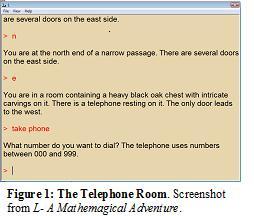
The telephone room is at the north end of a corridor to the west of the workshop. The possible phone numbers run from 000 to 999 (see Figure 1). The telephone itself is a red herring in the quest: no useful information is revealed in solving this puzzle. It is the chest on which the telephone sits that is important. Due to the route taken, this was one of the last places I looked: I was laden with objects and it is only thanks to a friendly games guru that I realised I had to drop them all to move the chest. I initially tried a few likely numbers (000, 111, etc.) to no effect. I then tried prime numbers, and got messages for 002, 003 and 005. When 007 yielded nothing, I tried 008, the next Fibonacci number, and on its success I tried the remaining Fibonacci numbers below 999 – 16 in all (see Appendix 1).

The Fibonacci sequence is named after Leonardo of Pisa [1] (O’Connor & Robertson, 1998) -nbsp;undoubtedly the 13th century Italian mentioned in one of the telephone messages. It appears in his Liber Abaci, in which he also introduces place-value decimal numbers. Fibonacci came to the attention of the Holy Roman Emperor, Frederick II, and his court. He was set a series of problems, including a problem regarding rabbit populations (see Figure 2). Starting with a pair of rabbits, and assuming they mature at one month old and produce young at two months old, how many pairs of rabbits would there be at the end of any given month? Fibonacci determined that the number of pairs in any one month was equal to the sum of the pairs in the previous two months: 1, 1, 2, 3, 5, 8 being the number of pairs in each of the first six months.

Had the sequence remained in the sphere of population dynamics, it would have been of limited use: none of Fibonacci’s rabbits ever die, for example, and continue to breed unabated by considerations of food supply, or, indeed, the walls surrounding their habitat as described in the original problem. However, the sequence has found applications in such a wide arena that there is a scholarly journal, the Fibonacci Quarterly, is devoted to its academic study. An examination of the L telephone messages reveals some of the areas in which the Fibonacci sequence has been applied:

001, 377:  meteorology (Swinbank & Purser, 2006);
013:          botany and biology (Knott, date unknown);
089:          economics (Frost & Prechter, 1998);
114:          sports and betting (O’Connell, 2008).

An unusual property of the Fibonacci sequence is that, when each number in turn is divided by its predecessor, the results converge on a curious number known as ϕ (phi), or the Golden Ratio. This number is found in nature, in architecture, art, music, geometry, and visual perception; it appears to underlie our notions of beauty; and has even inspired authors such as Dan Brown. Its pervasiveness is such that some see it written by the hand of God (Meisner, date unknown).

Surprisingly then, under the circumstances, I have been unable to establish a link between Lewis Carroll’s Alice and the Fibonacci sequence, except for the rather trivial coincidence that both began with rabbits.

[1]: Leonardo was a member of the Bonacci family: Fibonacci may be a contraction of figlio Bonacci – son of Bonacci.


The Bat Room

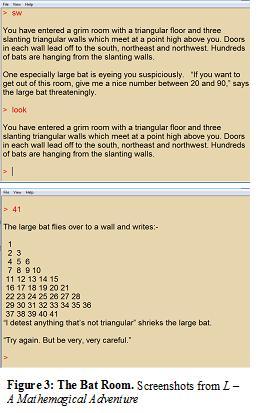
The Bat Room occurs towards the end of the game. The solution to this puzzle, any triangular number between 20 and 90, is one of the most clearly signalled in the game: the room has a triangular floor and walls. If this were an insufficient clue, any mistake causes the large bat to write out a triangular list of numbers, declaring that he hates anything that is not triangular (see Figure 3). This hint is repeated every time an error is made; any attempt to leave without completing the task causes the bats to swarm around the door, making escape impossible.

The triangular numbers are one of a class of numbers known as ‘figurate’, meaning that each term can be represented as a figure: graphically as a pattern of dots, or physically using counters, bottle tops, etc., where they can be used to teach younger students about the relationships between numbers, patterns and graphical representation. Such figures are regular geometric shapes – triangles, squares, pentagons, and so forth (Weisstein, date unknown–a). The figurate numbers are widely studied in number theory, but the triangular numbers attract considerable interest as they pop up in a variety of different equations, such as the sum of consecutive integers, square numbers, Pascal’s Triangle, and even integrals (Weisstein, date unknown – b). The most famous triangle number is the infamous 666, the so-called Number of the Beast. Sadly, the true Number of the Beast according to modern Biblical scholarship is the rather less inspiring 616.

The link to Lewis Carroll’s work in this task is again somewhat tenuous. The Bat was the nickname for Bartholomew Price, a professor of mathematics at Oxford known to both Lewis Carroll and Alice Liddell, the model for Alice, and Carroll parodies a well-known nursery rhyme through the voice of the Mad Hatter:

Twinkle, twinkle, little bat
How I wonder what you’re at!
Up above the world you fly
Like a tea-tray in the sky.
Twinkle, twinkle, little bat
How I wonder what you’re at!

The Code Room

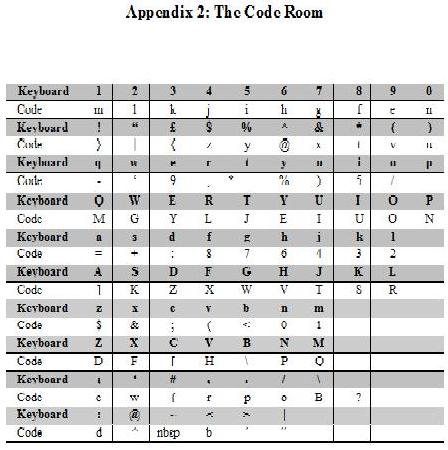
The code room is located to the south of the billiards room, through an anteroom, and was thus located at an early point in my quest. In the code room, the screen fills with apparently random letters, digits and punctuation marks (see Figure 4). I solved this by making a codebook: typing each line of keys on the keyboard, and writing down the resulting text (see Appendix 2). Fortunately, it turned out to be a simple substitution code. Despite my lack of gaming knowledge, I knew that there should be a device in the room which would return its appearance to normal, and this turned out to be the case. I kept the glasses with me for the rest of the quest: this was not necessary for all the tasks, but a few did turn into code if I had to set the glasses down.

Codes have a history beyond the scope of this paper, ranging from military ciphers to Victorian flower language. Much ingenuity has gone into producing unbreakable codes for military and political uses, where a variety of techniques and devices have been employed – once-only codes, and the Enigma machine are examples. While many early codes were simple substitution codes such as found in the code room, there has been a progressive move toward mathematically-based codes and ciphers – and the use of mathematical techniques in cracking them. Naturally, as codes became more complex, computers are needed: it is arguable that computers would not be the household item they are today, if they had not been necessary for code breaking in the Second World War. Today, encryption is a major area in computer and internet security.

Dodgson was greatly interested in cryptography both recreationally and academically, and is known to have produced several ciphers, including a matrix cipher (Abeles, 2005). Some of these ciphers cunningly included nulls – non-code characters, or code characters used randomly – to disguise the meaning further. He used these codes to write letters to friends, and to remember dates.


Baking a Cake

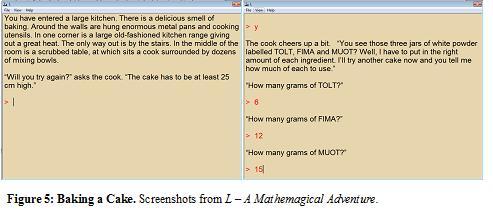
The new kitchen is situated on the east of the palace, almost opposite the old kitchen near the game entrance. A cook needs to bake a cake at least 25cm high, using three ingredients, TOLT, FIMA and MUOT, in grams. The scenario glosses the soup-making episode in Alice in Wonderland, substituting a salty cake for the over-peppered soup.

Initially, I attempted to use the codebook on the ingredient names. I tried to find another code or language that might convert the letters into digits, sums, four-letter number names, ingredients with four letters (e.g., eggs or soda), or even four-letter acronyms. Finally, I tried simply putting in random numbers. More than 100g was declared ‘wasteful’ by the cook. By systematically changing one number at a time, I found a rough relationship similar to a Bell curve between the ingredients and the cake: that is, up to a point, increasing the ingredients increased the size of the cake, but beyond that, the cake decreasing in size. However, I was unable to find any distinct mathematical relationship, such as Pythagorean Triples.

Then I had a happy accident. Having found that 6g TOLT, 10g FIMA and 8g MUOT produced a 25cm cake, I decided to leave the game but forgot to save my position. When I went back in, I accidentally typed 10g MUOT instead of 8g – and it worked. After another 20 or 30 tries, I determined that 5, 6 or 7g of TOLT, 10-18g inclusive of FIMA, and 1-100g inclusive of MUOT, in any combination, produced a cake of the desired height.

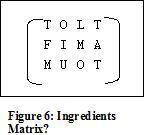
It would be disappointing if this task, which must on average take players more time to complete than any other, were merely some kind of trial and error problem. I searched for more possibilities, but with little success. However, amongst the extra pieces of information I gleaned was that Dodgson had done some research on matrices, or ‘blocks’ as he called them, and had produced a method for finding determinants, known as Dodgson’s Condensation, which remains one of the most efficient to date (Dodgson, 1867). I also discovered, quite incidentally, that a contemporary of his, Sylvester, worked on the determinants of rectangular matrices (Weisstein, date unknown-c). It then occurred to me that the ingredients could be arranged into a rectangular 3 x 4 matrix of letters, with 25 perhaps representing a determinant. Unfortunately, I could go no further forward with this idea – partly because the mathematics is currently beyond me, and partly because there is still a crucial element missing: the key to the matrix. I was unsuccessful in finding a copy of Dodgson’s matrix cipher, which may be the key – assuming, of course, that I am not seeing patterns where none exist.

Conclusion

As a disclaimer, I should say that I have an intense dislike of computer games. This dates back to my early experience of programming in the mid to late 1980s, when running silly games on a computer was irresponsible and wasteful. However, I do acknowledge that some games can be educational, and therefore worthwhile. L – A Mathemagical Adventure has thus been an interesting look at the possibilities of such games. I found there is plenty of food for more advanced thought – up to A Level and beyond in some tasks. The literary allusions are amusing, and could be useful in broadening students’ views on mathematics, too.

When drawing the map, I noticed that the palace is missing much of its ground floor. Perhaps it is a fully-working evaluation copy, missing some additional ‘levels’: some objects are of no use; some tasks are unconnected to the quest; and there are unresolved issues at the end of the game. If so, then I would love to play a full version – which is high praise indeed.

Reflective Processes

Once upon a time there was an academic discipline. Its practitioners were learned men, its advocates the wealthy and wise. It sought to explain the nature of man and of his actions. In this, it was successful: all agreed the profiles were highly accurate, the prognostications pleasing. No one noticed the over-detailed bland generalisations – or if they did, only so far as to feel validated to have their own analysis confirmed by such learned men.
That discipline was astrology. Today, it is called social psychology, American-style.
The methodology is quite simple:
1.      Find a normal social process;
2.      Give it a fancy name;
3.      Describe it to death, in lieu of real evidence (Coffield et al., 2004);
Should an ‘undiscovered’ process prove elusive, you have two options: a) find some piffling absence in a ‘discovered’ process; or b) tweak the existing model (bigger words are good) – and book your spot on Oprah[1].
The result is a proliferation of near-identical theories and instruments, with muddled and over-reaching claims (that learning is the same as knowledge, for example), and little empirical evidence – and that contradictory at best (Coffield et al., 2004, pp 61-69). Kolb’s Experiential Learning Theory (Kolb & Fry, 1975, in Smith, 2001a) is merely Lewin’s Action Research model (Smith, 2001b) turned into a circle, with bigger words for the stages. Gibbs’ Reflective Cycle (1988, in University of Brighton, no date) covers similar ground, but requires examination of one’s emotions: explicitly in one stage and implicitly throughout. However, this rehashes much of Boud et al.’s (1983) Reflection Model, albeit in a simplified form. Little information is available on Gibbs’ model: the book itself is out of print, and I found no mention of any empirical work. Nonetheless, many online professional development guides are based on Gibbs’ model, often aimed at student nurses, teachers, and social workers. Coupled with the lack of any reference to Gibbs’ work in Coffield et al.’s (2004) review, it is as if Gibbs[2] merely wrote a student guide – as many lecturers do – neither intending to pursue the ideas therein academically nor imagining that it would take on such impetus.
A final point is that, while both Kolb’s and Gibbs’ models are used for reflective practice, reflection per se is only part of each cycle, and is little elaborated. Does reflection arise from the full cycle, or only from these one or two stages? Is it necessary to complete every stage, or can they be combined, or skipped entirely?  Is there a set of procedures embedded in these stages, and if so, what are they – and is the rest of the cycle necessary at all? For answers, or at least clues, it might pay to review afresh Dewey’s original discussion of reflection (1910, ch. 6, pp 68-78); unfortunately, I must now move on.

******  Junior School: Reflection using Kolb’s Reflection Cycle.

Concrete Experience

***** ******** and I led a mathematics session with six mixed-ability Year 5 students. There were two main tasks: number skills, using Factor Bugs; and shape naming. The tasks were introduced by themed Bingo games respectively. At the end, the students were awarded certificates and given nets to take away.

Reflective observation

Positive:
1.      Students said they understood factors, squares and primes better.
2.      Students demonstrated a good grasp of shape names and their meanings.
3.      The amount of work planned was almost right for the time slot.
4.      The work lent itself well to the wide range of abilities.
5.      The certificates and nets.
Negative:
1.      We did not plan detailed timings. As a result, we did not fully cover the second task.
2.      We did not stick to the rules for the Bingo games, which overran and impacted on the task time.
3.      The tasks and activities were rather sedentary.

Abstract Conceptualisation

We had the advantage of previous groups’ experience and knew roughly how much work to prepare. However, the slight timing issue suggests that on another visit, we should plan one major theme rather than two, with shorter tasks and perhaps more games and breakout activities.
Rules for games should be planned in advance and adhered to as far as possible. This is important if the number of games and activities were increased.
We did not have competitions this time, as we could not gauge its impact on the dynamic on an unknown group.

Active Experimentation

Our plan for the next session is as follows:
1.      A single theme with related tasks and games, and practical activities get the students moving and doing.
2.      Planned differentiation for tasks.
3.      Game and activity rules agreed in advance and adhered to.
4.      Detailed timings, with some built-in flexibility.
5.      An optional competitive element.
6.      More prizes!


[1] Lest this critique be thought unnecessarily harsh, some authors have used the terms ‘disease’ (Coffield, 2008) and ‘snake oil’ (Atherton, 2009) to describe some of the work reviewed briefly here, and associated research.
[2] English, not American, as it happens. A clear case of American cultural imperialism. 

Bibliography

Atherton, J.S. (2008); Reflection; an idea whose time is past. [on-line] UK: Doceo. [Cited: 24/03/2010]. Available at: <http://www.doceo.co.uk/lincoln/index.htm >. 
Atherton, J.S. (2009) Learning and Teaching; Experiential Learning [On-line] UK: Doceo.  [Cited: 25/03/2010]. Available at:  <http://www.learningandteaching.info/learning/experience.htm>.
Boud, D., Keogh, R., & Walker, D. (eds.) (1985). Reflection. Turning experience into learning. [online]. London: Kogan Page. [Cited 24/03/2010]. Partial copy available at Google Books: <http://books.google.co.uk/books?id=xBshIryFdr0C&printsec=frontcover&source=gbs_v2_summary_r&cad=0#v=onepage&q=&f=false >.
Coffield, F. (2008). Just Suppose Teaching and Learning Became the First Priority… [online]. London: Learning and Skills Research Centre. [Cited 25/03/2010]. Available at: <https://crm.lsnlearning.org.uk/user/order.aspx?code=080052 >.
Coffield, F., Moseley, D., Hall, E., & Ecclestone, K. (2004). Learning styles and pedagogy in
post-16 learning: A systematic and critical review. [online].  London: Learning and Skills Research Centre. [Cited 24/03/2010]. Available at: <https://crm.lsnlearning.org.uk/user/order.aspx?code=041543 >.
Dewey, J. (1910). How We Think. [online]. New York: Dover Publications. [cited 25/03/2010]. Partial copy available at Google Books: <http://books.google.co.uk/books?id=zcvgXWIpaiMC&printsec=frontcover&source=gbs_v2_summary_r&cad=0#v=onepage&q=&f=false >
Smith, M. K. (2001a). David A. Kolb on experiential learning. [online]. London: The Encyclopedia of Informal Education. [Cited 24/03/2010]. Available at: < http://www.infed.org/b-explrn.htm >.
Smith, M. K. (2001b) Kurt Lewin, groups, experiential learning and action research. [online]. London: The Encyclopedia of Informal Education. [Last updated November 04, 2009] [Cited 24/03/2010]. Available at: <http://www.infed.org/thinkers/et-lewin.htm>.
University of Brighton. (no date). Reflection. [online]. University of Brighton Staff Central. [Cited 24/03/2010]. Download at: < http://staffcentral.brighton.ac.uk/CLT/events/documents/Ramage%20Example%202.doc >.

Resources in Brief

Factor Bugs: http://www.teachers.tv/video/37869, accessed 07/03/2010.

Polya, G. (1973) How To Solve It: A New Aspect of Mathematical Method. Princeton, New Jersey: Princeton University Press.

George Polya, or Pólya György, was a Hungarian mathematician who spent much of his career at the Federal Institute of Technology, Zurich (ETH Zurich) and at Stanford University. His is a family which suffered, or courted, difficulty. His father, perhaps best known for his Hungarian translation of Adam Smith’s The Wealth of Nations (Polya, 2006), was a lawyer whose academic ambitions were thwarted by institutional anti-Semitism, until he converted to Roman Catholicism. His brother Eugen (Jenö) was a surgeon, famous for a type of gastrointestinal bypass surgery for the treatment of stomach ulcers, who died at the hands of the Nazis; another gifted brother, Laszlo, was killed in the First World War. His great-nephew is the controversial artist and biochemist, Gideon Polya. George seems to have limited his misfortunes to an early punch-up with a student with royal and high level political connections in Göttingen: fortunately for mathematics, this incident partly led to his appointment at ETH Zurich.
Polya performed poorly in mathematics at school, which he later attributed to bad teaching. It was not until he was at university when, following qualifications in literature, he began to be interested in philosophy, that he began his mathematical studies. Despite this late start, he went on to make contributions in a range of topics so diverse as to call to mind the polymaths of ancient and mediaeval times, in a career that extended well beyond his retirement in 1953: remarkably, he was still teaching at Stanford University in 1978, at the age of 91. From the first, his real interest in mathematics seems to have lain in proof and mathematical discovery (Albers & Alexanderson (1985), in O’Connor & Robertson (2002)). Indeed, it is arguably that this underlies his contributions to mathematical education, for which he is most remembered. This legacy comprises a series of books on problem-solving in mathematics, the first of which, How To Solve It, is the subject of this review.
How To Solve It is an unusual book. There are in fact only 36 pages in all which outline Polya’s method: these form Parts I and II of the book, In The Classroom and How To Solve It – A Dialogue, respectively. These chapters are preceded by a two-page outline of the method, presumably intended as an aide memoire, and an Introduction, which outlines and explains the book’s rather unique structure. Part III, the largest section of the book, is entitled a Short Dictionary of Heuristic, essentially an appendix expounding in detail on the problem-solving techniques and ideas mentioned in Parts I and II, together with potted biographies of a few mathematicians and definitions of a few pertinent terms. The final section, Part IV, is the aptly-titled Problems, Hints, Solutions. Throughout the book, subsections within the chapters are numbered, rather more like a textbook or business document. Initially a little disturbing to the reader expecting something a little more literary, this does however reinforce the fact that this book is very much a guide: a textbook in mathematical guidance.
Of the book, Part I – In The Classroom – is the most important. It is this chapter that sets out the purpose of the book: to help improve and develop problem-solving in students. Five main issues are raised and explored briefly:
  • Helping the student
  • Questions, recommendation, mental operations
  • Generality
  • Common sense
  • Teacher and student. Imitation and practice.
The emphasis is very much on finding problems suited to, yet challenging at, the student’s level of knowledge and ability, and then on unobtrusively guiding the student to a solution. Polya then explains that his model, for reasons of convenience, is split into four phases: understanding the problem; making a plan; carrying out the plan; and looking back. Each phase is then examined in detail, with a running example. Polya recommends a method of a quasi-Socratic, positive questioning – posing a variety of leading questions, in a variety of ways, to steer students gently towards finding ‘their own’ solution. On completion, the solved problem can then be examined – mined, as it were – in the same manner to explore connections to other problems and concepts under the guise of checking, incidentally reinforcing the learning that has just occurred. 
A significant difficulty with the book is the language in which it is written. Originally published in 1945, it has something of the flavour of F. Scott Fitzgerald and the more serious works of P.G. Woodhouse and Dorothy Parker – a convoluted phrasing, an emotionally-detached remoteness, that makes for difficult reading. Polya’s literary and philosophical background shows strongly, although the fact that the text is readable at all by the layman indicates that he must have tried to play both down considerably. Some of the mathematical terminology is outdated: in the first running example, he uses a problem concerning a parallelepiped. Fortunately, I vaguely remembered seeing the –epiped suffix somewhere as meaning a 3D figure, so I did not have to interrupt my reading to look up a dictionary. There is a diagram, but this appears later in the exposition of the problem-solving phases – perhaps too late for another reader. However, I had a difficulty with the printed text: the suggested guidance questions were identified by italicised font, but unfortunately, so are all Polya’s emphases. For the teacher skimming through for ideas, this is unhelpful. Since the edition I read was published in 1973, it is odd that some alternative was not found.
In all, this is an immensely useful book which fully repays the endeavour of reading, despite the difficulties of language. Polya makes a heroic attempt to explain, in albeit condensed and simplified terms, a difficult task. As anyone who has ever attempted to solve a difficult mathematical problem can attest, the thought processes that lead to an answer are proof (sic) against analysis: occasionally lightening fast, at other times tortuously slow, and then again, suddenly productive after perhaps weeks of drought. Polya takes this amorphous thing, and supplies a structure, a logic, and a process from which something might reliably emerge. It is not a book to be read through, short as it is. It is a book that should be kept on a convenient bookshelf, to be referred to, dipped into, and mulled over. Frequently.

References
J J O’Connor, J.J., & Robertson, E.F. (2002). MacTutor: George Pólya. [online]. University of St Andrews: MacTutor. [Cited 26/03/2010].

Polya, G. (1973) How To Solve It: A New Aspect of Mathematical Method. Princeton, New Jersey: Princeton University Press.
Polya, G. (no date). Personal Profile. [online]. Media With Consciousness News . [Cited 26/03/2010].
Polya, G. (2006). Global Avoidable Mortality. [online]. Blogger. [Cited 26/03/2010].
Who Named It? contributors (no date). Eugen (Jenö) Alexander Pólya. [online]. Oslo: Who Named It? [Cited 26/03/2010].