
The same way a hairdresser can cut your hair without hurting you, or a barber can shave you without hurting you.
Originally appeared on Quora.
The same way a hairdresser can cut your hair without hurting you, or a barber can shave you without hurting you.
Originally appeared on Quora.
#Ophelia
I feel ya
Are not taken serya
-Sly. North or in Éir-ia
We don’t seem to fear ya.
The kids are deleria
-S, the memes are hilaria
-S, our preppers plan enebria
-Ted parties to cheer ya,
While Americ-ya Prays for ya,
Erin goes “Bromaire –
We’ve a laethanta saoire,
#Ophelia
Ya hoor ya
Come blow us awayyyyy”
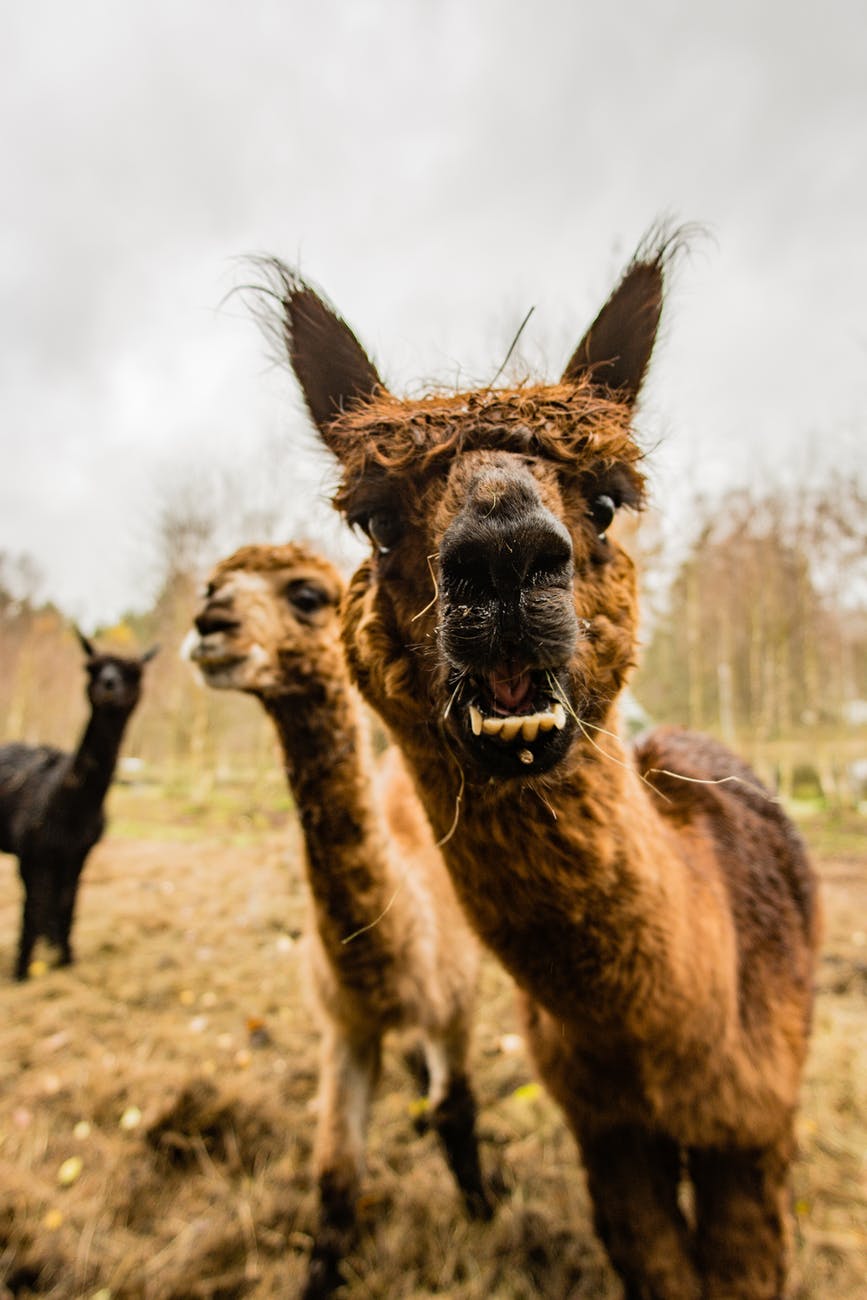
Llama! LlamaLlamaLlamaLlamaLlamaLlamaLlamaLlamaLlamaLlamaLlama…
Seriously, if you know of a homeless llama, send it my way. Llama wool is gorgeous…


Look how these natural shades GLOW:

And when it’s dyed, you get this:

Or you can knit scrummy warm things like these:

And they look like John Taylor from Duran Duran


Originally posted on Quora.
There are plenty of polyester– and other plastics-based substitutes for woollen fabric of all types.
They are usually sweaty, often dry-clean only, and melt or burn easily if ironed. Indeed, they’re often flammable, and are generally not recommended for children’s wear because of this. Many are derived from fossil fuel byproducts or from highly-polluting chemicals, and are non-biodegradable. They do not have the same warmth as wool of a similar thickness, and, unlike wool, are not usually showerproof without additional chemical coatings.
They are usually cheaper than the wool equivalent, though, so there’s that.
Originally posted on Quora.
Yes, and there are nearly 400 commercially-available yarns which combine yak and silk, of which 76 are blends of yak and silk only. The usual fibre to which they are added is (sheep) wool, where proportions can be as little as little as 5%. In yak-silk blends, the proportions are generally 50:50, or 55:45.
Yarn weights vary from Thread, such as Treenway Silks’ Silken Fog (1,527 m per 100g), to Worsted (slightly thinner than Aran weight yarn), such as Lotus Yarns’ Cathay 4 Streak (165 m per 50g).
Originally posted on Quora.
If you mean raw wool, it often depends on the level of care by the farmer. Some shepherds I know wash their sheep regularly – well, more than once – while the fleece is growing, others don’t bother. Imagine you wore the same sweater for a year: you sleep in it, you exercise in it, and once in a while you stand in the rain in it. It would stink, right? Same deal when that sweater is still growing on the sheep, except the sheep also poop and roll in mud in their fleece.
Lanolin, a thick yellowish grease with a strong smell, is another source of the sheepy odour. Different breeds have differing levels of lanolin, and there can be wide variations within a breed depending on grazing, age, sex, whether a ewe has lambed that year, etc. Some mills remove some or all the lanolin, while others make it a point of pride to retain as much as possible. I personally don’t find lanolin to be an offensive smell, and it doesn’t bother me to work with wool ‘in the grease’. Lanolin is a component of many moisturisers, so it’s lovely for my hands. My mother won’t let me in her house if I’ve been working with greasy wool, though – the smell gives her the dry heaves.
A third source of smell is urine. Specifically, horses’ urine, if I recall correctly, though I’d imagine any large, regular source, such as cattle or human, would do at need. Historically, stale urine was the go-to cleaner for raw wool, and the finest tweeds were dyed using urine as a mordant (fixative). While these have largely been replaced with manufactured chemicals, urine-cleansed or mordanted wool can give off a distinct whiff of wee when damp, or if the wearer gets a little sweaty. It is alleged that the British House of Lords, where a substantial number of the Hereditary Peerage wear their historical tweeds, often honks like a dunny in the sun.
Originally posted on Quora.
Qiviut, the wool of the Musk ox, is THE warmest fibre, which makes sense considering they’re Alaskan. Qiviut has an advantage over many other warm animal fibres in that it can be spun unblended. Others, such as cashmere, angora, etc., are often too short to spin on their own and/or too easily worn out.
However, pure qiviut is quite expensive – around $35 per ounce (that’s about $1.25 a gram, and twice the price of cashmere) raw and unprocessed, and $25 an ounce spun into yarn. If you’re too lazy to knit or just want a wearable RIGHT NOW, expect to shell out $200-$300 for a hat, or around $1,000 for a sweater.
It’s not the most expensive fibre though: that is vicuña, from the undomesticable South American camellid of the same name. Raw prices are comparable, but a vicuña scarf costs $1,500, and a sweater can cost up to $5,000.
A more affordable alternative is alpaca fibre. It’s plenty warm, not that much more expensive than (sheep) wool, and hypoallergenic.
Originally posted on Quora.
Well, my main hobby, and dream of supporting myself as a designer of hand-knitting patterns, would be severely compromised, for a start. We’d lose a sturdy, renewable, bio-degradable, hygroscopic, fire-proof, naturally insulating fibre that can be used for clothing, soft furnishings and home insulation; and lanolin, a waxy substance with waterproofing, emollient, lubricant, and antiseptic qualities.
Sheep farmers would have gone bankrupt, which could have serious economic implications for some countries – New Zealand, for example. Lamb and mutton, two of my favourite meats, would be off the menu permanently.
I haz a sad now.
Originally posted on Quora
Image from When someone tells you, “The climate is always changing,” show them this cartoon | Grist http://ow.ly/TAO530aL67G

I grew up in a house with no TV. Shocking, yes? We also had no phone. GASP. There were lots of other things we didn’t have – mains water and central heating, for example, but it’s the TV I’m concentrating on here. I only got to watch the goggle box in other people’s houses, and that rarely: people in those days still switched the TV off when visitors came, to facilitate conversation. Those without TVs switched off the ‘wireless’ – as radios were known – and those without wireless put their books/knitting/embroidery down, or removed their wellies/aprons, depending on the time of day.
However, when I was about 9, we got our first TV, a black and white model in a beautiful, possibly fake wood surround, with a big dial for tuning into the channels. There were four channels, none providing more than 8 hours of programming a day. Actually, there were only four channels because we lived near enough to the border with Northern Ireland to get their 3 channels (BBC1 & 2 and UTV). We were lots more swanky than our compatriots further south, who only got RTE. Not RTE1, 2, etc. – it was the only channel then.
I became almost instantly obsessed. I absorbed TV into my bones, memorising cast lists, story lines, directors, production companies – I was a walking IMDB. But my most favouritest thing ever was the Saturday matinee. Every Saturday, one of the channels put on an afternoon movie, usually a black and white classic. There was also usually a Sunday matinee, but they weren’t quite so good: too many musicals, and from different eras. They were great family watching, but oh, the Saturday matinee knocked them all into a cocked hat. On Saturdays, square-jawed men in hats traded cigarettes and incomprehensible quips with sultry, sassy women in suits or negligee, in train stations and piano bars. Cynics and losers sacrificed themselves for love and honour, heroes and heroines self-destructed from their darker passions, life was lived against a backdrop of swelling piano and strings, and the Dame ruled them all.
The Dame wasn’t always a beauty, or a brain. She wasn’t innocent, or evil. What she was, was confident. She knew herself, and was happy with it. She put on no airs, put up no pretences, suffered no fools. Tough and tender by parts, she went after her goals, and even if she failed, you knew she’d be okay. There were many takes on the Dame – Katharine Hepburn’s tomboy athleticism, Bette Davis’ brittle sharpness, Barbara Stanwyck’s hardness, Ava Gardner’s voluptuousness – but the epitome was the wonderful Lauren Bacall. Perhaps because Betty, as she was known to her friends, seems to have sashayed the walk in real life too, her performances have a multi-layered authenticity that other dames simply don’t match. They’re too sweet, too venal, too remote. Even as a teen in To Have and Have Not, Bacall exudes the BTDTBTTS attitude of a woman who knows she can handle whatever comes her way.


Bacall was an inveterate knitter herself, often photographed with a WIP on movie sets and in private life.
And so, to knitting. Normally I like to outline where my inspiration comes from, but in this instance, it’s all a bit … nebulous. I like Bacall, but I can’t say she was the direct inspiration. I’m a big fan of monochrome, tessellation, and fitted clothing, but again, these didn’t call to me. Knit Now put out a call with a theme of budget knitting. That didn’t call to me either! Sheesh, I do nothing BUT budget knitting! Somehow, though, the various elements fermented away at the back of my brain until a couple of days before the call was due, and then it was all, “how do I want to look when I’m strapped for cash? FABulous, that’s how. How can I look fabulous? Try for classy rather than runway. Who’s classy? Lauren Bacall. What’s she worn that’s particularly classy? well, that houndstooth suit in The Big Sleep is kind of iconic…” and so on. Lots of Google image searches for the structure of the kind of sexy-but-not-sexy clothes Bacall wore, trying to pin down an appropriate shape.
The Dame Pullover grew, rather than sprang fully formed into my mind. I think it’s a style that’ll grow on people too. It’s smart enough for the office, elegant enough for cocktails, and, yes, classy enough for everything from a church jumble sale to the Aspen ski slopes. I love it more than is seemly for its creator – I should be more modest about these things, and I usually am, I think – but this is perhaps my favourite pattern of those I’ve produced to date, and I design only what impassions me. The nipped waist, the Vikkel braid borders, the pointless wee buttons on the polo neck make my toes curl with joy.
The fact that it’s also the first and, so far, only pattern of mine that’s gone through tech editing with no issues is just the whistle to my pucker…

And here’s the sub. Spot the statutory misspelling that escaped me! And the novel design element that I forgot to take notes on, and then couldn’t reproduce for the sample… I’m making a lot of use of my Kindle Fire, a slim Targus stylus, and an app called SketchBookX Express to produce my sketches these days. Find an image, import it, put a layer on top and ‘trace over’ the image, then delete the image and save the tracing. It’s pretty much what the cool kids have always done with Photoshop, but for me, the touchscreen beats the mouse any day. This technique should work as well on any touch-enabled screen, though I can’t recommend software for individual platforms.
Till next time!