TdF23, D+11/S12 – Non, j’en ai rien…

No, pas de toison français…

But I do have a tiny amount – 20g or so – of fibre from a sheep with a French name:
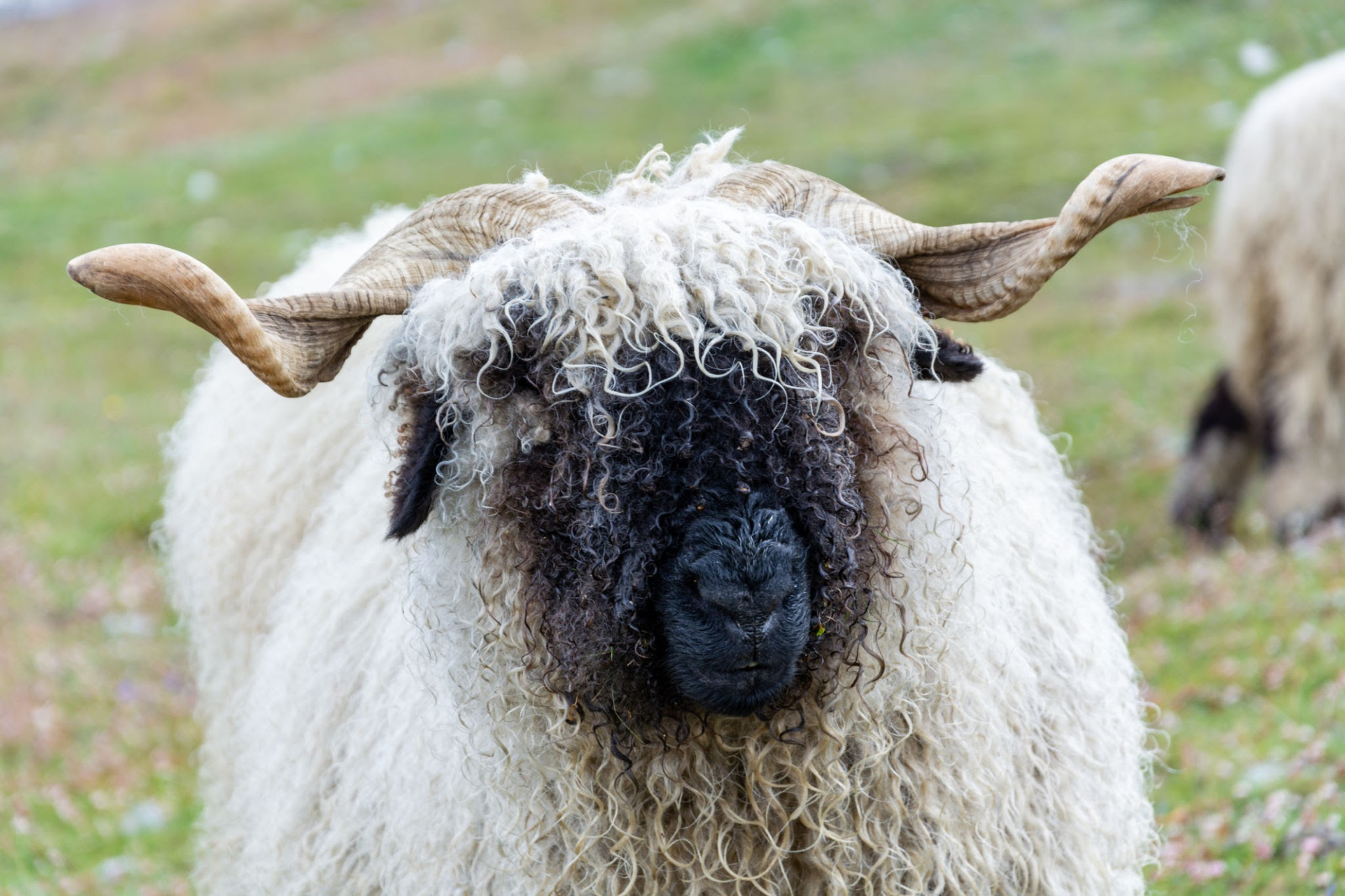
a head shot of a Valais Blacknose sheep
Valais Blacknose sheep. Okay they’re Swiss, but they’re French Swiss.

I got this even after hearing things about this sheepiest of sheepy sheep. Specifically that this paragon of sheepdom, this avatar of sheepiness, this apotheosis of Ovidae*, has, well, shit fleece. Despite appearing to be the Living Epitome of Fluff on Earth, its wool is coarse, abrasive and frankly worthless for anything but pot-scourers, though you’d probably want something that was kinder to your hands…
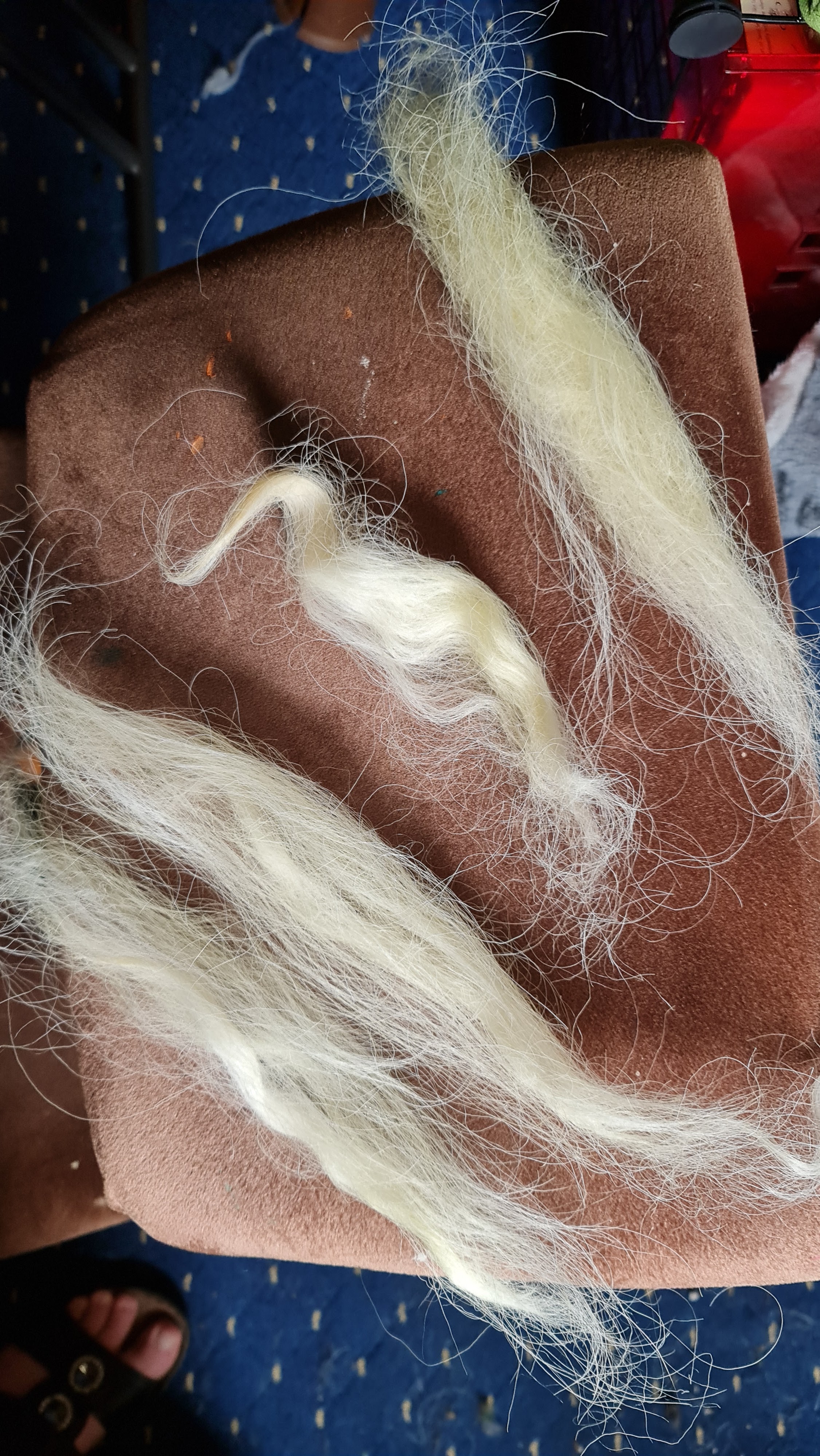
20g of Valais Blacknose raw fleece, washed and split into sections for spinning

Knowing all this, I still went ahead and bought some. I do not have a pic of it when it arrived in the post, but, take it from me – I know whereof I speak – it came out of the envelope looking like the hair from the end of a cow’s tail:
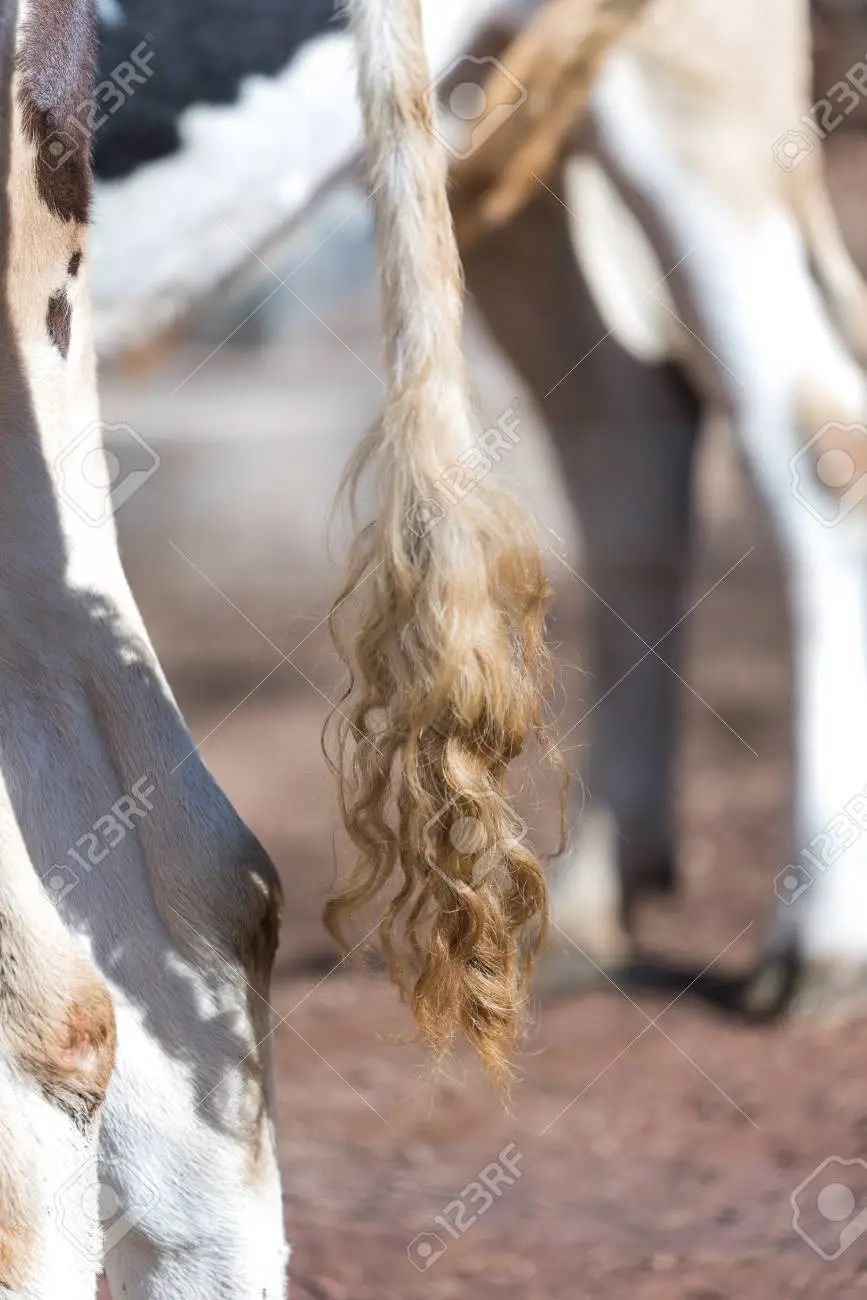
Close-up photo of a cow's tail
Like this, but slightly less smelly

On first touch, it was rougher than a cow’s tail. Washing did nothing to improve the feel, it just made the individual hairs sprout out of the locks. I even tried my intensive moisturising hair conditioner on it – nada. The locks do have a bit of a curl to them, but it’s really just the last inch or so that curls. The rest is straight, inelastic, and utterly lacking in crimp. It looks, feels, acts like … hair. I don’t get how a sheep breed developed for the Alps has fleece so lacking in downy goodness.

Nevertheless, I spun that sucker. It spun surprisingly easily, without trying to tangle or felt in the hands. The individual hairs are quite thick: I tend to spin finer singles, but this is the first occasion where I’ve been able to count the individual hairs in one of my singles:

Photo of my hand, holding the end of the fibre supply before allowing twist into it, clearly showing there are only 8 individual hairs going into the spun single.
EIGHT hairs. Count them.

I would not use it for anything that gets closer to your skin than a hat-veil – it’s quite stiff and unyielding, so it may have suitable sculptural qualities. Spun thicker, it might have uses in some housewares (net curtains?), cordage, or basket-weaving. I plan to try Irish lace crocheting with it.

One positive from the experience – this could be a good fibre for teaching spinning. The fibre moved very smoothly through my hands without tangling or bunching or sticking to itself like normal wool does (or is that just me??!), and there was no problem keeping the twist out of the fibre supply. As a result, I got to practice a few different drafting techniques, including the dreaded long-draw that I messed up a few days ago. These would make Valais Blacknose a good practice fibre for a novice spinner, even if it’s overall a disappointing spinning experience.

Aside from that, I plied the two bobbins of black alpaca I worked on earlier, and started spinning a crazy batt that I think I got at Yarnfolk. It’s huge – about 50cm wide and 70cm long! I had a long think about how I wanted to spin it, looked at loads of tutorials, and finally decided to tear more-or-less uniformly coloured sections off it. There’s still substantial quantities of other colours in each section, so it’s not just going to be long runs of boring stripes. I finished one section today, basically orange, but transitioning through gold, brass, red and brown – and it’s so pretty on the bobbin! I’ll probably 2-ply each section to maintain the basic colour, then maybe make a basic shawl like Revontuli with it. Pics tomorrow!

Allons-y!


*: yes, yes, it’s Bovidae, but that calls to mind cattle, not sheep.
TdF23, D+11/S12 – Surprise middle…

I wasn’t going to bring this out til near the end, but #teamwow’s challenge today is to spin a plant fibre. Bonus points if it’s a fibre from your garden. Soooo…

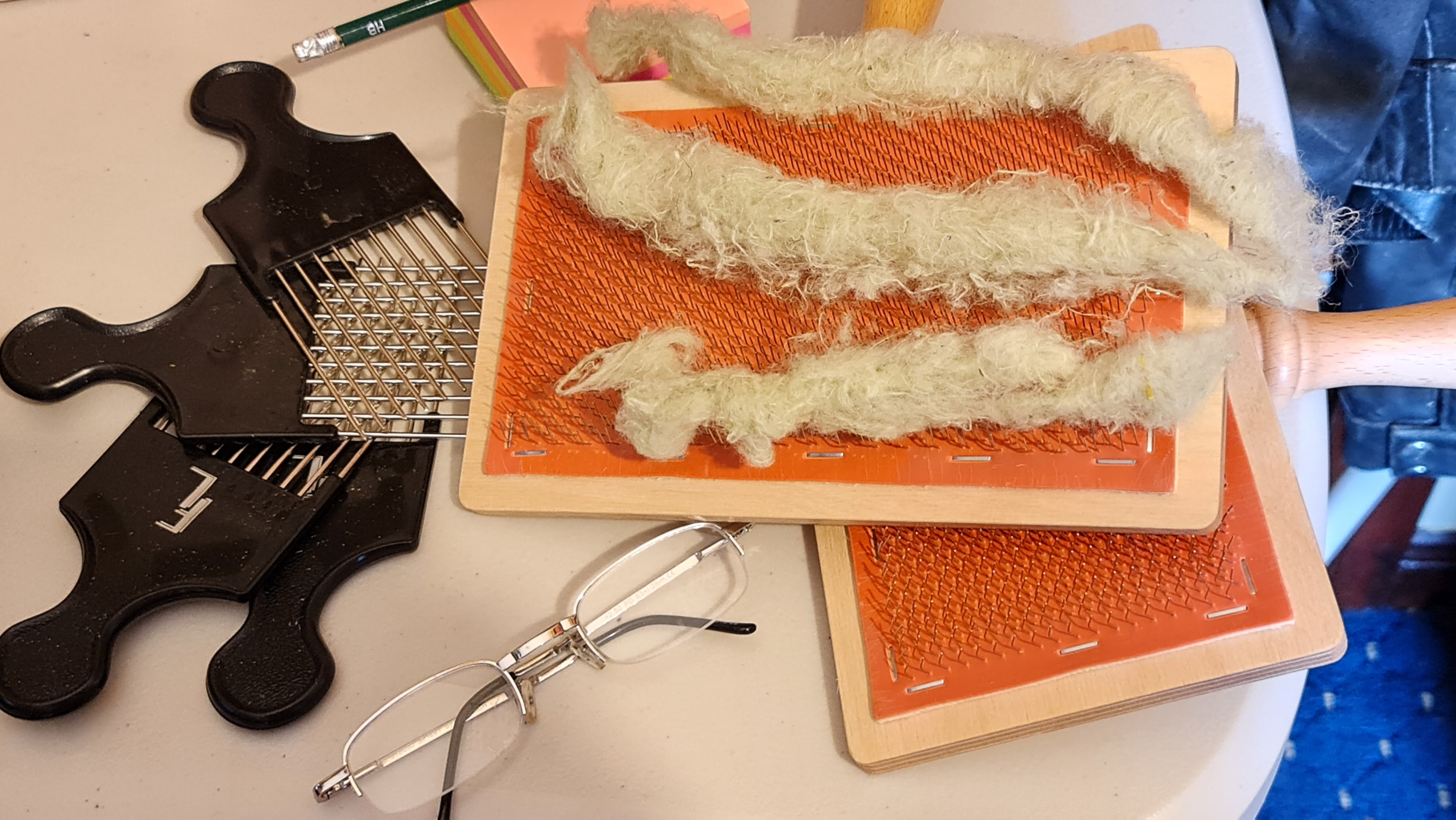
3 very pale green rolags sitting on a pair of hand carders. 4 hair pick combs and a pair of reading glasses lie to the side.
Carded rolags – I use the hair picks in pairs for combing fibre

Can you guess what it is?

A small quantity of very pale green yarn on a Takhli spindle with an Irish half-crown coin as a whorl.
Thread on my Takhli spindle, Tosh.

Does this help?

Illustration from the fairy tale, The Wild Swans, showing a young woman knitting a green top, surrounded by 10  swans wearing crowns.
The Wild Swans

It’s nettle fibre!! Picked, de-foliated, stripped, bashed, dried, scutched, hackled, boiled in washing soda, dried again, and finally carded all by yours truly. I have been following experimental archaeologist Sally Pointer for a while now, finding out the many ways to process bast fibre (the outer ‘skin’ on the stem) from a variety of plants including nettle. This fibre is about 1/5 of the crop from about 100 dried green-stemmed nettles from the clump at the top of my garden (well, it’s really a field, just with some flowers in one part). The rest is soaking in washing soda for a week and will then be divided into combed-only and carded-only, to see if that makes a difference. I also have another 100 red-stemmed nettles from the bottom of the garden, which were processed differently – I stripped the bast off when the nettles were fresh, not dried – and are still drying. I plan to do a few other experiments this year to see what works best for my purposes.

And what are my purposes? I have become a wee bit obsessed with producing the finest possible fibre from my nettles – the kind used in expensive textiles known as ‘Nordic silk‘.

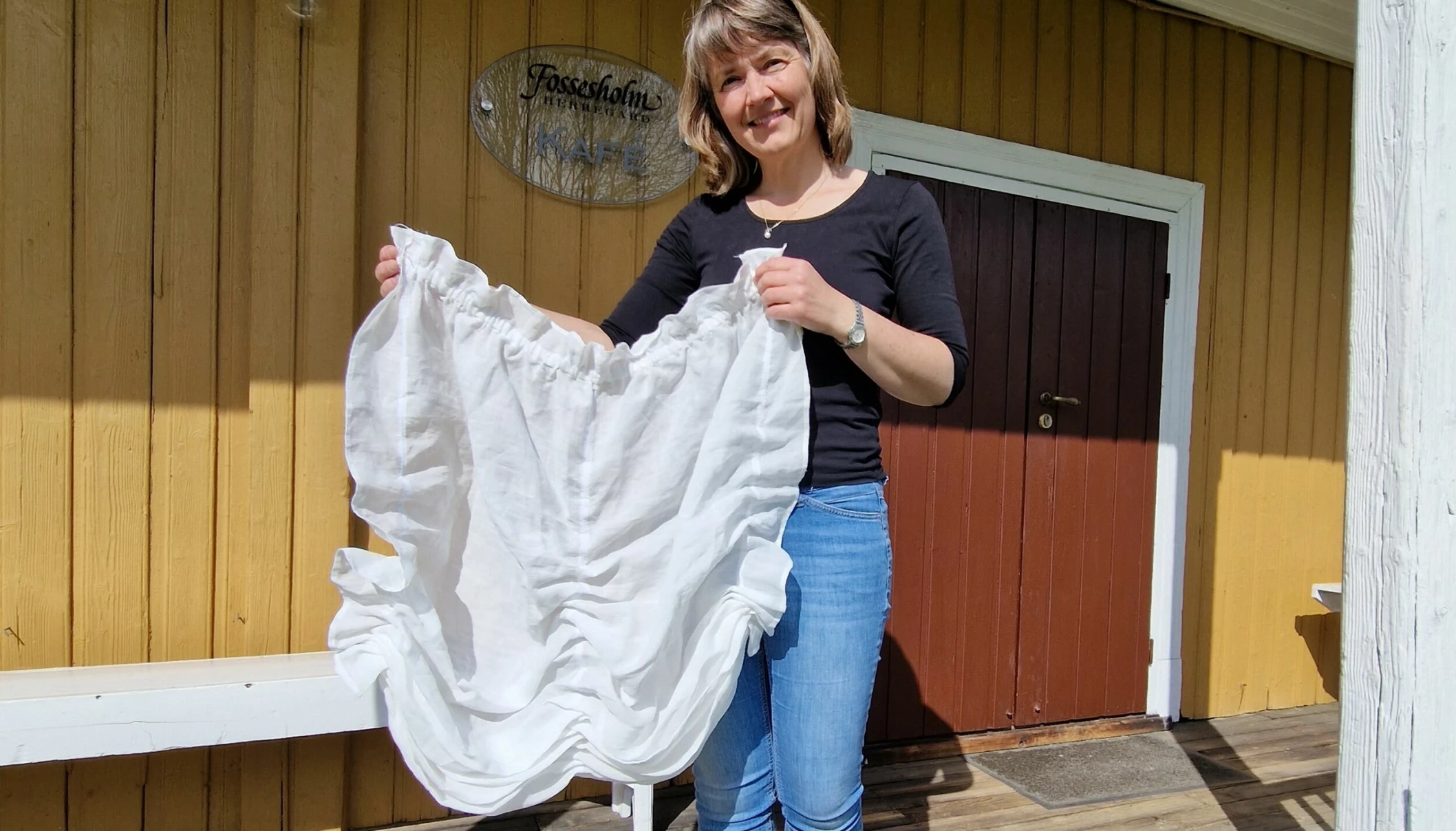
Nordic silk curtains found in Fossesholm Manor, Buskerud, Norway
Nordic silk curtains found in Fossesholm Manor, Buskerud, Norway (Photo: Nina Kristiansen)
Rear view of 18th-century Danish embroidered wedding dress woven from fine nettle fibre, now held in the National Museum of Denmark.
Nettle wedding dress,  National Museum of Denmark.

No, I’m not planning a wedding dress. But a little lace scarf would be nice.

This experiment was not very successful. The boiling was probably too harsh, breaking down most of the fibres to fluff, leaving just enough whole bast fibres to spin into a rather thick twine. Still, plenty more nettles in the garden!

FAQs

Yes, they do sting. But, like rambunctious dogs and snotty teenagers, they are best handled firmly. Grab the nettle at the base in one hand, clamp your other hand firmly on the bottom of the stem and pull the stalk through. At a pinch, you can use something to cover your hands for protection, e.g., kitchen gloves, plastic shopping bag, etc.

No, you shouldn’t make soup/tea/beer with the leaves you’ve removed. Older leaves have tummy-upsetting chemicals – but they can be added to your compost. If you wish to consume your nettles, get them early in the season, before they’ve flowered. Don’t throw away the seeds! They’re very nutritious – if you don’t eat them, leave them out on your bird table.

Nettles are best harvested for fibre after flowering and when the lowest leaves begin to turn yellow. However, useable fibre can be harvested from dead nettles that have over-wintered. Choose tall nettles with no side-shoots.

The fully-cleaned fibre is white – I was just in a bit of a rush!

TdF23, D+10/S11 – Dark natural challenge

Today’s #teamwow challenge is to spin a dark natural fibre, so I’ve dug out a black alpaca roving I purchased at my first-ever Woolfest in… 2014? I don’t know why, as I had little intention of spinning then but it was the first time I’d even touched alpaca so maybe that was it. My intention after another day of grey Herdygurdy yesterday was to spin something colourful a wild orange-gold-black-grey-neppy* batt I picked up at the inaugural (and so far only) Yarnfolk festival in Whitehead, Co Antrim, just up the road from my first alma mater, the University of Ulster at Jordanstown (the old Ulster Polytechnic). I was slightly nervous about spinning alpaca, as I’ve heard it’s slippery and hard to handle, but so far so good.

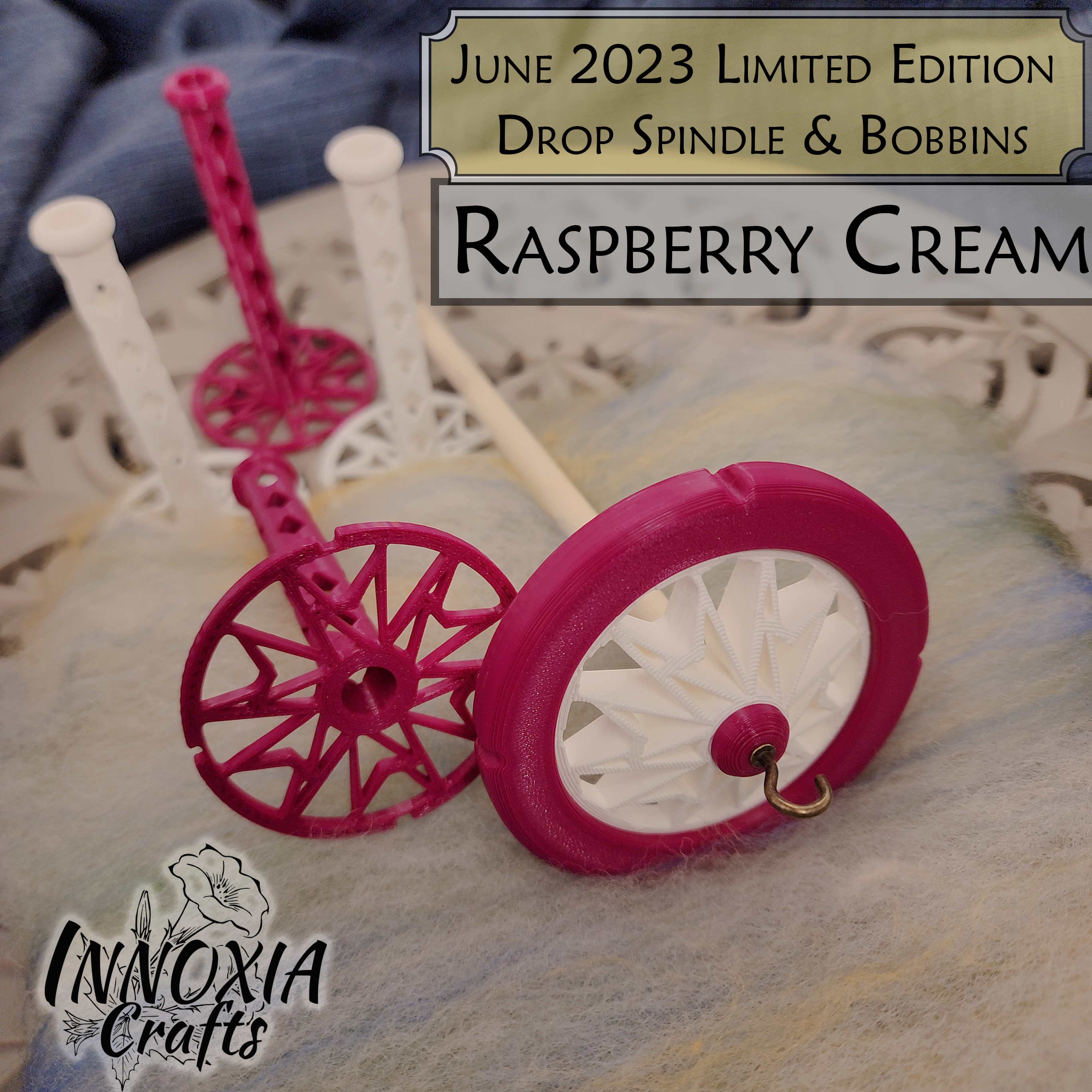
In today’s post, I received a new spindle from Innoxia Crafts in Canada! If u don’t know about these spindles, they are 3D-printed using a plant-based plastic and feature removable bobbins on the shaft. I ordered the June 2023 Limited Edition Raspberry Cream spindle, with 4 matching bobbins:

June 2023 Innoxia Crafts promotional image, showing a pink and white 3D-printed top-whorl spindle with a wood shaft and brass hook. Also shown are 4 matching bobbins, 2 pink and 2 white. The bobbins have only one flange (the big circular disk on the end of the shaft that stops thread coming off).
The open construction of this spindle reminds me of Victorian ironwork and fairground carousels, so her name is Caro(usel)

The bobbins click into the whorl and are held in place with tiny rubber bands. They also fit nicely onto my lazy kate for easier plying! They also only have one flange (which is what Wikiwand informs me is the name for the disks at the ends of the bobbin shaft that stops the thread falling off). This is presumably to cut down on weight as the spindle is 39g, which is toward the upper end of my experience with spindles. The flange is not grooved as a whorl, so they won’t be of any use on my spinning wheels, but no matter – I can ply from them on the lazy kate onto a wheel bobbin. Isn’t she pretty?!

This is today’s effort – 55g of Herdwick/bio-nylon 2-ply, and 39g of black alpaca singles:

2 bobbins, one filled with grey Herdwick/bio-nylon 2-ply, the other half-filled with black alpaca singles.

Allons-y!


*: This, of course, demonstrates my hypocrisy towards clown barf yarns…

TdF23, D+9/S10 – Rest Day

As if. I said I’d spin every day, so every day it is.

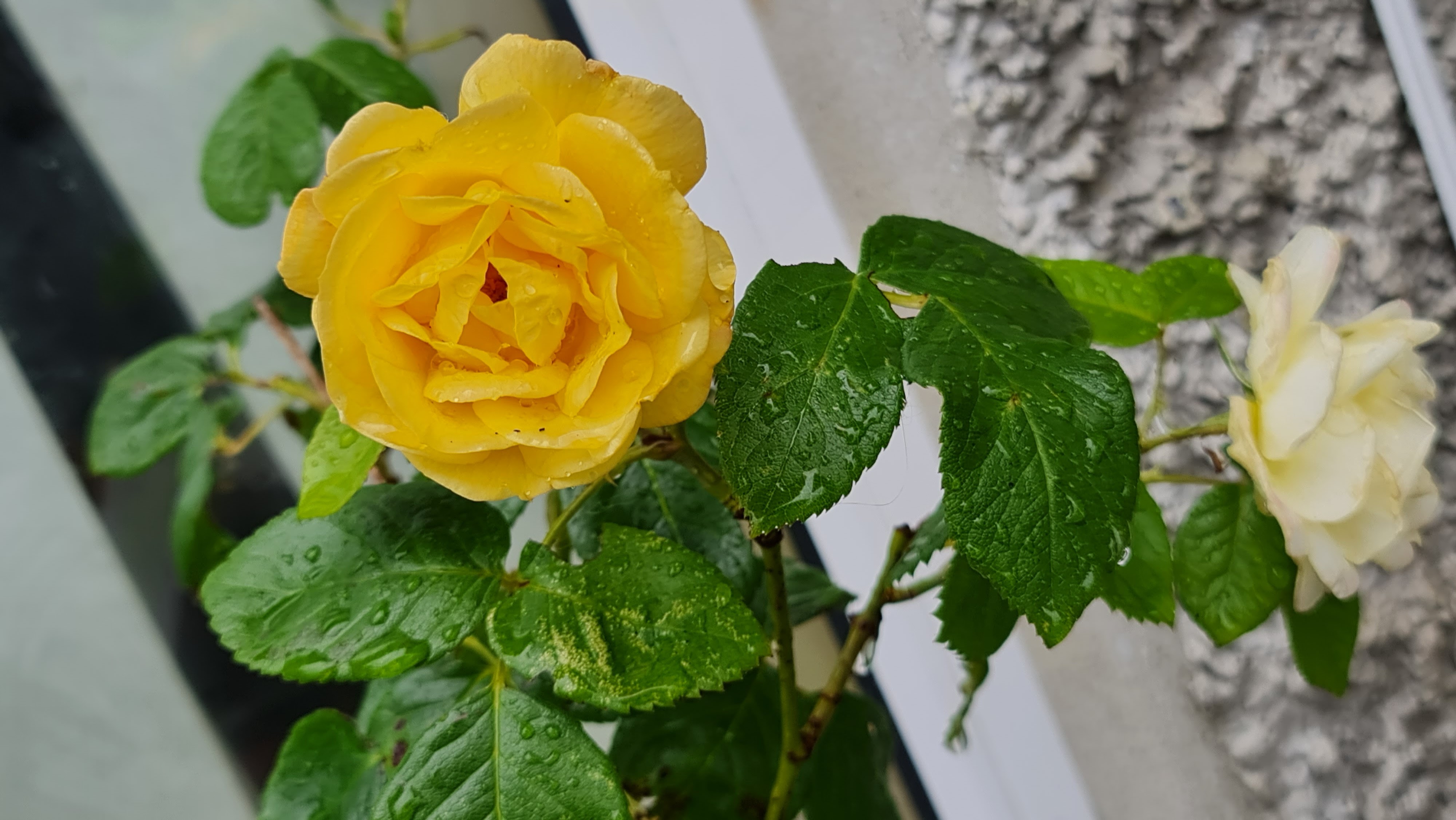
While out in the rain this morning, I spotted something odd on one of the rose bushes I inherited from my mother:

Two roses on the same bush, one bright yellow, the other white.
Same rose bush, different-coloured roses!

I’m pretty sure it didn’t do this for my mother, or she’d have shown me. Hopefully it’s not a problem, like lack of feeding or something.

Today, I finished up the 3rd of my Poppy Fields rolags. It’s went rather smoother than the other two, mainly because I relented on using it to learn long-draw and am instead spinning it as it comes. The sari silk is in no way blended into the rolags, it’s just randomly distributed lumps, so I just stop spinning when I come to one and winkle the silk fibres apart as much as possible to lie parallel along the single. I don’t always succeed, but the single is more consistent now and the silk slubs aren’t as huge. The drafting is a kind of short backward draw, between slubs, and not spun too tightly.

I also did some plying, weighing and measuring the length of what I’ve spun so far:

  1. Donegal Tweed, 2 ply, approx 12wpi, 33.6m.
  2. Mystery wool top, 2 ply, approx 20wpi, 33.4m.
  3. Shetland moorit top, 2 ply, approx 20wpi, 54.5m.

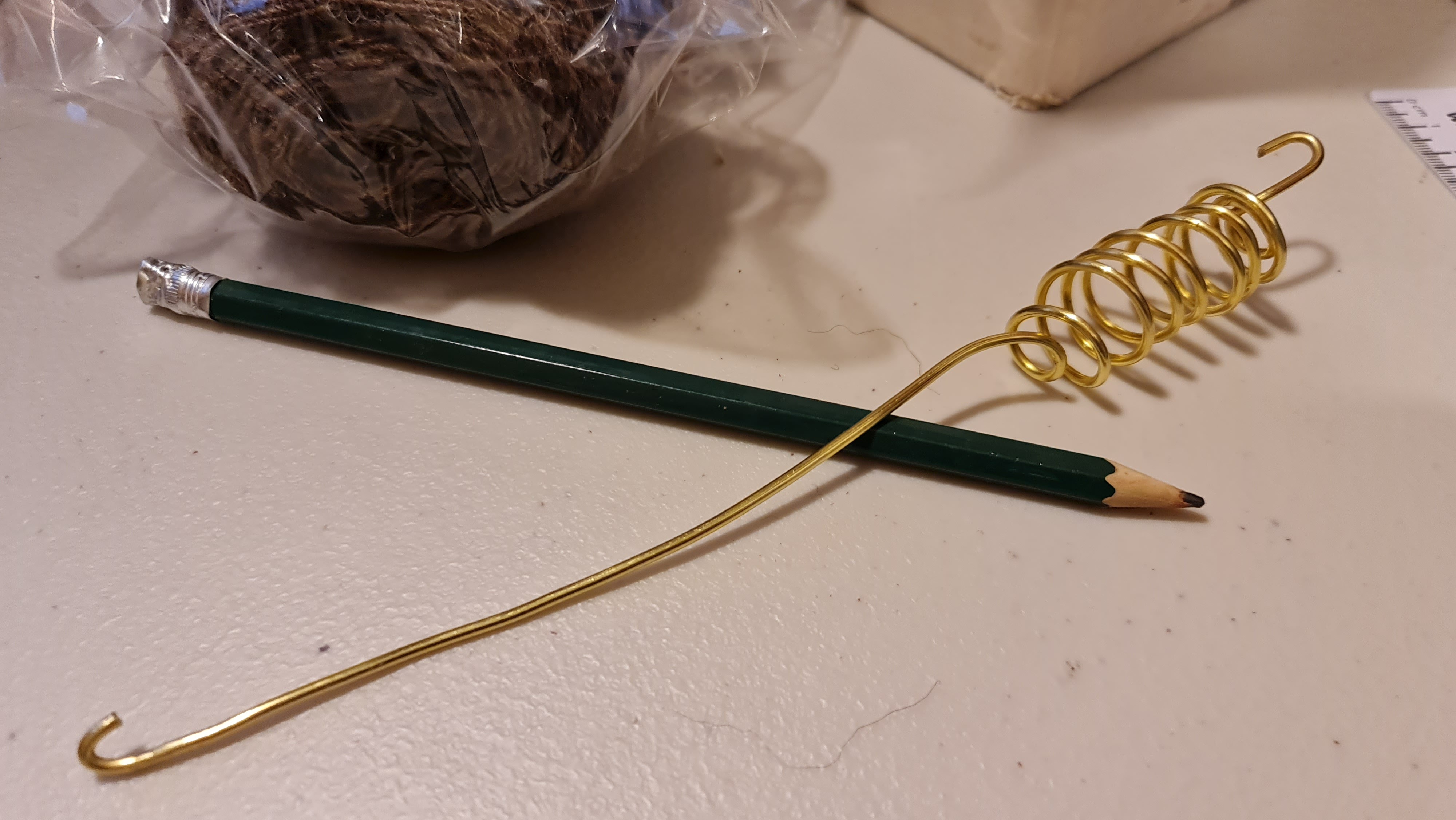
I also tired of faffing about with crochet hooks and made myself a new orifice hook with 10ga brass jewellery wire. My hands hurt after making those spirals, lemmetellya. I need to invest in some sturdier jewellery pliers.

A brass orifice hook with a spiralled wire handle ending in a second hook for hanging conveniently on your spinning wheel. It is resting on a pencil for size reference (they are approximately the same length), and there is a plastic bag of Shetland 2-ply handspun in the background.
I suspect this gaudy object will be harder to lose.

And so to bed, with a final pic of my first 2 bobbins of Herdwick/bio-nylon singles, where they’ll rest for da or so until they’re plied:

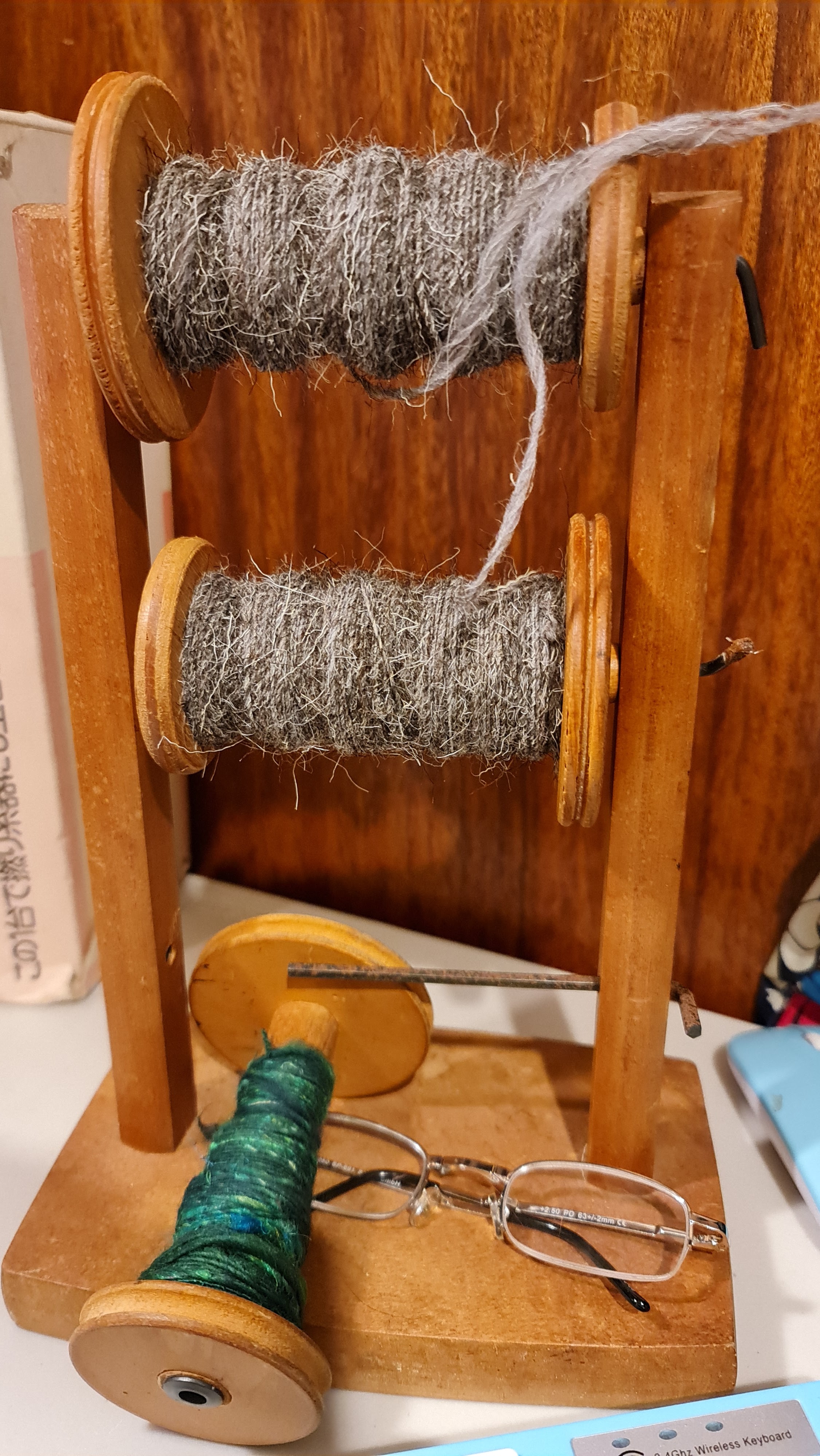
Two bobbins of dark grey Herdwick/bio-nylon yarn on a lazy kate. On the base of the lazy kate are a pair of rimless reading glasses and another bobbin holding a green single from the Poppy Fields rolags.
Herdygurdy and the 3rd Poppy Fields rolag awaiting plying.

Allons-zzz….

TdF23, D+7/S8 to D+8/S9 Round-up

Between injury and family stuff, I have not done much spinning, but I have spun something every day so I’m still meeting my TdF goal.

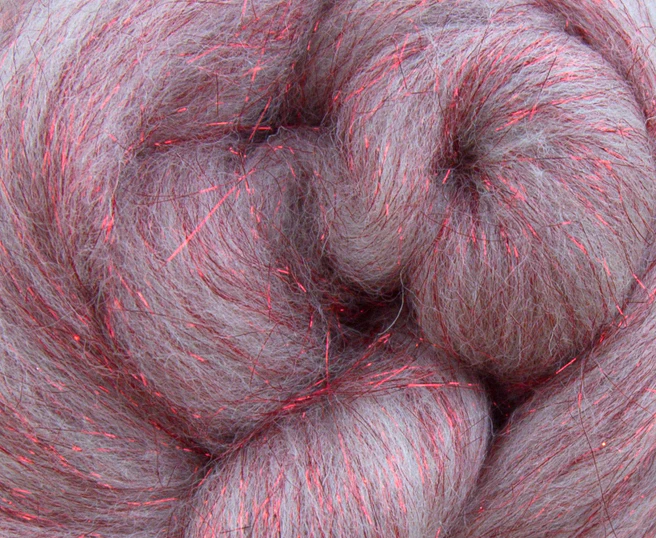
D+7 challenge: Glitter. And wouldn’t you know it, another delivery from WoW*, including two glittery tops from their recent Fibre Friday offerings:

A top of 70% white merino, 30% red stellina blend. The overall hue is a deep pink.
GL13, Glitter White/Red
A top of 70% white merino, 30% multi-coloured stellina blend. The overall hue is a soft grey.
GL18, Glitter White/Multi

Both are 70:30 merino-stellina (polyester-nylon) blends, where the merino is white and the stellina provides the colour. What I find interesting is the overall colour of each: the red stellina results in an overall deep pink hue, and the multi-coloured stellina a soft grey.

Salvador Dali's 1945 painting, The Eye. A featureless landscape in blues and greens, with distant range of mountains in the far left distance, a set of graph-like lines on the ground disappearing off into the distance, and a band of dark cloud across the middle sky. A single human eye floats in the air beneath the cloud, the lower lid dripping a black ichor, casting a shadow to the right in the middle distance.
Salvador Dali’s The Eye (1945)

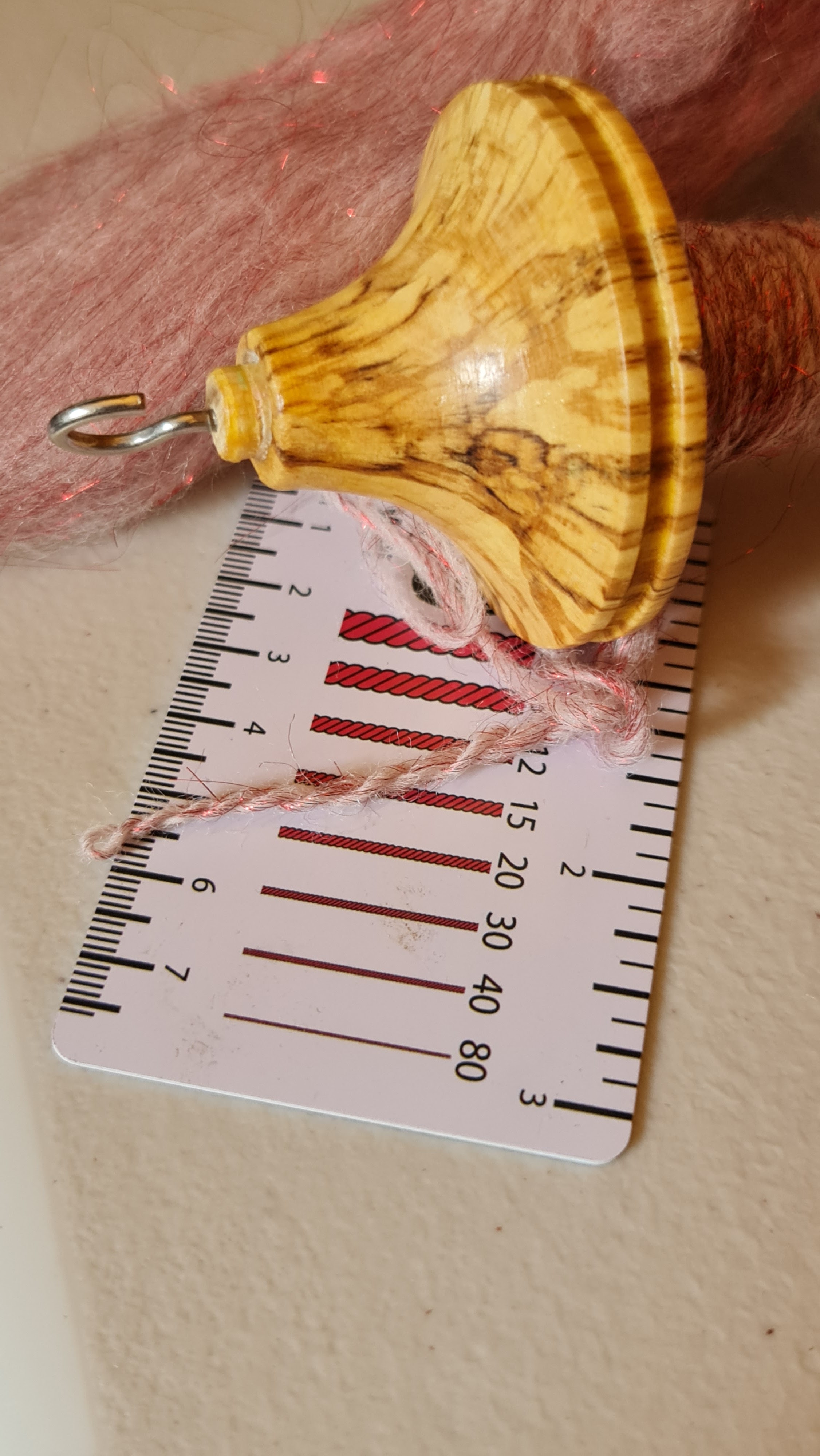
I decided to spin the white-red blend on a spalted beech drop spindle from Thomas Wood & Wool. One part of the spalting resembles Salvador Dali’s The Eye, so the spindle’s name is Dali. I remember reading somewhere that roving? top? is created by combining 3 pencil rovings into one, and that the 3 parts can quite easily be separated. I unfolded the blend and lo! it was so! Not terribly obvious, but I broke a hand-length off and divided it in 3 for spinning. Out of concern for the single getting too thin and ending up spinning just stellina, I made the effort to spin a wee bit thicker than I normally do. I also twirled the spindle slower – which meant it spun for shorter runs – and allowed it to “un-spin” until the single was only slightly twisted, just beyond the point of falling apart. The result looks like a woollen-spun single, and the 2-ply will likely be somewhere between sportweight and DK.

A spalted beech spindle resting on an Electric Eel Yarn Counter card, showing the eye-like spalting. A length of Glitter red-white single lies beside it, spun back on itself at between 8 and 12 wraps per inch, with some of the unspun blend in the background.
Glitter Red/White on Dali – you can see the “eye” just below the reflection.

D+8 challenge: Fractal spinning. Sorry, no. Not only do I not have any suitable fibre, I have almost zero interested in the effect, having opinions about multi-coloured yarn. I do a fair amount of colourwork, but generally I want my colours to be solid or at most heathered (I am also a hypocrite and love more random multis – see above). I did go and look at some fractal spinning tutorials, but that’s as far as I care to go. Instead, I continued with my Herdwick/bio-nylon spinning.


Other round-ups: I finished spinning the angora bunny sample on Enola the micro Turk. I will probably follow this white rabbit down a warren of textile physics at some point, because it. took. forever. to spin, not because of the difficulty of doing so (though it was tricksy) but because the single is sooooo long. Angora fibre must be very lightweight compared to other fibres, because I swear the meterage from this teaspoon-sized sample must be comparable to that from the 25g of Shetland I spun the other day. It might even be longer. I do spin these samples extremely finely, but neither of the other two I’ve done have produced so much:

A 10g black bog oak Turkish spindle with white Angora rabbit fibre spun onto it, resting on an Electric Eel Yarn Counter card. The singles yarn on the spindle is around 80 wraps per inch, maybe as high as 80 wpi,
The Angora rabbit sample – I think if it was 2-plied, it would come in around 40wpi or higher (lace- or cobweb-weight)

I doubt I’d be able to spin this on my wheel, certainly not at my level of what I laughingly call ‘skill’, but I wonder if I could spin a blend of Angora with something else? Where the Angora is there just to be fluff, not fibre? Possibly with a longwool?

Anyway. I also worked a wee bit more on the Seacell on my new Enid Ashcroft spindle, Enda. I’m consciously spinning it a bit thicker, around 20wpi, but keeping it worsted:

An oak burr spindle with a taupe Seacell single on it, resting on an Electric Eel Yarn Counter card, with some of the unspun fibre in the background. The single is roughly 20 wraps per inch, or about fingering weight.
Seacell on Enda

It’s quite lustrous and silky, though more like Tussah silk than the posh stuff as it has a grabbier handle. There’s a little of the feel of synthetic silks which normally have me scrubbing my hands raw, but overall it’s silky rather than squeaky. The colour is rather like the yellowing you see in vintage linens, so this would be a nice choice for an instant heirloom, woven, knit or crocheted. I’m seeing a lovely baptismal shawl, though given my track record it ain’t gonna happen!

Allons-y, there, and everywhere…


*: Including a gorgeous black and lime-ish gold Tub of Joy, 50g Angora bunny fibre, 300g scoured Wensleydale (I think my finger slipped when ordering – I meant to get the carded top…), some crystal Angelina, and a Beginner’s Dyeing Kit.

TdF23, D+6/S7 – another bust…

Today’s challenge was to spin something watery or blue.

If you know me, or have read any of my blog, you know that the one colour I just can’t be doing with is blue – or bleurgh, as I call it. It is true that sometimes I have knit with blue – usually baby jumpers or the like for baby boys, of which I once had one – but it does not feature greatly in my stash, and there’s not a sausage of blue in my admittedly quite small spinning stash.

But I do have some Seacell fibre… and Enda needs a run in.

Whether I’ll do much depends on how the rest of the day goes. I hurt my back somehow during my energy-crash nap yesterday.

A meme. 
The text says: When you're over 30 and fall asleep in a weird position.
The image is from Johnny Cash's cover of Nine Inch Nails' song Hurt, featuring the lyric, "I hurt myself today".
And I’m significantly older than 30, so I’m pretty much crippled…

Allons-y, oh, ow, argh…

TdF23, D+5/S6

After yesterday’s Day of Grey, I felt like a bit of sunshine – which is today’s #teamwow challenge, to spin outside. A glance outside revealed fog, so not doing that! Still, it’s only 8am, and misty summer mornings in Ireland often turn to blistering blue skies by around 10, so I will possess my soul in patience till then.

But I still don’t feel like continuing with the Herdwick, at least not immediately. So I am going to attempt to spin a set of rolags I got from Etsy seller, DorIdeas, called Poppy Fields:

A set of 9 rolags in red and green, some with black and yellow accents.
Gradient/Fractal Merino & Sari silk Rolags

Poppies are my favourite flower. There’s something in their rush towards the sun, their translucent vividness, and their brevity that grabs me. Can’t grow them to save my life, but at least I now live in a house where a previous occupant dotted big clumps of these wonderful flowers around the garden, so I get to admire them. If I’m quick!

This will be a challenge for me. Most of my spinning to date has been worsted-spun, or worsted-adjacent – I don’t really know what I’m doing, but I’ve mostly produced thin, smooth singles. But rolags are a woollen prep, which I’ve never knowingly done. After viewing a couple of JillianEve Youtube videos, I think I’m supposed to do a long draw on a slow treadle… I’ll figure it out! But I have only 80g of this fibre and that makes me want to cry. I always have problems thinking what to do with multicoloured yarns, but so little? and woollen-spun? Even if I leave it as singles, that’s not enough for a pair of socks, assuming I can spin it as fingering…


10am.

Well phooey. Overcast, windy, and promising rain. That’s the thing about foggy Irish mornings – sometimes they LIE. All you can do is wait and see.

I have spun my first rolag, the darkest one at the top left of the pic. It has frequent flashes of green and fewer of red on a black base. I think the red and green are sari silk slubs because they are extremely shiny but don’t want to draft. My fumble-handedness doesn’t help, with sensation in only 6 out of 10 digits. I should really talk to my GP about this… Too late today, I’ll have to call tomorrow morning. My first woollen long draw was less than successful. I don’t think I got beyond about 10cm/4in “long” before the draft started falling apart, and the result is thick-and-thin even where there are no slubs. I’ve also decided to spin each rolag separately, with a view to making a pair of 2-at-a-time gloves/mitts using the start of the yarn for one glove and the end for the other, IYSWIM. I think a pair of poppy gloves would be very pretty, don’t you??

Now I’m going to put contact lenses in, I’ve had enough of these stupid varifocals for today.


8pm.

I spun a second rolag, during which An Caitín Deasa came to berate me for not sitting on the sofa, where she likes to snuggle round my bum:

A small brown tabby cat scent-marking my spinning wheel.
Outraged, so she was. And now my wheel belongs to her.

Fortunately, she didn’t discover all the lovely soft floofy wool or it would now be hers, too – though given her fondness for rolling around on my son’s sweaty socks, I don’t think any of the floof here is stinky enough for her.

Shortly afterwards I had one of my energy crashes, and just about stayed awake long enough to fall into bed. I woke around 6pm, but I haven’t the energy to do much, and I appear to have pulled a muscle in my back whilst asleep… So this is the sum total of what I’ve achieved today:

7 rolags in shades of red and green, and two small skeins, one black with red and green highlights, the other dark green.

It’s lumpy and bumpy, sewing-thread thin in parts and super-bulky slubs in others, so I don’t know how it would average out or if it’s worth plying. Ho hum…

Allons-y!

TdF23, D+4/S5 – Blend challenge

Today’s #teamwow challenge is to create a blend. Not only do I not have a way of blending – no drum carder, no blending board – but blending fibres… isn’t really where I’m at. I prefer my fibre and yarn 100% pure, and I’m not a fan of the clown barf. I’ll put up with some nylon in my sock yarn, or a blend for fragile/expensive fibres, and I have been known to work with multicoloured yarn, but it’s not where my heart is. So this challenge is a BIG challenge for me.

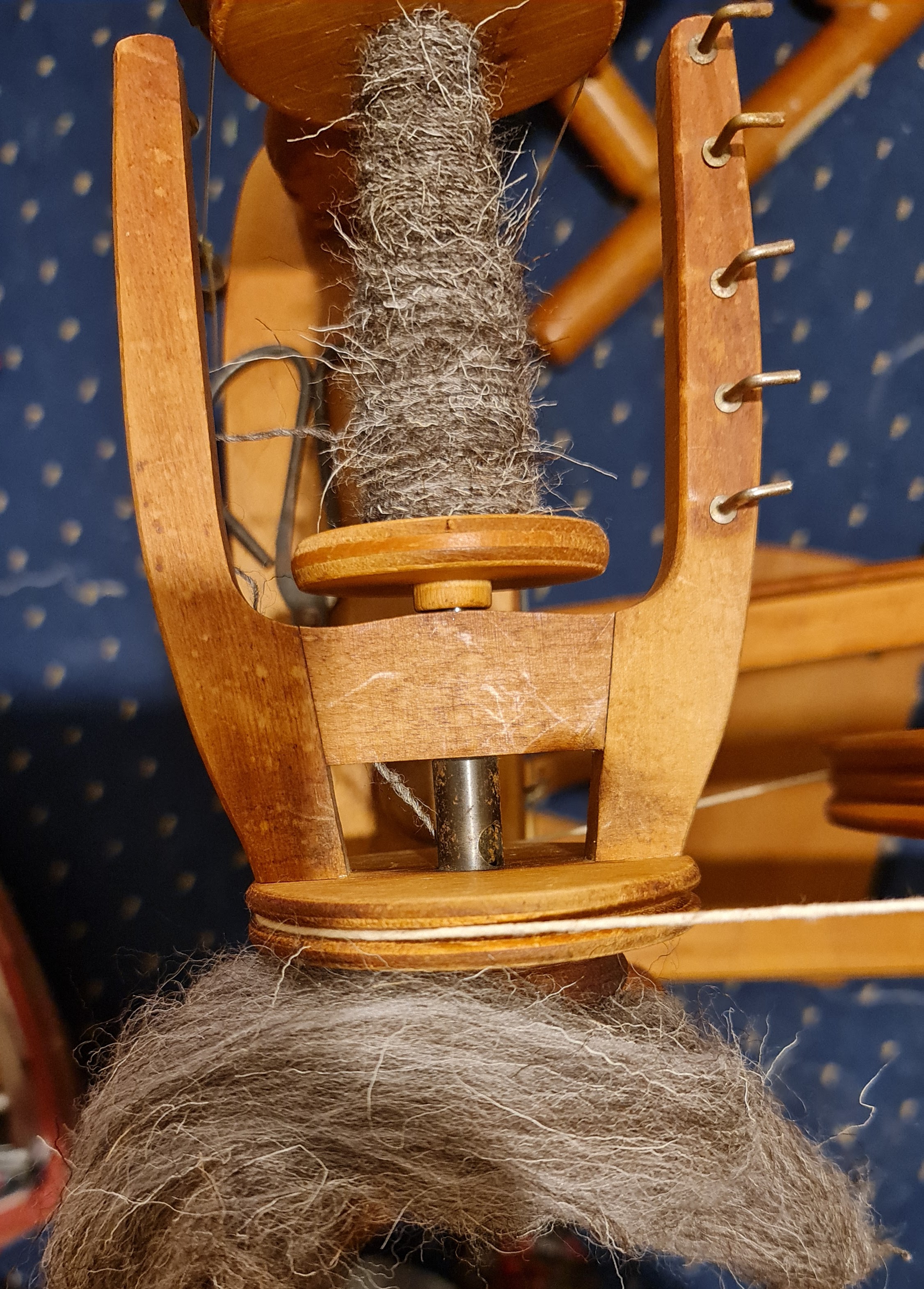
But, but, but. What if it is a blend that I have caused to be created? I didn’t mix it up myself, but it wouldn’t exist without me? Okay, the latter is pushing it, I’m pretty sure this blend exists and is available to anyone, but this precise bag of blended fibre within my arm’s reach certainly wouldn’t have existed without me. Ta-da! It’s my Herdygurdy blend of 75% dark grey Herdwick and 25% bio-nylon from World of Wool! I got this, and another blend of black Hebridean and bio-nylon, to knit socks. Here is how far I’ve got so far:

A spinning wheel flier and bobbin filled with very hairy grey yarn. A length of the unspun fibre is lying across the flier upright.
Herdygurdy on the bobbin

My first thoughts are that some of what I’m assuming is the bio-nylon is falling out during drafting, and, while what’s left goes into the orifice smoothly enough, it doesn’t want to wrap around the bobbin with the Herdwick, instead sticking out. I’m not going to panic just yet, as it might settle down when it’s plied, washed, thwacked and balled, but I’m going to be a bit careful how I handle it.

I’ve also put Enola back in harness to spin my next 5g sample, which is angora. It’s not the easiest thing I’ve ever spun. The fibres are teeny, and my hands are not as reliable these days with cubital inflammation numbing the ring and little finger of my left hand and whatever it is that’s causing the numbness in both thumbs, but I think I’ve got the trick of it now. However, I’ve only managed to spin about a third of the sample, so no pics yet.

I did get a parcel in the post today, and I’m so excited! It’s an Enid Ashcroft spindle in oak burr with an African Padauk shaft! These spindles are like hens’ teeth – they no sooner appear on Etsy than they are gone. I could not believe when I clicked through from her Insta and there were 3 -3! – left, so I snaffled this one up straightaway. I haven’t tried it out yet, but I think I will call it Enda. No, that’s not a mis-spelling, it’s an Irish boy’s name, a saint’s name (Saint Enda of Aran – yes, those Aran Islands!), and the name of a former Taoiseach (Irish prime minister), Enda Kenny, who had quite the burr (get it? oak burr…). This is Enda:

A top-whorl drop spindle with an oak-burr whorl and a red African Padauk shaft. The top of the shaft is shaped like an acorn, and has a brass hook to hold the yarn during spinning.
Enda!

Allons-y!

TdF23 D+2: switching up

Today, I only continued to spin the white mystery top on my wheel, and let Enola rest. I have 11 samples total in my WoW sample card, 2 already completed, and this is a 3-week event – 4 if you count the Tour de Femmes – so it’s okay to space things out a bit.

So I thought I’d talk about one of my other wheels. I have 3, one the Freecycled Ashford Traditional that I’m using for TdF, and two others that require some TLC. This is Blaise:

A photo of a modern-looking spinning wheel made from smoothly-bent wood (not cut). The wheel itself has only 4 spokes, which are made from 2 lengths of wood bent at around 135 degrees and attached to each other at the centre. All the lines of the wheel are smoothly curved.
Blaise

I bought her for mere pennies at a local auction – about £10-15 I think, and I may* have bought her unsold after the actual auction took place. I have no idea how she wound up in Darkest Fermanagh, but it’s probably an interesting tale.

Here’s what I do know: she is not, as spinning wheel afficionados might think, a Herring Gordon wheel – the one that won a London Design Centre award for its aesthetics – but a Shapwick Blaise wheel made by S.H. (Simon) Williams on behalf of Frank Herring & Sons. Shapwick was in business for only about 3 years in the 1980s: Williams may or may not have continued to make wheels afterwards, I don’t know. The Blaise wheel might have been sold as a Herring Gordon – again, I don’t know. I was able to learn that only 1,000 Herring Gordons were ever sold, but I’m not sure if that figure includes the Shapwick Blaises. Regardless, this is a fairly rare English wheel. Frank Herring & Sons still exist as an arts and crafts supplier in Dorchester, but there is no mention of their own-brand wheels on their website. I shall have to contact them, though, due to the state poor Blaise is in.

Both Gordons and Blaises were made from laminated beech plywood, which was then bent rather than cut into shape. The drive wheel is a single length of plywood, bent into a perfect circle with only one seam. On some Blaises, the wheel is a solid circle, but this one has 4 spokes, made from 2 lengths of plywood curved at about a 135-degree angle about a flattened middle where the lengths are connected about the wheel-hub. The mother-of-all is another length bent into an open rectangle, as is the flier. The table and legs are formed from 2 lengths of plywood, bent into a split table to accommodate the drive wheel, then elegantly splayed to make the legs. Technically there are 3 legs, as the 2 lengths come together to form a single leg under the flier assembly; under the wheel, the lengths form 2 legs, separated by a movable piece of wood that appears to function as a wheel brake. There’s a Lazy Kate on the table – 2 pegs for bobbins. Even the treadle is elegantly curved. There are no sharp corners anywhere on the wheel, all having been sanded down. It really is a most exquisite piece of craftsmanship. Apparently, the Herring Gordon (and therefore possibly also the Shapwick Blaise) could run as a single drive band machine with Scotch tensioning, or as a double drive.

Now, what’s wrong. Blaise has no drive band, though that’s easily fixed. If there was a spring on the Scotch tensioning line, it’s gone. The orifice hook, which normally fits into a hole on the table, is also missing. Only the bobbin in the flier remains, of the 3 with which this model was originally shipped – and these are gigantic bobbins that are likely difficult to replace. The footman appears to have been replaced with a piece of cord – how does that even work? But worst of all is that there’s no sign of the whorl. Was the previous owner not using the whorl? How? Or did they remove it because it was damaged, and never got round to replacing it? I know there’s people out there who can fix and recondition wheels, even one like this – but that will be another day’s rabbit hole.

Any information, advice, craftsperson recommendations welcome!

So that is my day. I could take another terrible photo of my progress, but I’ve only filled the bobbin I showed from yesterday’s spinning, so it’s neither interesting nor necessary.

Allons-y!


* : I have memory problems. You’ll see this phrasing a lot with me. My brain is borked – memory-deficient dyslexia and fibro fog. If I don’t take notes, write a blog post, or elaborate small details into a big story in my head, I will forget.

Why were some early swimsuits made of wool?

Why not?

Back in the day, undercrackers, especially those worn in winter, were made of fine wool.

A 1920s newspaper advertisement for men's commercial woollen underwear, featuring 3 men in full-body button-fronted Union suits in fine 100% wool or part wool, one smoking a pipe, one holding a newspaper and reading glasses, and all 3 looking remarkably happy to be standing around together in their underwear as if that was a completely normal thing to do in the 1920s.
Commercial woollen underwear, 1920s, an age where manly men were in the habit of getting together in their underwear to smoke and discuss the latest news.

Commercial woollen underwear, 1920s.

Wool was a huge, huge industry in most Western countries. We cannot imagine, today, with cheap off-the-peg clothing imports, what the wool industry was like before the 1970s. Think Amazon, think eBay, think Microsoft: that sort of big. Just getting dressed was a major part of life, before you could pop into Primark and come out with a complete wardrobe, including smalls, for £10–20. In my grandparents’ day, it meant going to a tailor for your decent outdoor and winter clothing, purchasing rolls of cotton or linen to sew your summer clothing, and knitting, knitting, knitting in every spare moment to provide yourself and your family with socks, underwear, gloves and other ‘comforts’. For many families, it meant carding and spinning the wool, before knitting. Much of Great Britain’s former wealth, and its Industrial Revolution, was driven by wool.

And so, of course, when sea-bathing became the In thing to do in the Victorian era, the outfits were naturally made of wool – though usually woven flannel fabric, rather than knitted.

2 photos of the same woman in a sailor suit styled swimsuit (try saying that after a couple of gins) comprising a short-sleeved dress and knee-length bloomers.
The first shows her entering the sea, the second shows her leaving the water and entering a beach cabin. The peplum of the dress portion appears to have lengthened slightly in the second photo.

This fabric did not sag and expand (much) when wet, and if it did, so what? It just meant it covered up more of the body, which was the point of these cumbersome outfits.

It was only when fashions changed to more skimpy swimsuits that it became apparent that wool, particularly when knitted, wasn’t ideal: the sagging then revealed more than hid.

But there’s no reason to avoid crafting your own swimwear: crocheted cotton is a sturdy fall-back –

A woman wearing an orange bikini in crocheted lace. I'm probably just a touch too old for this style. A mere smidge. Which pretty much describes what it covers.
Crocheted cotton bikini

and even wool is okay, if you work with its qualities rather than against:

Quora linky.