Today’s #teamwow challenge is to create a blend. Not only do I not have a way of blending – no drum carder, no blending board – but blending fibres… isn’t really where I’m at. I prefer my fibre and yarn 100% pure, and I’m not a fan of the clown barf. I’ll put up with some nylon in my sock yarn, or a blend for fragile/expensive fibres, and I have been known to work with multicoloured yarn, but it’s not where my heart is. So this challenge is a BIG challenge for me.
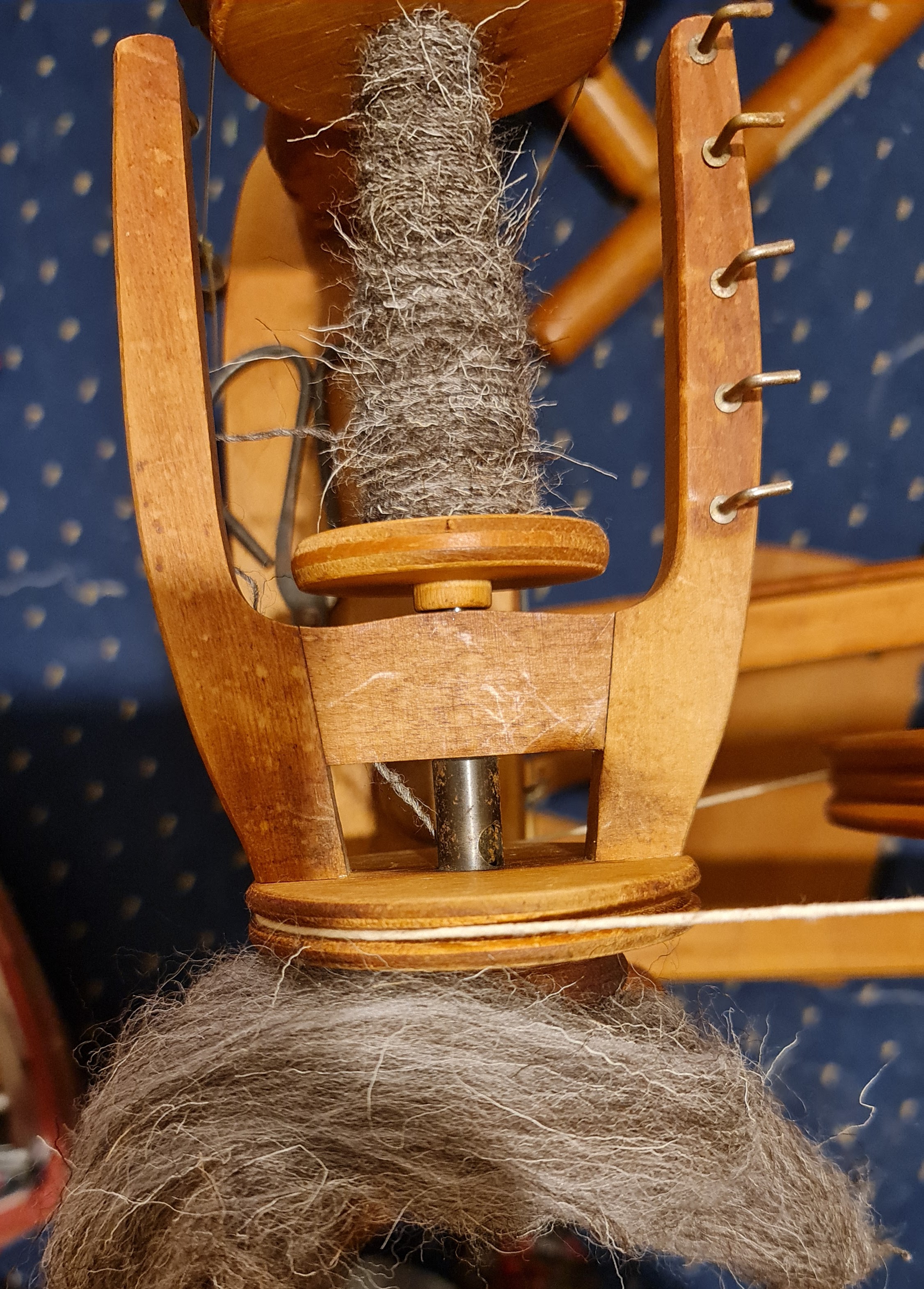
But, but, but. What if it is a blend that I have caused to be created? I didn’t mix it up myself, but it wouldn’t exist without me? Okay, the latter is pushing it, I’m pretty sure this blend exists and is available to anyone, but this precise bag of blended fibre within my arm’s reach certainly wouldn’t have existed without me. Ta-da! It’s my Herdygurdy blend of 75% dark grey Herdwick and 25% bio-nylon from World of Wool! I got this, and another blend of black Hebridean and bio-nylon, to knit socks. Here is how far I’ve got so far:
Herdygurdy on the bobbin
My first thoughts are that some of what I’m assuming is the bio-nylon is falling out during drafting, and, while what’s left goes into the orifice smoothly enough, it doesn’t want to wrap around the bobbin with the Herdwick, instead sticking out. I’m not going to panic just yet, as it might settle down when it’s plied, washed, thwacked and balled, but I’m going to be a bit careful how I handle it.
I’ve also put Enola back in harness to spin my next 5g sample, which is angora. It’s not the easiest thing I’ve ever spun. The fibres are teeny, and my hands are not as reliable these days with cubital inflammation numbing the ring and little finger of my left hand and whatever it is that’s causing the numbness in both thumbs, but I think I’ve got the trick of it now. However, I’ve only managed to spin about a third of the sample, so no pics yet.
I did get a parcel in the post today, and I’m so excited! It’s an Enid Ashcroft spindle in oak burr with an African Padauk shaft! These spindles are like hens’ teeth – they no sooner appear on Etsy than they are gone. I could not believe when I clicked through from her Insta and there were 3 -3! – left, so I snaffled this one up straightaway. I haven’t tried it out yet, but I think I will call it Enda. No, that’s not a mis-spelling, it’s an Irish boy’s name, a saint’s name (Saint Enda of Aran – yes, those Aran Islands!), and the name of a former Taoiseach (Irish prime minister), Enda Kenny, who had quite the burr (get it? oak burr…). This is Enda:
I posted to the Tour de Fleece 2023 Facebook group about my Shapwick Blaise wheel and I think it’s had the most engagement of anything I’ve ever posted on social media outside my Quora content!
She is an absolute beauty, but there’s so little information about this wheel that I’m slightly despairing of ever putting her in working order. I found someone via Google who had recently (May ’23) reconditioned a Herring Gordon, but their website no longer exists apart from a few scrapes on the Wayback Machine. Frank Herring is still in business, but the website doesn’t even mention their history of producing these beautiful and unusual wheels… I will email them, but I’m almost as fond of email as I am of cold-callers so it will take some time for me to work up the courage to engage.
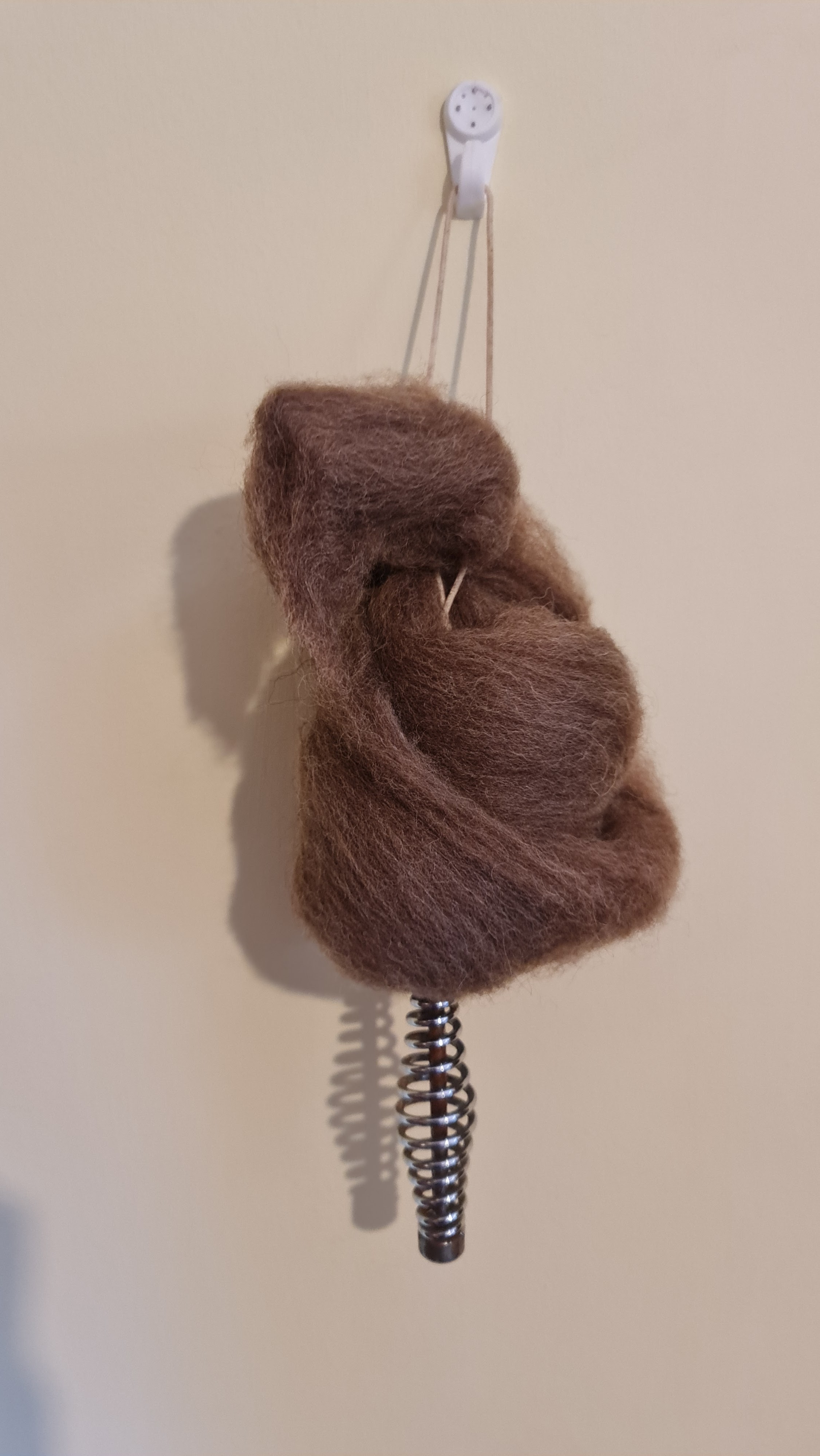
I’m on #TeamWoW, World of Wool‘s TdF team, and today being Stage 4 (I think?) the challenge is to spin some Shetland. I got another delivery this morning from WoW with Shetland wool – the Woodland Collection, and the Breed Discovery pack – but I’ve decided to spin from a colour pack of Shetland top that I picked up at Woolfest instead. I picked the dark-ish fawn colour for a change of pace – I have lots of black, grey, and white fibre to work on, but not much in the brown spectrum. I think the Shetland word for this colour is Moorit. I also have dark brown, fawn, and Musket, a greyish mid-brown. The plan was to spin the whole 25g, then ply it. Here’s the whole thing, wrapped around my homemade wrist distaff:
Shetland top (probably moorit) on a wrist distaff.
And the Fates must have been smiling on me, because it went to plan! I cannot stress how rarely this happens for me. I am a disaster magnet. The house could have burned down, I could have been struck by lightening, the wool might have had hatching tarantula eggs in it – none of these happened. The phone didn’t even ring! Okay, I cheated a bit – instead of plying on my wheel, I used my ancient Daruma Home Twister, a ball-winder which has a plying attachment. It’s not ideal, so the yarn is not perhaps as tightly plied as it should be – I don’t care. Today, I have done what I set out to do, even if the end result is kinda half-arsed. Gotta say, too, this Shetland top has survived brilliantly for being shoved in a paper bag in my junk room for years. It fed beautifully through my hands, and there’s only the tiniest dot of waste – you can see it at the bottom of the balling attachment:
Shetland 2-ply on a Daruma Home Twister, with remaining fluff at the bottom right.
Today, I only continued to spin the white mystery top on my wheel, and let Enola rest. I have 11 samples total in my WoW sample card, 2 already completed, and this is a 3-week event – 4 if you count the Tour de Femmes – so it’s okay to space things out a bit.
So I thought I’d talk about one of my other wheels. I have 3, one the Freecycled Ashford Traditional that I’m using for TdF, and two others that require some TLC. This is Blaise:
Blaise
I bought her for mere pennies at a local auction – about £10-15 I think, and I may* have bought her unsold after the actual auction took place. I have no idea how she wound up in Darkest Fermanagh, but it’s probably an interesting tale.
Here’s what I do know: she is not, as spinning wheel afficionados might think, a Herring Gordon wheel – the one that won a London Design Centre award for its aesthetics – but a Shapwick Blaise wheel made by S.H. (Simon) Williams on behalf of Frank Herring & Sons. Shapwick was in business for only about 3 years in the 1980s: Williams may or may not have continued to make wheels afterwards, I don’t know. The Blaise wheel might have been sold as a Herring Gordon – again, I don’t know. I was able to learn that only 1,000 Herring Gordons were ever sold, but I’m not sure if that figure includes the Shapwick Blaises. Regardless, this is a fairly rare English wheel. Frank Herring & Sons still exist as an arts and crafts supplier in Dorchester, but there is no mention of their own-brand wheels on their website. I shall have to contact them, though, due to the state poor Blaise is in.
Both Gordons and Blaises were made from laminated beech plywood, which was then bent rather than cut into shape. The drive wheel is a single length of plywood, bent into a perfect circle with only one seam. On some Blaises, the wheel is a solid circle, but this one has 4 spokes, made from 2 lengths of plywood curved at about a 135-degree angle about a flattened middle where the lengths are connected about the wheel-hub. The mother-of-all is another length bent into an open rectangle, as is the flier. The table and legs are formed from 2 lengths of plywood, bent into a split table to accommodate the drive wheel, then elegantly splayed to make the legs. Technically there are 3 legs, as the 2 lengths come together to form a single leg under the flier assembly; under the wheel, the lengths form 2 legs, separated by a movable piece of wood that appears to function as a wheel brake. There’s a Lazy Kate on the table – 2 pegs for bobbins. Even the treadle is elegantly curved. There are no sharp corners anywhere on the wheel, all having been sanded down. It really is a most exquisite piece of craftsmanship. Apparently, the Herring Gordon (and therefore possibly also the Shapwick Blaise) could run as a single drive band machine with Scotch tensioning, or as a double drive.
Now, what’s wrong. Blaise has no drive band, though that’s easily fixed. If there was a spring on the Scotch tensioning line, it’s gone. The orifice hook, which normally fits into a hole on the table, is also missing. Only the bobbin in the flier remains, of the 3 with which this model was originally shipped – and these are gigantic bobbins that are likely difficult to replace. The footman appears to have been replaced with a piece of cord – how does that even work? But worst of all is that there’s no sign of the whorl. Was the previous owner not using the whorl? How? Or did they remove it because it was damaged, and never got round to replacing it? I know there’s people out there who can fix and recondition wheels, even one like this – but that will be another day’s rabbit hole.
Any information, advice, craftsperson recommendations welcome!
So that is my day. I could take another terrible photo of my progress, but I’ve only filled the bobbin I showed from yesterday’s spinning, so it’s neither interesting nor necessary.
Allons-y!
* : I have memory problems. You’ll see this phrasing a lot with me. My brain is borked – memory-deficient dyslexia and fibro fog. If I don’t take notes, write a blog post, or elaborate small details into a big story in my head, I will forget.
This is the peripatetic sample card I couldn’t find yesterday:
World of Wool sample card. From top right: light brown de-haired yak; soybean; white angora; milk protein; pineapple fibre; banana; mint fibre; Whiteface Woodland; lotus fibre; adult mohair; kid mohair.
World of Wool gives you the option to purchase small samples of their fibres – 5-10g, depending on the fibre – to try before you buy. While too small to do anything much with, given the dizzying array of fibres, it’s worth it. Sometimes you know by the feel that something is not what you want to spin – I can’t say I’m terribly interested in vegan fibres that are basically nylon, acrylic, etc, so I’m never going to order them. But I am intrigued enough with, say, pineapple fibre to want to see what it’s like without committing to spinning up 50g, especially if it turns out to be horrible (I’ll let you know on, umm, Wednesday). I spun the yak when the card arrived a while back. It’s fiddly – very fluffy and wispy, and you have to be quite stern with it to make it adhere together long enough to get a thread. But it is oh so soft and lovely that it is well worth the effort. think if I was to get yak again, I’d blend it with something more cooperative, like merino (or get WoW to do me a custom blend). I haven’t bothered plying it – I don’t plan to do so with any of these samples as there really isn’t enough yardage to bother. Instead I just wound the single onto a bit of card, and will keep it in its pocket for future reference and stroking.
Today, I began spinning after lunch, starting with the soybean sample on Enola, my 10g black bog-oak Turkish spindle from Ian at The Wood Emporium: teeny, dark and rather fast, but with hidden metal, like the Enola Sherlock character. The soybean sample was quite voluminous for its weight, and this wonderful mustard yellow. I was able to pre-draft it into 5 ‘locks’, whereupon it took on the colour and appearance of baby hair in my family, a kind of lustrous primrose:
Enola and the locks.See what I mean?
Also very fluffy and very, very sheddy. There’s will o’ the wisps of the stuff floating around my craft room now. It was an odd one, full of contrasts. Very short fibres, but I had to draw it out longer than I’m comfortable with – I’m not an experienced spinner and have just graduated from death-grip park and draft, I have only the vaguest idea of the other spinning techniques, so don’t be coming at me with your forward and backward short draw, double drafting, Texas long draw, 52 pick-up – I’m just happy that the fibre is moving onto the spindle without my hands being frozen into rictus claws after the first five minutes. And the fibre was a little like silk – super-soft but strong – while also having the squeaky feeling of a plant fibre like ramie. It’s another one that might be better blended due to the shortness of the individual fibres, but I can’t think with what. Maybe another, coarser plant fibre, trading softness for strength? Or one of he scratchier wools, for a bit of sproinginess?
I got distracted midway by deliveries (another book, and a box of gluten-free flours to try in the sourdough starter I’ve adopted) and sunshine, and decided to continue the spin outside, but no sooner had I got my hammock seat set up than it started bucketing down. Then the damn dog escaped again, which is bad as I live in sheep-and-shotgun country and said dog is a sheepdog school flunk-out I took on when he proved too independent* of the shepherd. He still wants to round up sheep, but local farmers don’t distinguish between unwanted “help” and sheep-worrying. As a result I was late getting back to the second half of my daily spin: the dreaded wheel.
With quick run-through some wheel-spinning tutorials on Youtube, I made a start. I used some roving that might have been nice once upon a time when I bought it, but which is now compacted and a wee bit felted. I figured it wouldn’t upset me too much if I wasted it, and I did waste a whole chunk! But look!
Actual string!
It’s not very much, but it’s nearly consistent with no lumps. It’s similar to the thickness I spin on my drop spindles, which makes a reasonable 2-ply fingering yarn. I’m so pleased with myself, I’ll be unbearable for a few days.
*: It’s a problem with Border Collies. They’re very smart so some decide they know better than the shepherd, and pretend deafness to command.
My spinning setup in my very scruffy, half-painted craft room – excuse the mess: it’s much tidier than when the transformation from junk-room to craft room started, but it’s still evolving!
Oh my giblets, what a start!
I’ll preface by saying that my vague plan for TdF23 was to spin every day – that’s all. Firming up slightly, I thought each day I’d spin a 10g sample from a World of Wool sample pack on one of my drop spindles, and then hit up the spinning wheel with something more weighty, like the 400g Herdwick ‘n’ bionylon WoW custom blend destined for sock knitting, or the Dye Candy art batt, etc. I don’t do detailed schedules and timings. I used to, but the universe has all kinds of ways of tearing up my plans and throwing them in my face, whether or not there are any plans in the first place, so nowadays I save the time and energy for the inevitable disaster management instead.
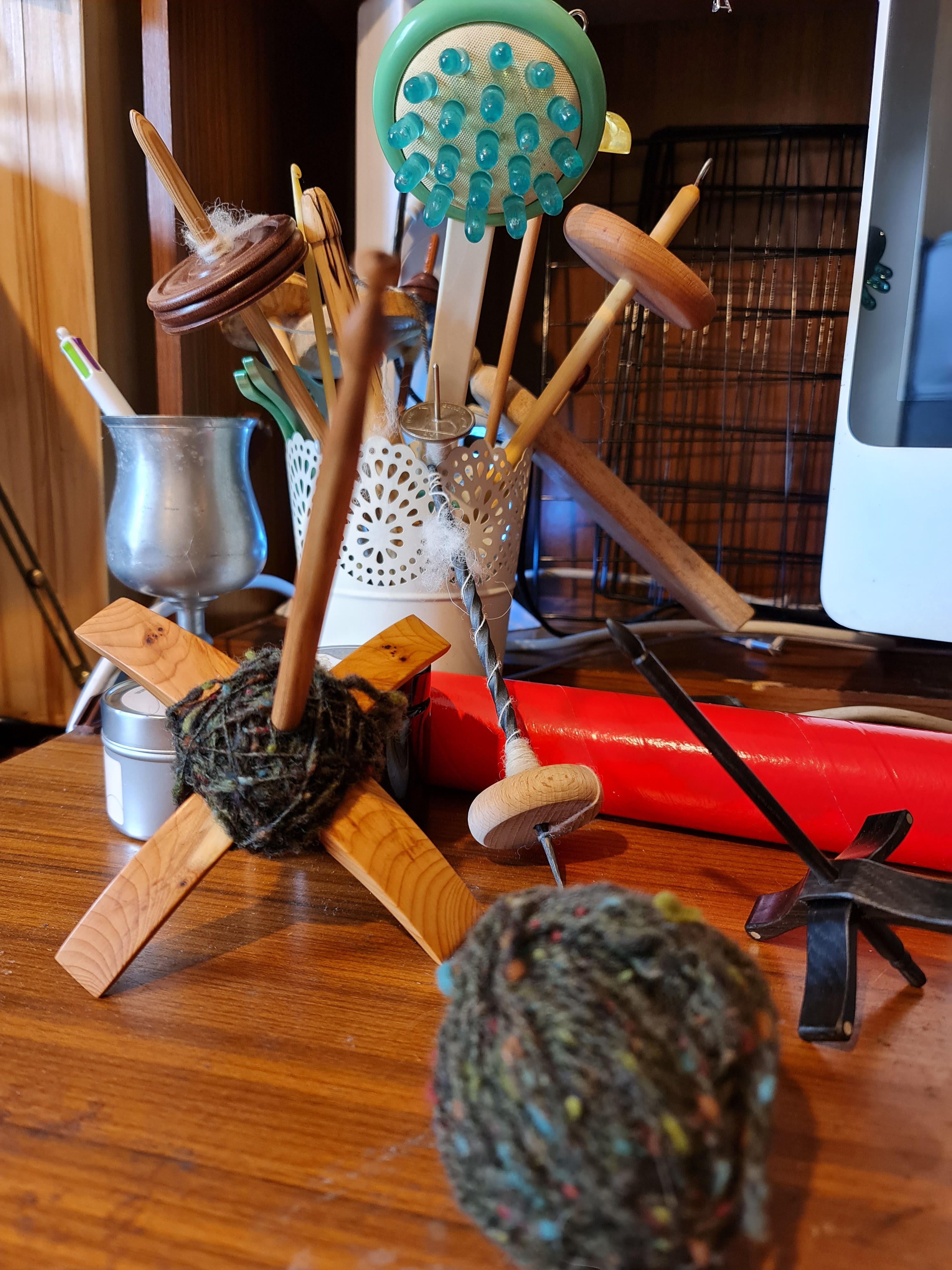
Well, first I couldn’t find the @&%$ing sample pack, but that wasn’t much of a problem. While looking for the samples, I found a remnant of some tweedy floof I picked up on a visit to Donegal Yarns. It wasn’t meant for hand-spinning – it was some intermediate stage in their processing of fleece into yarn, and by now it’s only fit for stuffing cushions. When I got my drop spindles out earlier this year, I’d spun up the rest and a brutal job it was too, basically just ripped clumps out of it and hoped for the best. And yes, it’s a lumpy bumpy yarn – but here’s the thing: I bought a cone of that same colour on my visit, and it’s not wildly different to my handspun.
So I spun up this remnant in lieu of one of the samples on my big yew Turkish spindle, whom I have named Bow Diddly:
Bow Diddly with his little bog-oak friend Enola, and the green tweed.
Enola stood ready for the 10g samples, which I promptly found after finishing plying the tweed. Of course. Oh well, at least they’re there for tomorrow.
So then I hied me the 50cm or so to my spinning wheel, and this is where the trouble really began. And begat more problems. And then some. The wheel is one I got on Freecycle at least 10 years ago. I never actually used it. Although I’d taken it along to a spinning workshop a few years ago, it misbehaved, even flummoxing the instructor, so I’d ended up using a borrowed wheel. I did look into finding someone who could repair it, but it would have meant shipping it over to England and then there was the whole pandemic thing so that didn’t happen. And today, sitting before it, I realised I didn’t even know what make it was anymore… And the orifice hook was gone, and the drive band kept popping off, and why is there fishing line on it…???
Onto Youtube to look for some Setting Up A Spinning Wheel For Dummies videos. No worries, I’ve done some spinning, so I’d fulfilled my obligations for the day, and isn’t this spinning-related too?
Eight hours later I picked myself off the floor where I’d fainted from hunger. But I had learned SO MUCH. Like I apparently have a Ashcroft Traditional, probably 1982, and it’s a double drive – but is set up as a single drive. And you guys, the whole maiden (?) thingy can be moved sideways! which lines up the groove on the flier with the groove on the wheel – which was the reason the drive band kept flying off – they weren’t aligned properly! It finally spun properly, but the yarn wouldn’t wind onto the bobbin, so I went down another rabbit hole where I spent an unreasonable amount of time trying to find a replacement whorl for my flyer (learning in the interim that I had a jumbo flier) before realising that Traditionals don’t have one (or at least they don’t have one that screws on after the bobbin…). Then I found a video showing how to put together a Traditional from bits of lumber without reducing it to kindling in the process as I was by then tempted to do… and this is where I learned about the fishing line thingy! Scotch tensioning! Which has nothing to do with Scotland, even though there’s an Irish tensioning which I still have to figure out.
Hmm… Irish tension… Nope. Get thee behind me, Spinning. (Laterz).
Apparently the fishing line (which is attached to a wooden knob at the front of the wheel and goes through a hook at the back) is placed over the groove in the bobbin, and secured via the spring on the end to a wee hook on the other side of the maiden assembly. The line can then be tightened by turning the wooden knob, which has the effect of of slowing the rotation of the bobbin with respect to the flier, which in turn allows the yarn to wind onto the bobbin!!
Somewhere in amongst all this the flaming drive band snapped, and if the postie hadn’t been right outside delivering a book I’ve been waiting for, I’d have hoofed the bloody thing out the window where it would have landed on top of him. But as I want him to keep bringing me books, I refrained. Luckily there is no shortage of long, fibre-y stuff about the place. Who’d have thought a knitter would have the like?!
So that was my Day 1. I think the wheel is operating correctly and and is ready to tackle the blizzard of floss awaiting…
I have decided to do this yarn-spinning event for the first time this year.
I’m not really a spinner, at all. I did a few workshops years ago – one was my, I think 40th birthday present to myself? 41st? Long time ago anyway. I wasn’t very good, so I never continued, though I did purchase a very pretty drop spindle at one workshop, along with some fluff. I also bought a spinning wheel that was going cheap at some point, thinking I might use it (I didn’t), and picked up a castle wheel for pennies ag an auction a while ago with some vague idea of turning it into a lamp (I didn’t).
So that was the state of play until a couple of months ago when I decided to turn the “junk room” into a crafting/painting/computer fixing room. While cleaning, painting, moving, collecting, building, shovelling it all into place, I came across the drop spindle and fluff, and, being a lady of a certain age and thus glowing like a pig, I sat down and had a wee fiddle at it.
And now I have about a dozen spindles of various types and sizes, a fudge-ton of fibre,
… and a crown.
Why a crown? This is deep TdF lore. It has something to do with a Rie Cramer illustration in the fairy tale Rumpelstiltskin, where the now-queen gets the better of the fairy; and something to do with encouraging a spinner who may be flagging during the 3-week TdF challenge. Mine is an old white-metal sugar-tongs that I turned into a choker, some 18ga silver-plated jewelry wire, and a bunch of stitch-markers.
I have no plan or goals for this, other than
seeing if I can stay the course, and
mastering at least one of the wheels.
I have some random fibre that I can practice spinning on the wheel, the Pandemic batt from Dye Candy, a rolag from I can’t remember but it looks like poppies, and a whole pile of interesting fibres from World of Wool, including 2 custom blends (20:80 bio-nylon with – 1. black Hebridean; and 2. dark-grey Herdwick) which are destined for winter socks.
British fisher ganseys need to be tightly worked in worsted-spun sport-weight pure wool.
Cowichan sweaters should be worked in greasy handspun bulky-weight wool in natural colours.
and so on. You can, absolutely, knit an Aran sweater in bulky-weight cotton, but prepare to be deeply disappointed in how cold it is, and the way it expands with every wash. A Cowichan in qiviut would be toasty-warm, but outside pretty much anyone’s budget. And a Fair Isle jumper in acrylic yarn just doesn’t bear thinking about, especially if you’re going to knit it properly with steeks.
For other knit items, the appropriate yarn is the yarn that does what the designer wants. Linens and silk, and the higher-end breeds of sheep, produce a great draping effect. Alpaca and cashmere are luxuriously warm, with widely differing price points. Woollen- and worsted-spun yarns have differing uses, which can vary depending on the source fibre – worsted-spun in, say, Wensleydale, makes marvellous – and sexy – thermal underwear, but in mohair is perfect for all-weather overcoats, while woollen-spun yarns trap heat and are usually terrific for textured knits.
Of course, not everyone is going to have access to, or be able to afford the yarn recommended in the pattern. Many designers get free yarn as part of the deal when knitting for a yarn producer, and yarn producers offer such freebies as part of their marketing campaigns to get knitters to buy their yarn. Learning to substitute yarns properly is an essential skill for knitters, at least as important as learning different cast-ons and bind-offs (sturdy, firm, relaxed, decorative, etc.).
Make a policy of learning about different yarns and their qualities, what they’re best suited for, and – most importantly – what YOU like about them. If you’re a vegan or allergic to lanolin, wool isn’t your best choice; similarly, ladies of a certain age (moi) should avoid synthetic yarns, and look to linen, hemp, and lighter-weight animal fibres. And some people cannot knit with cotton without their hands cracking, chapping and bleeding (also moi).
The Fleece and Fiber Sourcebook should be in your project bag, and under your arm when attending wool festivals.
You should also have Yarn Substitution bookmarked in your browser, for when you can’t find or afford a recommended yarn, or when it’s been discontinued.
Is this a metaphorical question? If so, it’s generally a bad idea to mix your metaphors. You can lead a horse to water, but a pencil must be lead, if you see what I mean.
If you seriously believe that black sheep TURN INTO goats – no. Not even slightly possible.
They’re different genuses – Ovis (sheep) and Capra (goats) – which means they’re like taxonomic cousins. They can interbreed, but it’s rare, like human cousin-marriage. But a sheep turning into a goat is as likely as you turning into your Cousin Kevin.
What makes you think sheep farming is a “terrible industry”?
Have you spent any time on a sheep farm, or any kind of farm? Even a petting farm? Or are you just spouting nonsense from delusional idiots who know nothing about farming?
If you’re genuinely interested in ethical clothing, forget about “brands”. A lot of the big brands you’ll have heard of may have ethical lines, but quite often they’re not as ethical as they’re cracked up to be. Those who are genuinely ethical are usually very small brands, and can be hard to find because they embrace local marketing – for example, a sheep farmer who shears, spins, and weaves or knits garments for sale in local farmers markets or online, and/or sells wool to handknitters and weavers.
One way in which you could actually make an impact and have some control is to try making your own clothes. You can recycle fabrics and clothing, or buy artisanal fabrics. Here’s a duvet cover dress:
Here’s a puzzle dress you could also make from a duvet cover. Or an old embroidered linen table cloth: