
The same way a hairdresser can cut your hair without hurting you, or a barber can shave you without hurting you.
Originally appeared on Quora.
The same way a hairdresser can cut your hair without hurting you, or a barber can shave you without hurting you.
Originally appeared on Quora.
Millions, probably.

PS: I can’t find any indication that Tommy Hilfiger knits. He may well sell knitwear, but he almost certainly doesn’t knit or design it.
#Ophelia
I feel ya
Are not taken serya
-Sly. North or in Éir-ia
We don’t seem to fear ya.
The kids are deleria
-S, the memes are hilaria
-S, our preppers plan enebria
-Ted parties to cheer ya,
While Americ-ya Prays for ya,
Erin goes “Bromaire –
We’ve a laethanta saoire,
#Ophelia
Ya hoor ya
Come blow us awayyyyy”
In addition to Yarnsub, you can look up the pattern on Ravelry. Click on ‘yarn ideas’ or ‘projects’ to see what other people have used to make this pattern.
This has the advantage that you can see what the pattern looks like made up in the different yarns, and read the crafters’ notes – some of which can be extremely helpful in making your choice.
Ultimately, the yarn you use will have an impact on the finished product. Cotton will make a heavy blanket, and may ‘grow’ when it’s washed. Acrylic can be soft and easy-care, but can look threadbare and thin after a few washes. Non-superwash wools can felt! You’ll need to swatch and launder to ensure you get the same gauge as the pattern and the feel you want – sometimes more than once.
Quora linky.
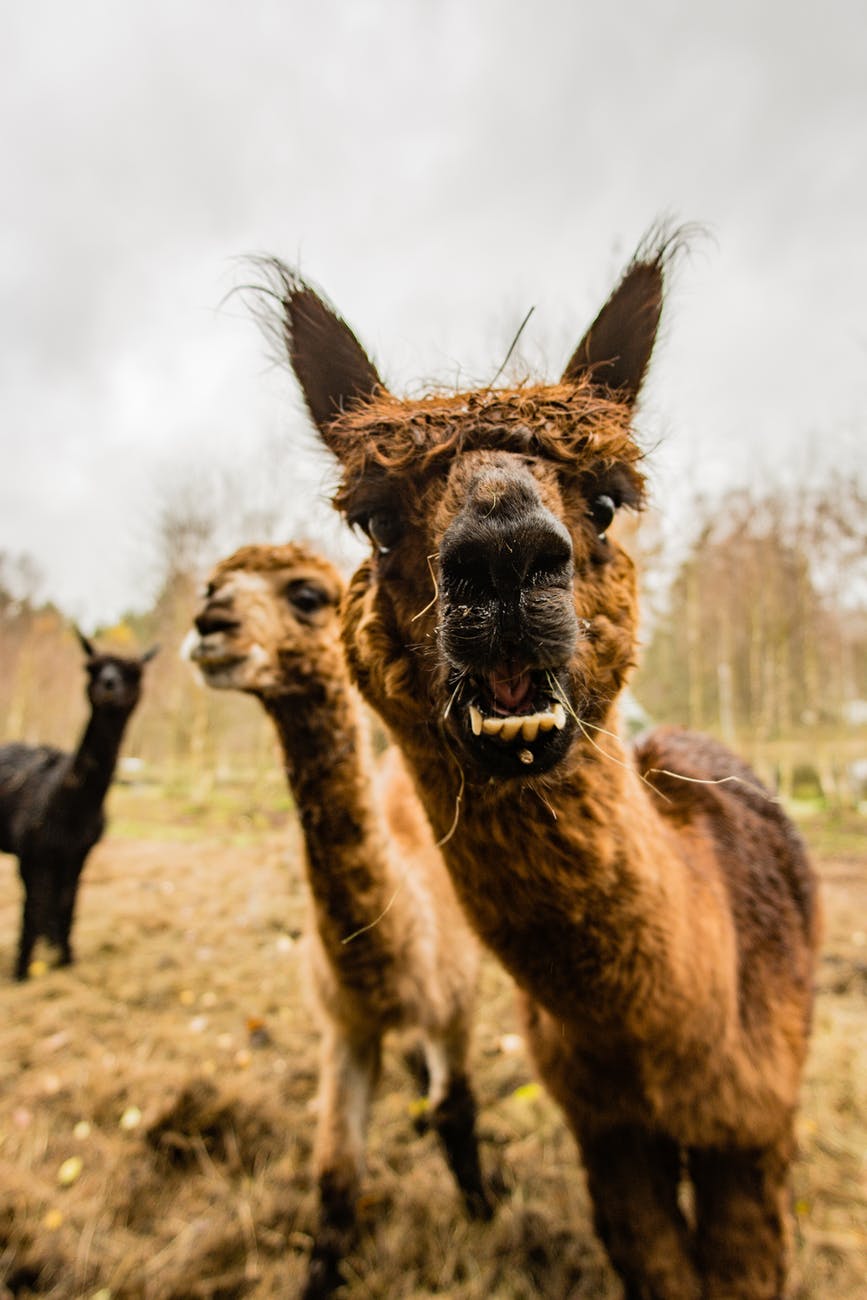
Llama! LlamaLlamaLlamaLlamaLlamaLlamaLlamaLlamaLlamaLlamaLlama…
Seriously, if you know of a homeless llama, send it my way. Llama wool is gorgeous…


Look how these natural shades GLOW:

And when it’s dyed, you get this:

Or you can knit scrummy warm things like these:

And they look like John Taylor from Duran Duran


Originally posted on Quora.
There are plenty of polyester– and other plastics-based substitutes for woollen fabric of all types.
They are usually sweaty, often dry-clean only, and melt or burn easily if ironed. Indeed, they’re often flammable, and are generally not recommended for children’s wear because of this. Many are derived from fossil fuel byproducts or from highly-polluting chemicals, and are non-biodegradable. They do not have the same warmth as wool of a similar thickness, and, unlike wool, are not usually showerproof without additional chemical coatings.
They are usually cheaper than the wool equivalent, though, so there’s that.
Originally posted on Quora.
Yes, and there are nearly 400 commercially-available yarns which combine yak and silk, of which 76 are blends of yak and silk only. The usual fibre to which they are added is (sheep) wool, where proportions can be as little as little as 5%. In yak-silk blends, the proportions are generally 50:50, or 55:45.
Yarn weights vary from Thread, such as Treenway Silks’ Silken Fog (1,527 m per 100g), to Worsted (slightly thinner than Aran weight yarn), such as Lotus Yarns’ Cathay 4 Streak (165 m per 50g).
Originally posted on Quora.
If you mean raw wool, it often depends on the level of care by the farmer. Some shepherds I know wash their sheep regularly – well, more than once – while the fleece is growing, others don’t bother. Imagine you wore the same sweater for a year: you sleep in it, you exercise in it, and once in a while you stand in the rain in it. It would stink, right? Same deal when that sweater is still growing on the sheep, except the sheep also poop and roll in mud in their fleece.
Lanolin, a thick yellowish grease with a strong smell, is another source of the sheepy odour. Different breeds have differing levels of lanolin, and there can be wide variations within a breed depending on grazing, age, sex, whether a ewe has lambed that year, etc. Some mills remove some or all the lanolin, while others make it a point of pride to retain as much as possible. I personally don’t find lanolin to be an offensive smell, and it doesn’t bother me to work with wool ‘in the grease’. Lanolin is a component of many moisturisers, so it’s lovely for my hands. My mother won’t let me in her house if I’ve been working with greasy wool, though – the smell gives her the dry heaves.
A third source of smell is urine. Specifically, horses’ urine, if I recall correctly, though I’d imagine any large, regular source, such as cattle or human, would do at need. Historically, stale urine was the go-to cleaner for raw wool, and the finest tweeds were dyed using urine as a mordant (fixative). While these have largely been replaced with manufactured chemicals, urine-cleansed or mordanted wool can give off a distinct whiff of wee when damp, or if the wearer gets a little sweaty. It is alleged that the British House of Lords, where a substantial number of the Hereditary Peerage wear their historical tweeds, often honks like a dunny in the sun.
Originally posted on Quora.
Qiviut, the wool of the Musk ox, is THE warmest fibre, which makes sense considering they’re Alaskan. Qiviut has an advantage over many other warm animal fibres in that it can be spun unblended. Others, such as cashmere, angora, etc., are often too short to spin on their own and/or too easily worn out.
However, pure qiviut is quite expensive – around $35 per ounce (that’s about $1.25 a gram, and twice the price of cashmere) raw and unprocessed, and $25 an ounce spun into yarn. If you’re too lazy to knit or just want a wearable RIGHT NOW, expect to shell out $200-$300 for a hat, or around $1,000 for a sweater.
It’s not the most expensive fibre though: that is vicuña, from the undomesticable South American camellid of the same name. Raw prices are comparable, but a vicuña scarf costs $1,500, and a sweater can cost up to $5,000.
A more affordable alternative is alpaca fibre. It’s plenty warm, not that much more expensive than (sheep) wool, and hypoallergenic.
Originally posted on Quora.
Her Imperiou s Highness, the Princess Deasa Sheepworrier, Scythe-Clawed Destroyer of Soft Furnishings, Dementer of Little Birds, Terror of the Hedgehog Crossing, would probably say the most annoying thing I do is lock all my lovely wool away from her. She’s particularly partial to hand-dyed silk blends and cashmere.
She has excellent taste, but I’m glad I don’t have any qiviut or vicuña.
Quora linky.