The current handcrafts fad was started by two beginners’ books – Stitch ’N Bitch and The Happy Hooker, both by Debbie Stoller. Most of the handcrafts magazines I see also have an absolute beginners’ section at the back of every issue. The former, as I recall, used photographs, and the latter are more likely to use diagrams.
My learning style is primarily visual, secondarily kinaesthetic (doing), and not remotely auditory. I find diagrams easiest to understand:
photographs somewhat less so because people’s hands can get in the way more than help:
and I prefer watching a living person who I can slow down or ask to repeat an action over video tuition. I have heard of some folk learning by ear, but I don’t even get how that’s possible.
Diagrams are more common in older books such as this one – here’s an example of a typical page:
I’d suggest you consider whether perhaps your learning style lends itself to ‘book-learning’ in the first instance, and see if YouTube or a live tutor might help you more.
Researching yarns probably takes up more of my time than knitting it, or designing. I spend a lot of time on Ravelry, Yarnsub, and the various yarn manufacturers’ sites, finding out as much as I can about yarns, comparing them, looking at examples of projects worked in them, and reading yarn reviewer blogs. Sometimes I’ll know what fibre content I want (or have to use), sometimes I’m looking for certain colours in the same range, sometimes I’m looking for an equivalent yarn to one that’s no longer available.
While I’m fortunate to have a standard LYS, a locally-grown luxury and rare breed LYS, and an independent dyer practically on my doorstep, I still don’t have access to many of the yarns I want. Hand-painted silk, yes. Mushroom-dyed mohair from an Angora goat flock down the road, yes. Cheap ‘n’ squeaky acrylic, no problem. But not Manos Silk Blend, not MadTosh Pashmina, not Nerd Girls Clever, not Jamieson and Smith Cobweb. I can also pick stuff up at yarn festivals, they don’t happen frequently enough – and I can’t plan for inspiration or design calls around them.
One thing I do commonly, with yarns I can’t pick up locally or in a timely manner at wool festivals, is order small amounts of the yarns in contention for a design from an online stockist or the manufacturer. I’ll get a skein (or one skein in each colour if it’s a colourwork design) and see how it works up. Sometimes, I can order these try-out skeins along with a bigger order for another design where I know what I want and how much, other times I’ll get a lot of try-out skeins for many designs that are still in concept. This has recently worked out to be quite expensive for a modern Fair Isle I’m working on, as I’ve had to order multiple shades from different brands as far away as Canada, Norway, Iceland and the US. But mostly, it’s a fairly economical method – and even if I decide not to use Brand X, at least I now have some Brand X to try-out elsewhere.
Or just make another hat. Never can have too many hats!
Pooling is something that yarn does, not something yarn is. It is usually undesirable, but sometimes planned.
Multicoloured yarn
If you have a yarn like this, the colours can form unwanted blobs, instead of spreading out in a nice way:
Yarn pooling
This is a massive problem with variegated or multi-coloured yarns, especially those gorgeous handpainted skeins you picked up at a wool festival for a small fortune, only to realise they look prettier in the skein than they ever will knitted up (~looks mournfully at the “special” shelf in her craft room~).
Whyyyyyyyyyy???????????
BUT: if the colour changes are regular, you can do a thing called ‘planned pooling’, which produces effects like this:
Trimming is the same as cutting, in hair terms – except less hair is removed. Trimming wool does not help the sheep; it leaves most of the wool in place which is uncomfortable and unhealthy. In addition, the trimmed wool ends would be too short to have any commercial value and would end up in landfill. As wool flocks would no longer have any commercial value, thousands of sheep farmers would go out of business and their flocks would be slaughtered. Those industries dependent on sheep wool would have to turn instead to synthetic alternatives which are very damaging to the environment.
The main issue with storing wool is making certain that moths don’t get at it. Wool can survive almost anything else.
The best method is sealing it in something airtight. This might be some kind of sealable plastic box, or vacuum bags – the kind that you suck the air out of with your vacuum cleaner. NB: the vacuum method may leave the wool flat and crinkled, but you can restore it by steaming it for a few hours. Place the wool in your freezer for a few days before storage: this should kill off any moth eggs that might inadvertently have got into it (this also works for wool garments that have been infested with moth larva).
However, if you mean raw wool, just off the sheep, don’t seal it in plastic: that will just allow it to stew in the sweat and grease. Might not harm the wool, but no one will want to touch it afterwards. Raw wool should be scoured – cleaned – before long-term storage, and placed in an air-permeable bag – hessian, cotton, or hemp is good, or failing that an open plastic bag – if you’re just taking it to be scoured.
Goats are more like cats – only semi-domesticated. In some ways, that’s great – they’ll look after themselves. In others, it’s not so good – they’ll get into the veg garden or the laundry, and destroy all before them. They can be super-affectionate one minute, and charging at you malice aforethought the next. Just like cats, really.
Milk-goats are probably more domesticated, less damaging, and less homicidal than most. But they need to be milked at least once a day unless you want to deal with kid goats as well.
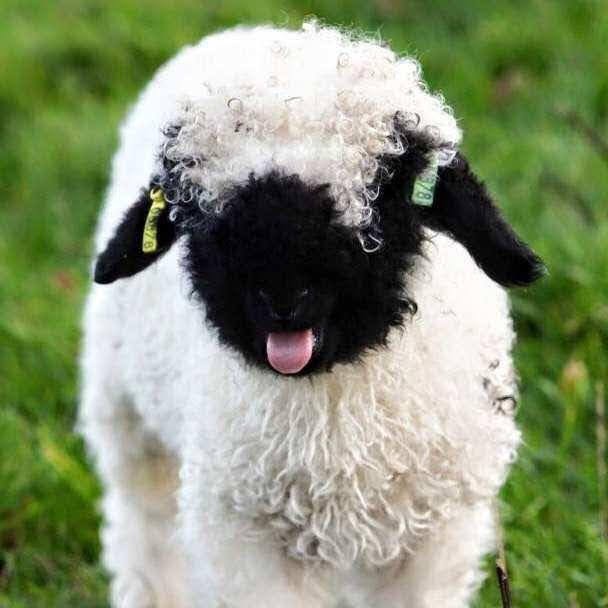
Sheep … well, temperament varies with breed. Blue-Faced Leicesters and Wensleydales are aristocrats and you are the peasant servicing their every need – they’re the cats amongst sheep breeds. Southdowns, Hebrideans and Valais Blacknoses are puppy-affectionate, if you’re willing to be a hands-on shepherd and spend time with them; they’re also great with children. The more feral Soay, Ronaldsay and Boreray are like wary domesticated dogs, or foxes. You can win their trust up to a point so they’ll come to you, but you will never be ‘pack’, and they will dash off at the first hint of something out of the normal.
However, virtually any sheep can be a pet provided you take them in and bottle-feed them from birth: ideally, pick a ewe or a castrated male – never a full ram, as they’re just as homicidal as goats, and often three or four times the size. Here’s a sheep that was raised with pups:
Its demeanour, body language, and movement is all dog. Hopefully, these dogs have all been trained not to jump on people – this boyo is only half-grown.
The downside is that sheep often require more veterinary input, and, of course, the shearing – unless you get a feral breed that naturally sheds its fleece, and are prepared to work hard on charming them.
… We now have the technology (sewing needles), but how do we get thread from wool?
Boredom.
I believe the next stage is a quantum leap from puffs of shed wool to thread, by means of boredom. Tending sheep is a dull business, even with plenty of Neolithic predators about. It’s hours, days, weeks of sitting around watching the woolly buggers eat, baa, and occasionally boink. I think some bored shepherd boy, or probably many bored shepherd boys and girls of all ages, in different places over thousands of years, got in the habit of picking up a piece of shed wool and twiddling with it. In the course of twiddling, they accidentally pulled some strands of wool together and twisted it – and, as wool tends to do, those strands stayed together, and just kept on coming, until the bundle of shed wool disappeared. I’ve done this with a ball of cotton wool while sitting bored in an A&E, waiting for an X-ray. It can be done with little to no attention or intention.
So now we have wool thread. It gets used for sewing. Then, someone has the bright idea of weaving with wool thread. And this happened between 6,000 and 3,500 years ago…
Did this knowledge precede the domestication of sheep?
In my previous answer, I assumed that this happened after sheep were domesticated. I based this on three facts:
sewing seems to have been invented 50,000 years ago (and therefore thread),
sheep were domesticated between 9,000 and 11,000 years ago – probably for meat, milk and skins, and
weaving is at least 6,000 years old.
(Knitting is a comparative late-comer, appearing only 1,000 years ago, give or take a few centuries – using cotton rather than wool).
However, there’s no reason why nomadic hunter-gatherers could not have picked up bits of shed winter undercoat (wool) and twiddled with them as they followed flocks of sheep across the mountains. But I doubt it went any further than that before domestication.
So, I think domestication came first, followed by breeding sheep to produce more of this rather useful winter undercoat – initially for felting, and then for thread, weaving, and finally knitting.
I had a little adventure into yarn production some years ago. I purchased the fleece, had it spun as a worsted-spun 4-ply, and wound into undyed hanks.
As I recall, the fleece, a rare-breed Galway (my Unique Selling Point (USP)) was £11 a kilo. I bought 10kg – £110.
I drove it to a spinning mill – around £200 by ferry plus 500miles petrol. Total in the region of £600 – lucky it was a multipurpose trip…
The mill charged £56 per returned kilo. I got 60-ish 100g hanks back, so about £336.
The resulting yarn was shipped to me at a cost of about £60.
>> 110+(600/2)+336+60=806 (travel costs halved because it was a multipurpose trip)
>> 806/60= 13.43333333
So, just to break even, I’d have to sell each hank for £13.50. And that’s without a ballband, gauge testing, packaging and posting, Etsy listing and selling fees, etc. A 50% markup would bring it to just over £20. And you’ll find, as you look around, that £20 is an average price for a hank of good-quality 4-ply yarn with enough yardage to make a pair of socks.
But that’s a profit of only £405 – half as much as I’d need to repeat the process the following year.
Rare-breed Galway sheep with characteristic top-knot.
I could, of course, have shipped the fleece instead of delivering it, at about £100 for the 10kg. I could have gone for a less expensive woollen treatment, costing a mere £52 per returned kilo – and if you think that’s still expensive, you should watch this:
Fleece processing is intensive both manually and mechanically. Neither the expertise nor the machinery (£1mn startup costs) comes cheap!
I could even have used any old fleece at half the price, instead of rare-breed Galway – but that would have eliminated my USP. I’d have to find some other way of adding value, such as hand-dyeing. Sadly, while I can do and enjoy dyeing… I’m not really ‘valuable’ as a dyer. I have no unique vision that allows me to create exquisite colourways that are Art in the skein, like my neighbour EweMomma does:
Ewemomma hand-painted yarn.
I’d produce plain solid colours like wot i dun ere:
Sooooo boring. But at least I got a good R-O-Y range.
The way you need to look at fibrecrafts is as a hobby, like golf, wine-tasting, or astronomy. A decent golf club can set you back £100 – and you’ll need more than one, plus balls, tees, club fees and funny trousers. Wine tastings can be as little as £30 – for a couple of hours, and you don’t even get to drink the wine! Astronomy costs – are astronomical. But a decent yarn is lovely and squishy in the hank, provides hours of knitting pleasure, and an end product that – with a little care – will last 1,000 years…