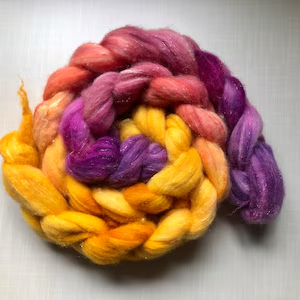
I have only fun stuff to spin this time. The sparkly Golden Sunset braid from craftwithcolour is first up. I didn’t get around to it on TdF or TdFF, partly because it arrived late, having to travel with my niece when she came home from uni, but mostly because I loaded up on extra spins.
Then, because I enjoyed spinning the rose/olive Merino Tencel braid from stephscraftybits, I bought some more of her braids! One is a Merino Tencel braid in sugared-almond colours that remind me of Jean Harlow’s evening dresses, rose, brown, grey and powder blue.
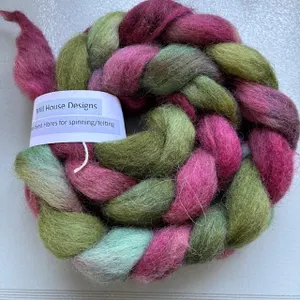
The second is 100% Bergschaf in bottle-green and wine. I’ve never spun Bergschaf before – no idea what to expect there. Some people say it’s soft, others that it’s coarse. The braid itself doesn’t feel particularly soft to me, but not so bad that I’d put it in the to-be-socks box.
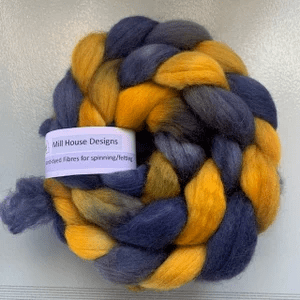
And the third… is blue. Royal & Prior uniform blue. And yellow, obviously. But the blue is nonetheless precisely the colour of the R&P gymslip that I had to wear 5 days a week for 5 years of my life, and which I hated with a passion that is unmatched to this day. But I kept coming back to this braid. It talked to me. It whispered that it wasn’t really that bad – just misunderstood – and wouldn’t it make a beautiful plaid shawl if I wove it on a continuous bias tri-loom…
So yah, I have that to look forward to…
The Golden Sunset and blue/yellow are divvied up into 1/2, 1/4 and 2 x 1/8 parts for fractal spinning. This time, I actually weighed everything to ensure they all worked out to be the appropriate weights when divided. Fiddly, and my scale isn’t cooperative with low-density volumes, but I got there. It’ll be interesting to see if it helps!
I couldn’t have imagined this three years ago, when, as a very new spinner, I joined my first TdF, but I have blown all my expectations out of the water!
My TdF25 aim was to work through a 400g 75% Hebridean/25% bio-nylon blend, with a couple of fractal spins as palate cleansers. I thought this would take me all of TdF and maybe Tour des Femmes too. However, I blasted through all the Hebridean blend midway though the second week.
So I added another 400g blend of 75% Herdwick/25% bio-nylon to my task list. And last night – or possibly early this morning – I plied the last two bobbins of that!
I only finished one of the fractal spins. I intended to continue through Tour des Femmes anyway, so I’ll work on the second braid, plus a third that showed up in the mail last week.
What has stunned me is the sheer quantity I’ve spun, without pushing myself hard. On my first TdF, I learned that some people’s goal was to spin as many yards or metres as the cyclists covered in miles or kilometres, calculated in either completed yarn, or as individual singles+plying. “Huh”, thought I. “I’ll never get anywhere near that!” So here are my data for TdF25:
I haven’t had time yet to measure the Herdwick blend, but it must be at least as long as the Shetland blend, as it wanted to spin up finer. So a guess-timate of my totals is 2331.8m in completed yarns, and 7156m as separate singles + the plying.
This year’s Tour de France covers 3,338.8 km. Ahahaha!
TdF25 haul!
Also, a pic of Sir Lasair in full winter plumage as penance for blowing my own trumpet here!
British fisher ganseys need to be tightly worked in worsted-spun sport-weight pure wool.
Cowichan sweaters should be worked in greasy handspun bulky-weight wool in natural colours.
and so on. You can, absolutely, knit an Aran sweater in bulky-weight cotton, but prepare to be deeply disappointed in how cold it is, and the way it expands with every wash. A Cowichan in qiviut would be toasty-warm, but outside pretty much anyone’s budget. And a Fair Isle jumper in acrylic yarn just doesn’t bear thinking about, especially if you’re going to knit it properly with steeks.
For other knit items, the appropriate yarn is the yarn that does what the designer wants. Linens and silk, and the higher-end breeds of sheep, produce a great draping effect. Alpaca and cashmere are luxuriously warm, with widely differing price points. Woollen- and worsted-spun yarns have differing uses, which can vary depending on the source fibre – worsted-spun in, say, Wensleydale, makes marvellous – and sexy – thermal underwear, but in mohair is perfect for all-weather overcoats, while woollen-spun yarns trap heat and are usually terrific for textured knits.
Of course, not everyone is going to have access to, or be able to afford the yarn recommended in the pattern. Many designers get free yarn as part of the deal when knitting for a yarn producer, and yarn producers offer such freebies as part of their marketing campaigns to get knitters to buy their yarn. Learning to substitute yarns properly is an essential skill for knitters, at least as important as learning different cast-ons and bind-offs (sturdy, firm, relaxed, decorative, etc.).
Make a policy of learning about different yarns and their qualities, what they’re best suited for, and – most importantly – what YOU like about them. If you’re a vegan or allergic to lanolin, wool isn’t your best choice; similarly, ladies of a certain age (moi) should avoid synthetic yarns, and look to linen, hemp, and lighter-weight animal fibres. And some people cannot knit with cotton without their hands cracking, chapping and bleeding (also moi).
The Fleece and Fiber Sourcebook should be in your project bag, and under your arm when attending wool festivals.
You should also have Yarn Substitution bookmarked in your browser, for when you can’t find or afford a recommended yarn, or when it’s been discontinued.
Most people who claim to be allergic to wool have simply been wearing (or were forced to wear) wool that is not fit for purpose.
Wool comes in many qualities, from soft enough for baby skin (e.g., most merino, Blue-faced Leicester, Wensleydale) to fire- and chemical-resistant industrial carpeting. Historically, people wore underwear in the softer wools,
and outerwear in progressively rougher wool, up to Melton fulled twill for weather-resistant coats. Even then, there were differences: trousers or skirts for indoor wear were typically in softer wool, and usually worsted-spun*; outdoor clothing was more usually in sturdier, coarser wools, often blended with mohair, woollen-spun*, and ideally should be lined if you’re not wearing your merino long-johns or cotton petticoat underneath.
In addition, a lot of these ‘wool allergies’ come from a time when wool blends became A Thing because (1) the wool industry was going into decline and (2) more people had washing machines and wanted to wash their woollens in them. So your granny couldn’t afford the quality wool when she was knitting your school jumpers, and used a crappy wool blend with scratchy plastic in it, the washing machine battered the crap out of it, part-felted it á la Melton – and you blamed the wool.
So, the simplest solution for people who find wool scratchy – apart from buying better-quality woollen goods – is to wear something else next to the skin, such as a shirt under Granny’s Christmas sweater that she knitted specially for you with her crippled, arthritic hands, you ungrateful brat. Or you can try ‘superwash’ wool, which has the sticky-outy scales on each fibre chemically stripped off, which means it won’t felt, and isn’t (as) scratchy.
However some people are allergic to lanolin, the natural grease in wool. This is a pretty serious issue, as lanolin is the skin-softening ingredient in many lotions and moisturisers, and finds its way into soaps and makeup too.
To my knowledge, only sheep’s wool contains lanolin. That leaves a huge range of yarns available – note, I say ‘yarn’. Wool comes from sheep, yarn comes from everything else. You can choose from –
Animal
Angora:
English
French
German
Giant
Satin
Camellid:
Alpaca
Huacaya Alpaca
Suri Alpaca
Camel
Guanaco
Llama
Paco-vicuña cross
Vicuña
Cervid:
Cashgora (Cashmere-Angora cross)
Cashmere goat
Mohair
Nigora cross
PCA (Pygmy-Cashmere cross)
Pygora (Pygmy-Angora cross)
Silk:
Bombyx / Cultivated / Mulberry
Eri (Peace Silk)
Muga
Tussah
Other:
Arctic Fox
Bison
Cat
Chinchilla
Dog
Highland Cattle
Horse
Mink
Musk Ox / Qiviut
Possum
Reindeer
Wolf
Yak
Plant
Cellulose:
Bast Bamboo
Flax (linen)
Hemp
Nettle
Paper
Ramie
Cotton:
Acala / Upland
Egyptian
Naturally Colored Cotton
Pima
Manufactured:
Acrylic
Angelina
Carbonized Bamboo
Corn (Ingeo)
Chitin
Microfiber
Milk (Casein)
Nylon / Polyamide
Pearl
Polyester
Rayon / Viscose
Rayon from Bamboo
Rayon from Banana
Rose
Seaweed/SeaCell
Silver
Soy Silk
Stainless Steel
Sugar Cane
Tencel / Lyocell
Full disclosure: I haven’t tried all of these.
Of those I have tried, I would recommend the following as a substitute for wool:
Alpaca – any;
Cashmere;
Muskox/Qivuit for next to skin softness;
Angora – if and only if you aren’t afflicted with the scratchies. Angora is incredibly soft, but fuzzy and therefore tickly;
Bamboo bast or rayon – suitable for baby-soft skin;
Pima cotton – even though it dries the hands out as a knitting yarn;
Banana or soy silk – baby-soft;
Milk or milk and cotton blends;
Sugarcane;
High-quality acrylic, if you absolutely, positively must. It fills the seas with plastic micro-fibres, so think long and hard before you spend (serious, like cashmere-serious) money on this.
Of these, in terms of value for money, I’d go for alpaca, bamboo and cotton, in that order.
* – Worsted spinning sees the wool combed before spinning, so that all the individual fibres are parallel. It produces smooth, non-fuzzy yarn which weaves to a superior fine fabric. Woollen-spun yarns are simply carded without combing: the fibres are higgledy-piggledy and produces a fluffy, round yarn which is wonderfully warm – one example being Melton fabric, used for coats and blankets. While woollen-spun fibres are popular with handknitters, and worsted-spun with weavers, it is possible to use woollen-spun in weaving and worsted-spun in knitting.
Wool comes in hundreds of different qualities, some suitable for next to the skin, others better suited to outerwear. For thousands of years, people wore wool – either as fabric or fleece – from swaddling to shroud, with none of this crybabying about thquatching their thoft dewicate thkin. You got used to it, or you scratched.
Nowadays, people haven’t the skill or knowledge to select the right quality of wool for the purpose, and are too precious to give themselves time to get used to wool. They pronounce themselves ‘allergic’ (only a very tiny proportion are allergic to wool; ETA: Claire Jordan reminds me that more people are allergic to lanolin, the oil in sheep’s wool – that one is nasty), and never wear wool again.
Here’s an experiment. Grab a cotton wool ball or a face flannel, and scrub it, dry, over your skin. Or actually look when you’re towelling off after a bath. They all scrape your skin. In the case of the towel, you might well see what looks like dandruff flaking off your body as you dry. You’ll probably need to slap on a load of moisturiser, because the cotton strips the oils off your skin as well, adding to the flakiness.
The only reason cotton “feels” soft, is because the specific cotton fabric in your clothes has been chemically and mechanically treated to feel soft. Untreated cotton sandpapers the top layer of your skin off.
Neither. Technically, wool is only produced by domesticated sheep.
Qiviut is the undercoat of the Arctic muskox, a relative of sheep and goats (not cattle, despite being called an ‘ox’). It is shed naturally in spring. Only about half of the shed or less is suitable for spinning into yarn. The fibre itself is very fine (around 18 microns), warmer and stronger than wool, non-itchy, and – like hair – does not felt.
The vicuña is a wild South American camelid, related to the alpaca and llama. Vicuña do not do well in captivity, so they are rounded up and sheared every 2–3 years. The amount of fibre is tiny – only 500g or so. Unlike qiviut, vicuña doesn’t take dye well, so it’s only available in its natural golden-brown shade. Like alpaca, the fibre is hollow, and its fine scales allow it to interlock to retain warmth. Each fibre is 8–13 microns thick, making it one of the finest known – only angora hair, from angora rabbits, is of a similar fineness.
FLOOOOOFFFFFF.
The main difference is that muskoxen can be farmed, but vicuña can’t. As a result, qiviut is cheaper. Both, however, are high-end luxury fibres.
There are plenty of polyester– and other plastics-based substitutes for woollen fabric of all types.
They are usually sweaty, often dry-clean only, and melt or burn easily if ironed. Indeed, they’re often flammable, and are generally not recommended for children’s wear because of this. Many are derived from fossil fuel byproducts or from highly-polluting chemicals, and are non-biodegradable. They do not have the same warmth as wool of a similar thickness, and, unlike wool, are not usually showerproof without additional chemical coatings.
They are usually cheaper than the wool equivalent, though, so there’s that.
Her Imperiou s Highness, the Princess Deasa Sheepworrier, Scythe-Clawed Destroyer of Soft Furnishings, Dementer of Little Birds, Terror of the Hedgehog Crossing, would probably say the most annoying thing I do is lock all my lovely wool away from her. She’s particularly partial to hand-dyed silk blends and cashmere.
She has excellent taste, but I’m glad I don’t have any qiviut or vicuña.







 thornmaiden.com