Where can I buy good quality wool that will allow me to knit high quality wool socks that don’t burn holes in them in the first year of use?

It’s not the wool.

Virtually any wool or non-sheep fibre can be used for making socks. Some people like a blend of wool with nylon/polyester/acrylic or cotton for strength and wear. Others like a sturdier fibre like mohair, or breed-specific wool such as Herdwick:

Herdwick ewe with lamb at foot.

Still more prefer worsted-spun over woollen-spun, or an unbalanced ply over balanced. Then there are the arguments over yarn weight, between the die-hard fingering-weight knitters, the never-anything-but sportweighters, and the worsted warriors.

And superwash wool is a must if you’re planning to machine-wash your socks – or even if they need vigorous handwashing.

But beyond such matters, there’s a deeper issue; a philosophy, as it were, of socks.

  • Socks go on your feet. Feet are the hardest-working, most active physical part of your body. Feet are also the roughest, most abrasive part of your body. Look at your feet. Look at your toenails. Are they hard, horny, ragged, split? The condition of your feet and toenails can affect your socks, like putting them on an orbital sander or an angle-grinder. Fix your feet, and you’ll fix most of the problems with your socks.
  • Even with perfect baby-soft feet, your socks still undergo a lot of wear and tear from shoes and simply being on your feet. You can’t do much about the latter, but you can make sure your shoes aren’t causing the problem. Assuming the shoes aren’t the problem, you need to accept that socks, however tough and hard-wearing, whether handmade or shop-bought, are going to require darning at some point. This is the truth of being the most hard-working item of clothing you own. You need to become a darning diva. It’s not difficult and can be as soothing to the soul as knitting the socks in the first instance.
  • Or you can rise beyond the sock to realise a more perfect solution, a sublimation of the sole if you will. The sock is not the problem – the sole is. So knit your perfect sock – and then, knit your perfect sole, and sew them together. You can even use completely different yarns, a delicate fingering for the cuff and foot arch, and a sturdy pure wool Aran or Bulky for the sole. And when that wears through, simply snip off the sole and replace it.

I’m a worsted warrior, and I like Novita 7 Veljestä wool right now. I will happily use pure wool Aran mill-ends, too, especially for kilt hose – you can get these directly from your nearest spinning mill, or they might have a local shop outlet. They’re on cones, from 500g upwards. I also have a 4kg cone of Herdwick, which I’ll probably be buried with, even though I have made multiple items from it. It just never seems to get any smaller.

Quora linky.
Are Irish wool sweaters itchy?

It’s very unlikely that you would ever find out.

The majority of sheep in Ireland are meat breeds. Their wool is poor quality, and usually goes into landfill.

Therefore, there is no Irish yarn to make into egg cozies, much less sweaters.

Most of the (very, very tiny amount of) yarn produced in Ireland is made from Australian merino. That’s not scratchy* in the slightest.

There is some (an incredibly tiny, miniscule amount) wool currently spun from Irish sheep, principally Zwartblés but including some other breeds including the rare-breed native Galway Longwool. However, this is usually only spun in fingering weight, for making socks. You can make a sweater out of sock wool, but it will take years and will only be suitable for hot summers.

Quora linky.

What is a “Donegal” sweater?

As a Donegalwoman, there is no such thing as a Donegal sweater.

There is, however, such a thing as Donegal tweed. Donegal tweed is woven from wool, of course. But what is interesting about this wool happens during the spinning process. The fleece is dyed after scouring (cleaning and washing), then woollen-spun with minimal or no carding to remove short fibres. During the spinning process, these short fibres fall on the mill floor. After a few days or a week, the floor is swept, and the resulting semi-felted little bobbles (‘neps’) are added to the next batch of spinning. The yarn looks like this:

The neps stick to the yarn giving little pops of colour. A sweater knitted in this yarn could be called a Donegal sweater:

Carol Feller, wearing her Killybegs cardigan, in Studio Donegal Aran Tweed in shade Green (4824). The cardigan is has a round collar and opens from throat down, and features a delicate honeycomb cable pattern at the cuffs, waist, and yoke.
Killybegs pattern by Carol Feller, in Studio Donegal Aran Tweed

Quora linky.

When making textiles, how would early people card them?

There is such a thing as craft historical re-enactment – it’s not all Vikings and Romans. Craft historical re-enactment can happen on its own, often in living history museums, but also in conjunction with the sword and sandals kind of re-enactment*. There are also many knitters who are interested in historically-accurate crafting – there’s large and active communities of Historic Knitters and Spinners on Ravelry, for example, and another dedicated group of crafters who are preserving old, out-of-copyright patterns and crafting books online.

So, how would people have carded fleece to make yarn in the pre-industrial era?

Image showing modern and historical carders.

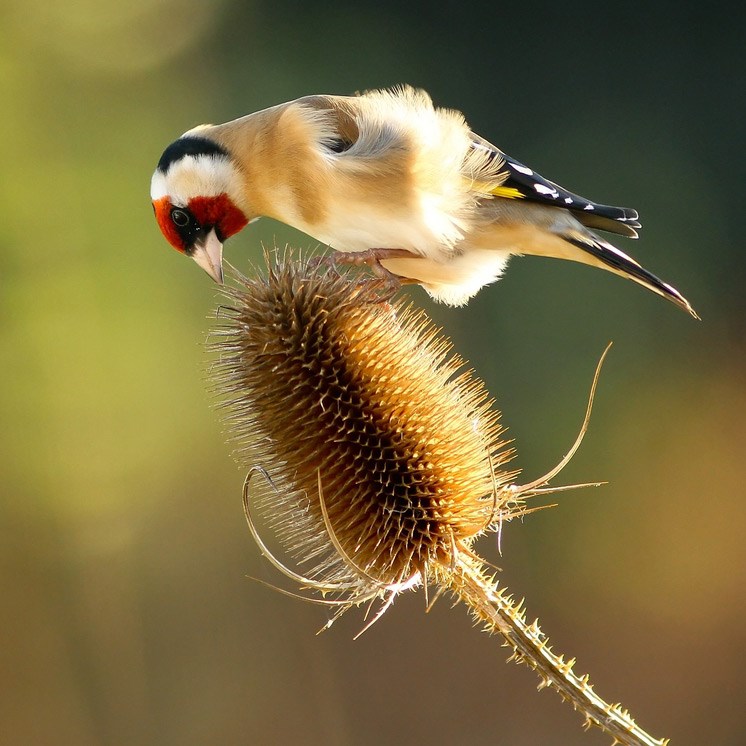
I’m sorry this is such a poor-quality image – I took it with my phone at my first-ever wool festival, and, while camera quality is my main criterion for buying a phone, that phone was high quality for 2009. These are carders: the pair at the front are relatively modern, but at the back, on the cross-shaped handle, is a typical pre-industrial carder. Those fuzzy blobs you can see are the seed heads of one of the Teasel species of plant:

Historically, Fuller’s Teasel seeds were used for both carding wool for spinning, and for finishing woven cloth by brushing and softening the surface.


* – In my LH characters of Jodis (formidable matron) and Finnbogi (beardless and somewhat inept young warrior), my craft skill was naalbinding, a kind of Viking knitting but with a sewing needle.

Quora linky.

Why don’t goats produce wool the way sheep do?

Strictly speaking?

Because goats produce their own spinnable fibre – notably the Cashmere goat breeds and the Angora goat, which produce cashmere and mohair respectively. Yes, mohair – not angora, which is produced by the Angora rabbit.

Historically, or rather paleoagriculturally, sheep appear to have been bred primarily for their wool, whereas goats seem to have been bred primarily for milk, although there are such things as milk sheep and, clearly, fibre goats. I can only hazard a guess that the primitive sheep domesticated by our ancestors must have produced more fibre than goats did*, and/or that primitive domesticated goats had more milk or were easier to milk than sheep

Milk goat

Milk sheep.

Yep, definitely easier to milk the goat.


* – The Jacob sheep, a relatively primitive breed, produces about 2–3kg fleece, whereas (modern) Cashmere goats produce only 1kg.

Quora linky.

What’s the carbon footprint of wool?

Somewhere between zero and a non-trivial fraction of infinity, depending on the production, preparation, marketing and post-purchase care, the locations thereof, and transportation methodologies between.

You’re going to have to be a lot more specific.

Can wool be synthetically made without sheep?

No.

It is possible to make something that looks like wool, either with plant materials or, more usually, petrochemicals.

Cotton and linen, two common plant-based yarns, can look the same but are cooling rather than insulating, flammable rather than inflammable, heavy rather than light, and liable to stretch irreparably rather than keep its shape. Other plant-based fibres such as viscose and ramie (e.g., bamboo, sugarcane, cornsilk) are similar. Their production, and that of cotton in particular, is also rather bad for the environment.

Petrochemicals, such as acrylic, are sweaty, very flammable (and melt into your skin when they do, which is oodles of fun at the Burns Unit), appallingly bad for the environment for centuries, and are only “easy care” if you wash them on the same cycle as wool – and even then, they shed microplastics into the watercourse and thence to rivers, lakes and seas.

Quora linky.

Does shearing a sheep’s wool hurt the sheep in any way? If it did hurt the sheep, could you just “trim” the wool instead of taking it all off?

No. It’s like you getting a haircut.

Trimming is the same as cutting, in hair terms – except less hair is removed. Trimming wool does not help the sheep; it leaves most of the wool in place which is uncomfortable and unhealthy. In addition, the trimmed wool ends would be too short to have any commercial value and would end up in landfill. As wool flocks would no longer have any commercial value, thousands of sheep farmers would go out of business and their flocks would be slaughtered. Those industries dependent on sheep wool would have to turn instead to synthetic alternatives which are very damaging to the environment.

Quora linky.

How do I store wool for a long period?

The main issue with storing wool is making certain that moths don’t get at it. Wool can survive almost anything else.

The best method is sealing it in something airtight. This might be some kind of sealable plastic box, or vacuum bags – the kind that you suck the air out of with your vacuum cleaner. NB: the vacuum method may leave the wool flat and crinkled, but you can restore it by steaming it for a few hours. Place the wool in your freezer for a few days before storage: this should kill off any moth eggs that might inadvertently have got into it (this also works for wool garments that have been infested with moth larva).

However, if you mean raw wool, just off the sheep, don’t seal it in plastic: that will just allow it to stew in the sweat and grease. Might not harm the wool, but no one will want to touch it afterwards. Raw wool should be scoured – cleaned – before long-term storage, and placed in an air-permeable bag – hessian, cotton, or hemp is good, or failing that an open plastic bag – if you’re just taking it to be scoured.

Quora linky.

How did early people discover or develop the complex process of making clothes from wool, and did this knowledge precede the domestication of sheep?

I’ll direct you to my previous answer: Do we know the first people to figure out how to make wool from sheep, and how did they do it? and specifically this part:


… We now have the technology (sewing needles), but how do we get thread from wool?

Boredom.

I believe the next stage is a quantum leap from puffs of shed wool to thread, by means of boredom. Tending sheep is a dull business, even with plenty of Neolithic predators about. It’s hours, days, weeks of sitting around watching the woolly buggers eat, baa, and occasionally boink. I think some bored shepherd boy, or probably many bored shepherd boys and girls of all ages, in different places over thousands of years, got in the habit of picking up a piece of shed wool and twiddling with it. In the course of twiddling, they accidentally pulled some strands of wool together and twisted it – and, as wool tends to do, those strands stayed together, and just kept on coming, until the bundle of shed wool disappeared. I’ve done this with a ball of cotton wool while sitting bored in an A&E, waiting for an X-ray. It can be done with little to no attention or intention.

So now we have wool thread. It gets used for sewing. Then, someone has the bright idea of weaving with wool thread. And this happened between 6,000 and 3,500 years ago…


Did this knowledge precede the domestication of sheep?

In my previous answer, I assumed that this happened after sheep were domesticated. I based this on three facts:

  1. sewing seems to have been invented 50,000 years ago (and therefore thread),
  2. sheep were domesticated between 9,000 and 11,000 years ago – probably for meat, milk and skins, and
  3. weaving is at least 6,000 years old.

(Knitting is a comparative late-comer, appearing only 1,000 years ago, give or take a few centuries – using cotton rather than wool).

However, there’s no reason why nomadic hunter-gatherers could not have picked up bits of shed winter undercoat (wool) and twiddled with them as they followed flocks of sheep across the mountains. But I doubt it went any further than that before domestication.

So, I think domestication came first, followed by breeding sheep to produce more of this rather useful winter undercoat – initially for felting, and then for thread, weaving, and finally knitting.

Quora linky.