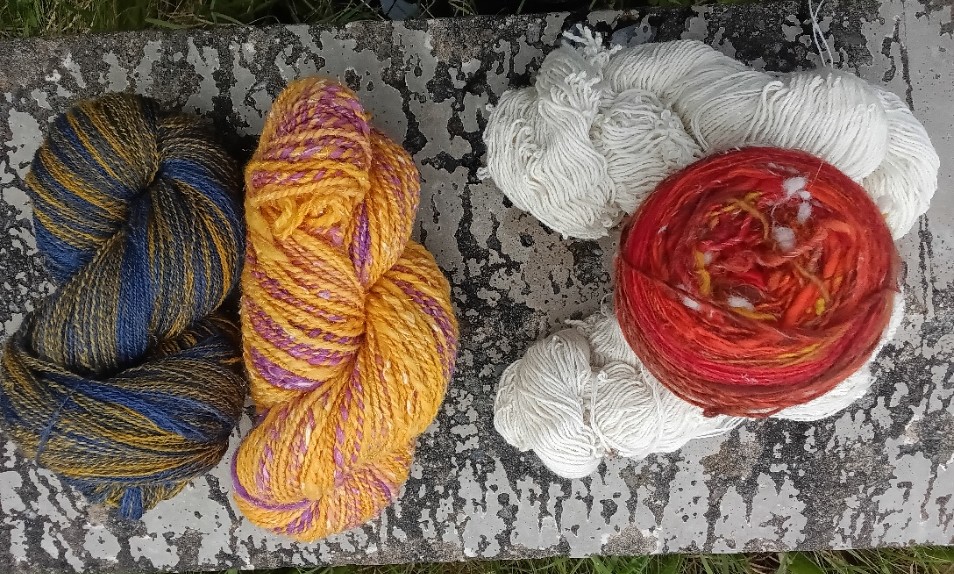
Blue-yellow 2 ply fractal spin from a space-dyed braid (Unresolved School Uniform Trauma), 642m (roughly 2/12Nm, lace/sock);
Yellow-purple 2 ply fractal spin from a gradient-dyed braid (Golden Sunset), Aran-weight, 156m (abt 2/3Nm);
2 skeins of chain-plyed warping yarn from a cone (World Of Wool), over-spun for strength, Aran weight, for weaving with the orange centre-pull ball which I spun from a batt during TdF23 – procrastination much?
Still to come – more space-dyed braids from stephscraftybits! I’ve just started the sugared-almond Jean Harlow one, which is also coming up rather fine. And if you’ve been paying attention, I did say “more braidS”, plural.
Yes, I went off and bought another 3 braids and a batt from stephscraftybits. A bottle-green/wine combo on Bergschaf, which I have named The Parting Glass – I’ll definitely at least start this.
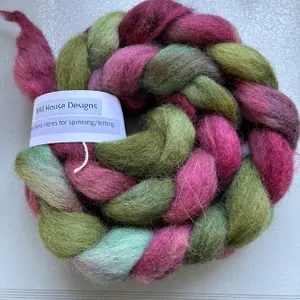
Then, this cheerful 100% Lonk braid, described as green/red/pink. The green is barely there, and a bit browny. I might take it out when I unwind the braid, depending on whether it looks okay.
The third, God forgive Steph for inflicting her irresistible colour choices on me, is BLUE, green and grey, on Charollais fleece. Charollais is a fibre I’ve wanted to try for a while, that’s not why I bought it. I… just… liked it??
The batt is a mystery blend of black, white and grey fibres – probably merino. They’re laid one on top of the other, so it’ll probably spin up as grey. It’ll be a relief from all this blue…
I couldn’t have imagined this three years ago, when, as a very new spinner, I joined my first TdF, but I have blown all my expectations out of the water!
My TdF25 aim was to work through a 400g 75% Hebridean/25% bio-nylon blend, with a couple of fractal spins as palate cleansers. I thought this would take me all of TdF and maybe Tour des Femmes too. However, I blasted through all the Hebridean blend midway though the second week.
So I added another 400g blend of 75% Herdwick/25% bio-nylon to my task list. And last night – or possibly early this morning – I plied the last two bobbins of that!
I only finished one of the fractal spins. I intended to continue through Tour des Femmes anyway, so I’ll work on the second braid, plus a third that showed up in the mail last week.
What has stunned me is the sheer quantity I’ve spun, without pushing myself hard. On my first TdF, I learned that some people’s goal was to spin as many yards or metres as the cyclists covered in miles or kilometres, calculated in either completed yarn, or as individual singles+plying. “Huh”, thought I. “I’ll never get anywhere near that!” So here are my data for TdF25:
I haven’t had time yet to measure the Herdwick blend, but it must be at least as long as the Shetland blend, as it wanted to spin up finer. So a guess-timate of my totals is 2331.8m in completed yarns, and 7156m as separate singles + the plying.
This year’s Tour de France covers 3,338.8 km. Ahahaha!
TdF25 haul!
Also, a pic of Sir Lasair in full winter plumage as penance for blowing my own trumpet here!
I did indeed race through my Hebridean/bionylon blend which I thought would take up the whole of TdF! By Monday I had 6 skeins plied, then washed and thwacked on Tuesday, and drying since. I suppose I could have measure the length, but I want to put them all on a single cone using my Royal cone winder – and the cone-hats have yet to arrive.
So, that stalled, I hoked out another 400g sock blend, Herdwick/bionylon. I wanted thick welly socks, but the Herdy isn’t cooperating, as I believe is normal for the breed. Instead of a Sport-cum-DK weight, it is stubbornly coming in as Fingering when 2-plied. It’s a bit like spinning Brillo pads, so hopefully they’ll be sturdy even if thin. In the background are a couple of blackcurrant liqueurs, vodka and whisky, which I started the same day! I just have one dwarf blackcurrant bush. This year it produced over 2kg of fruit!
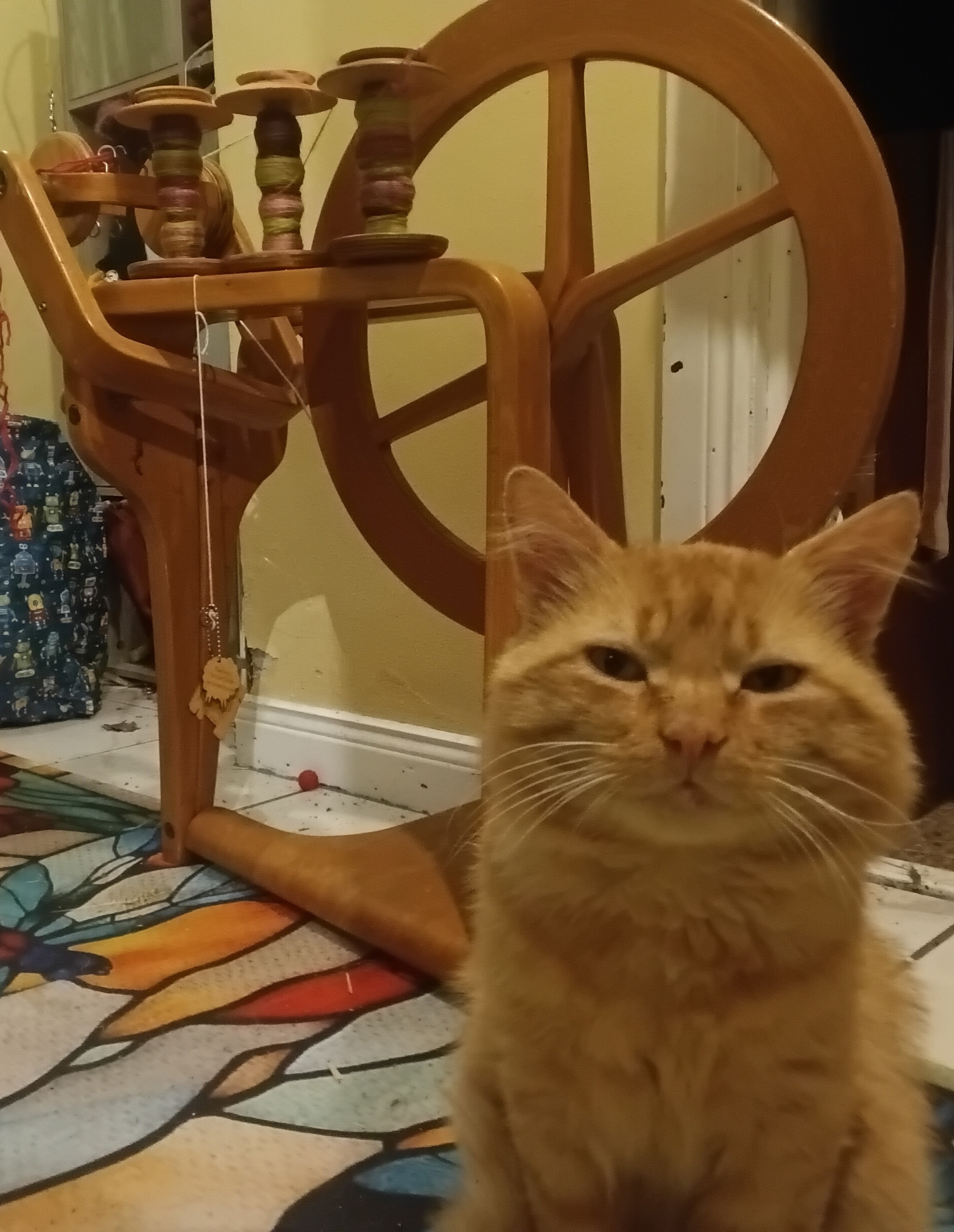
I finished the first fractal spin yesterday! The bobbins are waiting to be plied, and Sir Lasair Lothbrok the Loud approves 🙂
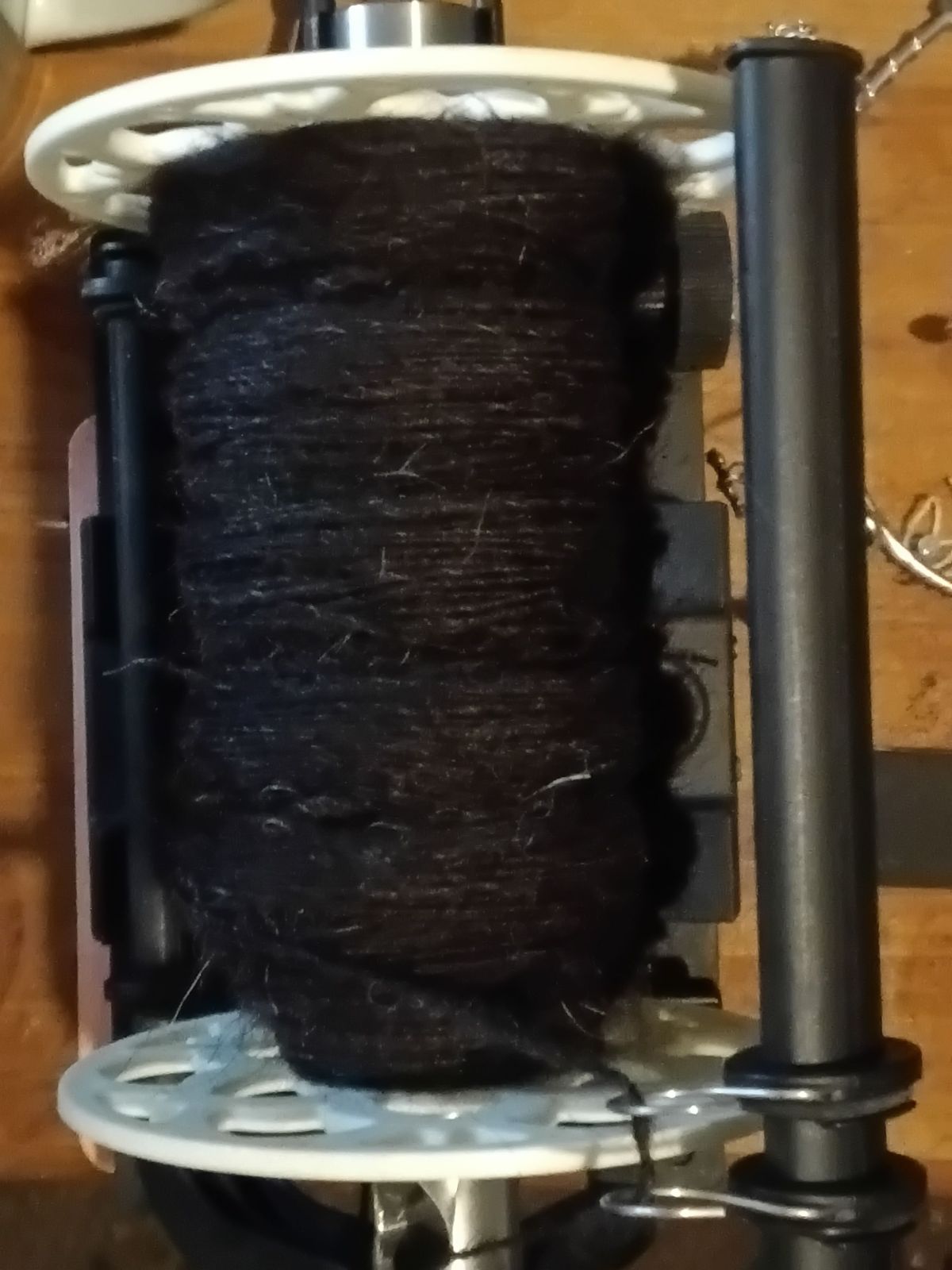
Yesterday I filled roughly half an EEW 6 bobbin with my Hebridean blend top! I was using a mongrel long draw: partly English, partly supported (mainly to coax more fibre into the thread when it was getting too fine), and not all that long due to my osteoarthritis. I call it my Cripple Crutch Drag Til It Hurts Draw…
These bobbins are BIG. They can hold 200g (8oz for the colonials) of singles. That means there’s close to 100g on it already. I bought 500g of this blend originally, and spun a sample to see what it was like. The sample is somewhere in my completed-spins bin. The bag of fibre now weighs around 300g, minus the sample and what’s on the bobbin. I thought it would take all of TdF, including the Tour Des Femmes, to slog through this fibre, but I’ve spun about 20% of it in a few hours, and have a (presumably) 100g sample already done??? This does not compute… I’m going to have to re-jig my TdF goals if this keeps up.
I also made a start on my 3-ply fractal spin on Blaise, my Herring wheel. That was not as epic as the Shetland. The fibre, which is sumptuous, is a bit compacted from being in the braid, so it’s fighting me all the way so far – snapping, not coming out easily despite pre-drafting, and of course I’m not used to the side-to-side drafting necessary to maintain colour separation – I’ve only done one fractal spin before. Blaise can be a little temperamental, too. Sometimes she sings along producing invisible gossamer strands fit for an emperor, then suddenly it’s DK singles or nothing and don’t even think about plying – this lady is not for turning (anti-clockwise).
Impressive, huh?
I should add something about the decision to do a 3-ply fractal spin. There are basically 2 reasons:
I tried to pull the released braid into 2 sections, but it insisted on parting into 3*.
A 3-ply fractal spin requires 4 bobbins – 1 for each single, and 1 to ply onto. By sheer coincidence, Blaise has 4 bobbins – 1 original, and 3 purchased recently from Frank Herring & Sons.
So obviously, it was a thoroughly-researched, analytically considered, and deliberative choice, as is usual for me.
Stop laughing, there at the back!
I did consider dividing the 2nd length into 2, and the 3rd into 4, before wising up. Instead, Bobbin 2 will consist of 3 x 1/6ths, and Bobbin 3 will have 3 x 1/9ths, as is tradition.
*: This is often the case with commercial combed top. The mills have 3, umm, extruders where the final top is spat out. These are positioned close together in a triangular shape, so the top comes out as one length, even though it’s really 3. IYSWIM.
British fisher ganseys need to be tightly worked in worsted-spun sport-weight pure wool.
Cowichan sweaters should be worked in greasy handspun bulky-weight wool in natural colours.
and so on. You can, absolutely, knit an Aran sweater in bulky-weight cotton, but prepare to be deeply disappointed in how cold it is, and the way it expands with every wash. A Cowichan in qiviut would be toasty-warm, but outside pretty much anyone’s budget. And a Fair Isle jumper in acrylic yarn just doesn’t bear thinking about, especially if you’re going to knit it properly with steeks.
For other knit items, the appropriate yarn is the yarn that does what the designer wants. Linens and silk, and the higher-end breeds of sheep, produce a great draping effect. Alpaca and cashmere are luxuriously warm, with widely differing price points. Woollen- and worsted-spun yarns have differing uses, which can vary depending on the source fibre – worsted-spun in, say, Wensleydale, makes marvellous – and sexy – thermal underwear, but in mohair is perfect for all-weather overcoats, while woollen-spun yarns trap heat and are usually terrific for textured knits.
Of course, not everyone is going to have access to, or be able to afford the yarn recommended in the pattern. Many designers get free yarn as part of the deal when knitting for a yarn producer, and yarn producers offer such freebies as part of their marketing campaigns to get knitters to buy their yarn. Learning to substitute yarns properly is an essential skill for knitters, at least as important as learning different cast-ons and bind-offs (sturdy, firm, relaxed, decorative, etc.).
Make a policy of learning about different yarns and their qualities, what they’re best suited for, and – most importantly – what YOU like about them. If you’re a vegan or allergic to lanolin, wool isn’t your best choice; similarly, ladies of a certain age (moi) should avoid synthetic yarns, and look to linen, hemp, and lighter-weight animal fibres. And some people cannot knit with cotton without their hands cracking, chapping and bleeding (also moi).
The Fleece and Fiber Sourcebook should be in your project bag, and under your arm when attending wool festivals.
You should also have Yarn Substitution bookmarked in your browser, for when you can’t find or afford a recommended yarn, or when it’s been discontinued.
What makes you think sheep farming is a “terrible industry”?
Have you spent any time on a sheep farm, or any kind of farm? Even a petting farm? Or are you just spouting nonsense from delusional idiots who know nothing about farming?
If you’re genuinely interested in ethical clothing, forget about “brands”. A lot of the big brands you’ll have heard of may have ethical lines, but quite often they’re not as ethical as they’re cracked up to be. Those who are genuinely ethical are usually very small brands, and can be hard to find because they embrace local marketing – for example, a sheep farmer who shears, spins, and weaves or knits garments for sale in local farmers markets or online, and/or sells wool to handknitters and weavers.
One way in which you could actually make an impact and have some control is to try making your own clothes. You can recycle fabrics and clothing, or buy artisanal fabrics. Here’s a duvet cover dress:
Here’s a puzzle dress you could also make from a duvet cover. Or an old embroidered linen table cloth:
That very much depends on a lot of different factors.
In wild sheep or domesticated self-moulting sheep, the fleece may just lie there and decompose, unless taken by another animal or bird for burrows or nests.
If the sheep is a meat sheep, the fleece is usually of very low quality. Occasionally, it can be sold as insulation material or for industrial carpeting, but it is quite often just dumped and allowed to decompose.
Better-quality fleece can be made into high-quality carpeting, upholstery and soft furnishings; clothing; or yarn for fibre arts – knitting, weaving, etc. In some countries, there is a central processing board to which all such fleece must be sold (e.g., British Wool, in the UK), in others there may be competing processers to which farmers can sell fleece.
As it happens, the other day I had one of those very common sink-tap accidents which resulted in me being sprayed down the front with water.
That kind of thing, except all over my woolly jumper.
If I’d been wearing almost any other top, I’d have had to change. However, with my woolly pulli, I just brushed off the drops sitting on the surface of the fabric and carried on. Some spray did go right through the fabric and landed on my chest, which was unpleasant, but that water swiftly evaporated with my body heat, right back through the fabric. So I had no excuse but to carry on washing those damn dishes.
This is the kind of thing woollen garments excel in. You can wear your Aran sweater out fishing on a drizzly day, and stay perfectly warm and dry on the inside. Your Melton-weave wool overcoat will see you through moderate to heavy rain, and only require a shake-out on the doorstep when you get home. However, if you fall off the boat into the sea, or are unfortunate enough to walk home in torrential rain, neither is going to help you much (of course, no other fibre will help either – you’re soaked: get changed).
The above shows the structure of a single wool ‘hair’. Off the left-most end is the root of the fibre, where it grows out of the skin. For our purposes, the important bits are the Cuticle, and the Cortex.
Cuticle: The outer surface of the fibre is made up of overlapping cuticle cells, or scales. These have a chemically-bonded waxy coating, which repels water. This allows tap-spray and light rainfall to simply run off the fabric.
Cortex: The cortex is made up of two types of cell with different chemical compositions. One type attracts moisture more than the other, and therefore expands more than the other. This difference in expansion causes the fibre to ‘crimp’ (curl). It is the crimp in wool that allows it to trap air pockets, providing insulation. So, a slightly-damp woolly jumper becomes ‘crimpier’ and warmer.
I’ll mention a third region for completeness: the Matrix. This is mostly hydrophilic sulphur-based proteins, which allow wool to absorb up to 30% of its weight in water. If you get thoroughly soaked, this layer fills up, your woolly garment weighs a ton, and it takes forever to dry out. In an emergency, you can try wringing it out and relying on the cortical crimp to – at least – keep you warm, but the waterproof outer cuticle has been subverted. You need to get somewhere warm, with hot food and dry clothes, stat.
Foxford Woollen Mills is a weaving mill, producing fabrics, including the fabric for the Garda Síochána uniform. It does not, to my knowledge, prepare and spin woollen yarn.
The company does not provide much information about the original travel rug (car blanket) presented to Gen. Michael Collins, beyond the fact that they used a 4-ply yarn. This is not particularly helpful, as 4-ply yarn today is a very thin yarn that produces a lightweight fabric unsuited to a travel rug. Presumably, the yarn they used was made up of 4 thick strands, plied together to create a rug yarn, closer to an Aran- or Bulky-weight knitting yarn.
While they do not reveal the source for their weaving yarn for Gen. Collins’ rug, given the period, it is likely that it was sourced from a spinning mill in Ireland, possibly but not necessarily in Co Mayo; and that that spinning mill purchased fleece from Irish sources, possibly but not necessarily locally.
Historically, sheep breeds in Ireland were mixed-use – farmed for wool and meat*. With the exception of a couple of breeds, the wool produced was often of relatively poor quality, too rough for anything but outerwear** or carpeting. There was nonetheless a thriving woollen spinning and weaving industry across Ireland, with mills in many towns, particularly market towns where animal marts took place. In Donegal, there was hardly a settlement of any size without a mill. Virtually everybody had a Donegal tweed suit, purchased as a wedding outfit, worn as Sunday best for decades – often picked apart and re-fashioned according to trends – until they were finally buried in it.
My grandparents in their tweed wedding suits, 1924.
This industry was decimated by the mid-20th century. Petroleum-based yarns destroyed the wool-spinning industry, cheap imports from the far east destroyed the knitwear and weaving industry, trends in agriculture towards specialised farming and a lack of political support for the industry meant that, from the 1960s on, these small local mills disappeared. Today, only 3 of these historic spinning mills survive: Donegal Yarns in Kilcar, Co Donegal; Kerry Woollen Mills in Killarney; and Cushendale Woollen Mills in Graignamanagh, Co Kilkenny. The latter two survived by amalgamating weaving and woollen products into their operation, Donegal Yarns through relationships with weaving mills and with international yarn brands such as Debbie Bliss and Lang Yarns.
Generally, weaving mills did better than spinning mills, partly due to the worldwide cachet of Irish tweed and carpeting, and there are still quite a few like Foxford around. But most sheep in Ireland are meat sheep, there’s no marketing support for shorn wool, so there’s virtually no Irish fleece for the spinning mills, and therefore virtually no Irish-grown yarn for the Irish weaving mills. Almost all the wool dyed and spun in Donegal Yarns comes from Australia, via a cleaning operation in Bradford, England.
And that is why Foxford Mills uses Australian wool: because it exists, and Irish wool (almost***) doesn’t.
*: I’m not aware of milk breeds being of much importance until recently.
**: Aran sweaters, while a 20th-century innovation, were outerwear, worn over a good flannel shirt.
***: There are some small-scale efforts to use Irish fleece – Donegal Yarns is working on a range using Wicklow Cheviot fleece, Cushendale Mills processes Irish Zwartble fleece, and Kerry Woollen Mills adds lowland Galway fleece to imported fleece. There’s also a new mini-mill in Cavan, Olann, which will spin small quantities of fleece (the others only accept commercial quantities in tons) which will likely appeal to hobby and rare-breed farmers with only kilos to process; but this won’t supply a large concern like Foxford Mills.
Because vegans lack common sense, and have no understanding of the natural world.
Their existence is only possible in a post-scarcity Western society, where there are lots of vegan alternatives which are only available by raping and bankrupting developing nations for their avocado toast, cutting down rainforest to grow their monoculture soybeans, and destroying and polluting the environment for their cotton clothing and ocean-destroying plastic ‘leather’.
They need to spend a year or two living on locally-sourced turnips and wearing nettles to knock some damned sense into them.



 thornmaiden.com