Reflective Processes

Once upon a time there was an academic discipline. Its practitioners were learned men, its advocates the wealthy and wise. It sought to explain the nature of man and of his actions. In this, it was successful: all agreed the profiles were highly accurate, the prognostications pleasing. No one noticed the over-detailed bland generalisations – or if they did, only so far as to feel validated to have their own analysis confirmed by such learned men.
That discipline was astrology. Today, it is called social psychology, American-style.
The methodology is quite simple:
1.      Find a normal social process;
2.      Give it a fancy name;
3.      Describe it to death, in lieu of real evidence (Coffield et al., 2004);
Should an ‘undiscovered’ process prove elusive, you have two options: a) find some piffling absence in a ‘discovered’ process; or b) tweak the existing model (bigger words are good) – and book your spot on Oprah[1].
The result is a proliferation of near-identical theories and instruments, with muddled and over-reaching claims (that learning is the same as knowledge, for example), and little empirical evidence – and that contradictory at best (Coffield et al., 2004, pp 61-69). Kolb’s Experiential Learning Theory (Kolb & Fry, 1975, in Smith, 2001a) is merely Lewin’s Action Research model (Smith, 2001b) turned into a circle, with bigger words for the stages. Gibbs’ Reflective Cycle (1988, in University of Brighton, no date) covers similar ground, but requires examination of one’s emotions: explicitly in one stage and implicitly throughout. However, this rehashes much of Boud et al.’s (1983) Reflection Model, albeit in a simplified form. Little information is available on Gibbs’ model: the book itself is out of print, and I found no mention of any empirical work. Nonetheless, many online professional development guides are based on Gibbs’ model, often aimed at student nurses, teachers, and social workers. Coupled with the lack of any reference to Gibbs’ work in Coffield et al.’s (2004) review, it is as if Gibbs[2] merely wrote a student guide – as many lecturers do – neither intending to pursue the ideas therein academically nor imagining that it would take on such impetus.
A final point is that, while both Kolb’s and Gibbs’ models are used for reflective practice, reflection per se is only part of each cycle, and is little elaborated. Does reflection arise from the full cycle, or only from these one or two stages? Is it necessary to complete every stage, or can they be combined, or skipped entirely?  Is there a set of procedures embedded in these stages, and if so, what are they – and is the rest of the cycle necessary at all? For answers, or at least clues, it might pay to review afresh Dewey’s original discussion of reflection (1910, ch. 6, pp 68-78); unfortunately, I must now move on.

******  Junior School: Reflection using Kolb’s Reflection Cycle.

Concrete Experience

***** ******** and I led a mathematics session with six mixed-ability Year 5 students. There were two main tasks: number skills, using Factor Bugs; and shape naming. The tasks were introduced by themed Bingo games respectively. At the end, the students were awarded certificates and given nets to take away.

Reflective observation

Positive:
1.      Students said they understood factors, squares and primes better.
2.      Students demonstrated a good grasp of shape names and their meanings.
3.      The amount of work planned was almost right for the time slot.
4.      The work lent itself well to the wide range of abilities.
5.      The certificates and nets.
Negative:
1.      We did not plan detailed timings. As a result, we did not fully cover the second task.
2.      We did not stick to the rules for the Bingo games, which overran and impacted on the task time.
3.      The tasks and activities were rather sedentary.

Abstract Conceptualisation

We had the advantage of previous groups’ experience and knew roughly how much work to prepare. However, the slight timing issue suggests that on another visit, we should plan one major theme rather than two, with shorter tasks and perhaps more games and breakout activities.
Rules for games should be planned in advance and adhered to as far as possible. This is important if the number of games and activities were increased.
We did not have competitions this time, as we could not gauge its impact on the dynamic on an unknown group.

Active Experimentation

Our plan for the next session is as follows:
1.      A single theme with related tasks and games, and practical activities get the students moving and doing.
2.      Planned differentiation for tasks.
3.      Game and activity rules agreed in advance and adhered to.
4.      Detailed timings, with some built-in flexibility.
5.      An optional competitive element.
6.      More prizes!


[1] Lest this critique be thought unnecessarily harsh, some authors have used the terms ‘disease’ (Coffield, 2008) and ‘snake oil’ (Atherton, 2009) to describe some of the work reviewed briefly here, and associated research.
[2] English, not American, as it happens. A clear case of American cultural imperialism. 

Bibliography

Atherton, J.S. (2008); Reflection; an idea whose time is past. [on-line] UK: Doceo. [Cited: 24/03/2010]. Available at: <http://www.doceo.co.uk/lincoln/index.htm >. 
Atherton, J.S. (2009) Learning and Teaching; Experiential Learning [On-line] UK: Doceo.  [Cited: 25/03/2010]. Available at:  <http://www.learningandteaching.info/learning/experience.htm>.
Boud, D., Keogh, R., & Walker, D. (eds.) (1985). Reflection. Turning experience into learning. [online]. London: Kogan Page. [Cited 24/03/2010]. Partial copy available at Google Books: <http://books.google.co.uk/books?id=xBshIryFdr0C&printsec=frontcover&source=gbs_v2_summary_r&cad=0#v=onepage&q=&f=false >.
Coffield, F. (2008). Just Suppose Teaching and Learning Became the First Priority… [online]. London: Learning and Skills Research Centre. [Cited 25/03/2010]. Available at: <https://crm.lsnlearning.org.uk/user/order.aspx?code=080052 >.
Coffield, F., Moseley, D., Hall, E., & Ecclestone, K. (2004). Learning styles and pedagogy in
post-16 learning: A systematic and critical review. [online].  London: Learning and Skills Research Centre. [Cited 24/03/2010]. Available at: <https://crm.lsnlearning.org.uk/user/order.aspx?code=041543 >.
Dewey, J. (1910). How We Think. [online]. New York: Dover Publications. [cited 25/03/2010]. Partial copy available at Google Books: <http://books.google.co.uk/books?id=zcvgXWIpaiMC&printsec=frontcover&source=gbs_v2_summary_r&cad=0#v=onepage&q=&f=false >
Smith, M. K. (2001a). David A. Kolb on experiential learning. [online]. London: The Encyclopedia of Informal Education. [Cited 24/03/2010]. Available at: < http://www.infed.org/b-explrn.htm >.
Smith, M. K. (2001b) Kurt Lewin, groups, experiential learning and action research. [online]. London: The Encyclopedia of Informal Education. [Last updated November 04, 2009] [Cited 24/03/2010]. Available at: <http://www.infed.org/thinkers/et-lewin.htm>.
University of Brighton. (no date). Reflection. [online]. University of Brighton Staff Central. [Cited 24/03/2010]. Download at: < http://staffcentral.brighton.ac.uk/CLT/events/documents/Ramage%20Example%202.doc >.

Resources in Brief

Factor Bugs: http://www.teachers.tv/video/37869, accessed 07/03/2010.
Polya, G. (1973) How To Solve It: A New Aspect of Mathematical Method. Princeton, New Jersey: Princeton University Press.

George Polya, or Pólya György, was a Hungarian mathematician who spent much of his career at the Federal Institute of Technology, Zurich (ETH Zurich) and at Stanford University. His is a family which suffered, or courted, difficulty. His father, perhaps best known for his Hungarian translation of Adam Smith’s The Wealth of Nations (Polya, 2006), was a lawyer whose academic ambitions were thwarted by institutional anti-Semitism, until he converted to Roman Catholicism. His brother Eugen (Jenö) was a surgeon, famous for a type of gastrointestinal bypass surgery for the treatment of stomach ulcers, who died at the hands of the Nazis; another gifted brother, Laszlo, was killed in the First World War. His great-nephew is the controversial artist and biochemist, Gideon Polya. George seems to have limited his misfortunes to an early punch-up with a student with royal and high level political connections in Göttingen: fortunately for mathematics, this incident partly led to his appointment at ETH Zurich.
Polya performed poorly in mathematics at school, which he later attributed to bad teaching. It was not until he was at university when, following qualifications in literature, he began to be interested in philosophy, that he began his mathematical studies. Despite this late start, he went on to make contributions in a range of topics so diverse as to call to mind the polymaths of ancient and mediaeval times, in a career that extended well beyond his retirement in 1953: remarkably, he was still teaching at Stanford University in 1978, at the age of 91. From the first, his real interest in mathematics seems to have lain in proof and mathematical discovery (Albers & Alexanderson (1985), in O’Connor & Robertson (2002)). Indeed, it is arguably that this underlies his contributions to mathematical education, for which he is most remembered. This legacy comprises a series of books on problem-solving in mathematics, the first of which, How To Solve It, is the subject of this review.
How To Solve It is an unusual book. There are in fact only 36 pages in all which outline Polya’s method: these form Parts I and II of the book, In The Classroom and How To Solve It – A Dialogue, respectively. These chapters are preceded by a two-page outline of the method, presumably intended as an aide memoire, and an Introduction, which outlines and explains the book’s rather unique structure. Part III, the largest section of the book, is entitled a Short Dictionary of Heuristic, essentially an appendix expounding in detail on the problem-solving techniques and ideas mentioned in Parts I and II, together with potted biographies of a few mathematicians and definitions of a few pertinent terms. The final section, Part IV, is the aptly-titled Problems, Hints, Solutions. Throughout the book, subsections within the chapters are numbered, rather more like a textbook or business document. Initially a little disturbing to the reader expecting something a little more literary, this does however reinforce the fact that this book is very much a guide: a textbook in mathematical guidance.
Of the book, Part I – In The Classroom – is the most important. It is this chapter that sets out the purpose of the book: to help improve and develop problem-solving in students. Five main issues are raised and explored briefly:
  • Helping the student
  • Questions, recommendation, mental operations
  • Generality
  • Common sense
  • Teacher and student. Imitation and practice.
The emphasis is very much on finding problems suited to, yet challenging at, the student’s level of knowledge and ability, and then on unobtrusively guiding the student to a solution. Polya then explains that his model, for reasons of convenience, is split into four phases: understanding the problem; making a plan; carrying out the plan; and looking back. Each phase is then examined in detail, with a running example. Polya recommends a method of a quasi-Socratic, positive questioning – posing a variety of leading questions, in a variety of ways, to steer students gently towards finding ‘their own’ solution. On completion, the solved problem can then be examined – mined, as it were – in the same manner to explore connections to other problems and concepts under the guise of checking, incidentally reinforcing the learning that has just occurred. 
A significant difficulty with the book is the language in which it is written. Originally published in 1945, it has something of the flavour of F. Scott Fitzgerald and the more serious works of P.G. Woodhouse and Dorothy Parker – a convoluted phrasing, an emotionally-detached remoteness, that makes for difficult reading. Polya’s literary and philosophical background shows strongly, although the fact that the text is readable at all by the layman indicates that he must have tried to play both down considerably. Some of the mathematical terminology is outdated: in the first running example, he uses a problem concerning a parallelepiped. Fortunately, I vaguely remembered seeing the –epiped suffix somewhere as meaning a 3D figure, so I did not have to interrupt my reading to look up a dictionary. There is a diagram, but this appears later in the exposition of the problem-solving phases – perhaps too late for another reader. However, I had a difficulty with the printed text: the suggested guidance questions were identified by italicised font, but unfortunately, so are all Polya’s emphases. For the teacher skimming through for ideas, this is unhelpful. Since the edition I read was published in 1973, it is odd that some alternative was not found.
In all, this is an immensely useful book which fully repays the endeavour of reading, despite the difficulties of language. Polya makes a heroic attempt to explain, in albeit condensed and simplified terms, a difficult task. As anyone who has ever attempted to solve a difficult mathematical problem can attest, the thought processes that lead to an answer are proof (sic) against analysis: occasionally lightening fast, at other times tortuously slow, and then again, suddenly productive after perhaps weeks of drought. Polya takes this amorphous thing, and supplies a structure, a logic, and a process from which something might reliably emerge. It is not a book to be read through, short as it is. It is a book that should be kept on a convenient bookshelf, to be referred to, dipped into, and mulled over. Frequently.

References
J J O’Connor, J.J., & Robertson, E.F. (2002). MacTutor: George Pólya. [online]. University of St Andrews: MacTutor. [Cited 26/03/2010].

Polya, G. (1973) How To Solve It: A New Aspect of Mathematical Method. Princeton, New Jersey: Princeton University Press.
Polya, G. (no date). Personal Profile. [online]. Media With Consciousness News . [Cited 26/03/2010].
Polya, G. (2006). Global Avoidable Mortality. [online]. Blogger. [Cited 26/03/2010].
Who Named It? contributors (no date). Eugen (Jenö) Alexander Pólya. [online]. Oslo: Who Named It? [Cited 26/03/2010].

What is this thing called Mathematics?

There is an apocryphal tale of the French mathematicians who published collectively under the name Nicolas Bourbaki, who apparently wrote 200 pages on the number one alone (Bergamini, 1972). I cannot say I believe this story completely, having heard similar anecdotes of topics broad (psychology) and narrow (the modern Italian historical novel). The experts shake their heads and chuckle wryly at the naivety of asking for a definition. Thus forewarned, I shall not fall into this trap: I shall say only what mathematics means to me. Mathematics is, to me, the science of number; its uses, both practical and theoretical (Courant, Robbins & Stewart, 1996); and associated notations. I will explain my take on these in reverse order. Notations I do not regard as especially important: Shakespeare is still Shakespeare, whether in the original Elizabethan English, translated into Norwegian, or performed in British Sign Language. It is unfortunate that notation is often the first thing people think of on hearing the word ‘mathematics’. Perhaps more effort is needed in schools to describe this as a code, shorthand, or language.

The uses of mathematics I regard as practical, meaning applied or descriptive, or theoretical. The practical element is relatively easy to explain: a shepherd counts his sheep to keep track of them, plan grazing, and so on; that number is also a handy descriptor for others, rather than taking them to the hills to see for themselves! This practical element also elucidate processes and phenomena which cannot be observed or comprehended directly, such as the detection of orientation in vision (Anderson, 2001) or the origin of the universe. The phrase ‘theoretical uses’ is something of an oxymoron – perhaps another synonym of ‘use’ would be better here – service, practice, exercise… However, I am inclined to think that theory – the study of a subject purely for the subject’s sake, as it were – is a ‘use’ whose day is not yet come. Reading a popular science book on mathematics some years ago, I was amazed (briefly, and I really shouldn’t have been. It won’t happen again.) that so many ‘pointless’ theories were discovered to have practical applications, some discovered long after the theory was first promulgated (Stewart, 1998). A true application may appear later, or suggest itself immediately: the effort is not wasted.

I define number very broadly and inclusively: the integer 6, a triangle, or the algebraic notation x2, are to me number. Similarly, the word ‘happy’, Hals’ Laughing Cavalier, and a smiley icon convey the same emotional information – in informational, pictorial/geometric, and symbolic forms. Where does number come from? While I don’t want to come over all Pythagorean, I feel that number is present in the structure and ordering of the Universe. Not as a separate and discoverable entity in itself, but as our code for the otherwise incomprehensible and ineffable. It should not have surprised me that the Fibonacci Sequence can be seen in the different petal arrangements on flowers – I should have been asking how could petal arrangements be modelled, and what are the biological processes underlying the Fibonacci Sequence’s fit to the data. God may or may not play dice, but is almost certainly a mathematician.

References
Anderson, R. (2001). Detection and Representation of Oriented Contours in Human Vision. Ph.D. Thesis, University of Birmingham.
Bergamini, D. (ed.) (1972). Mathematics. 3rd ed., Netherlands: Time-Life International.
Courant, R., Robbins, H., & Stewart, I. (1996). What is mathematics?: an elementary approach to ideas and methods. 2nd ed., Oxford University Press Inc.
Devlin, K., (2000) The Maths Gene, Why Everyone Has It, But Most People Don’t Use It. London: Weidenfeld & Nicolson
Richer, É. (no date). PlanetMath [online]. [cited 12th January 2010]. http://planetmath.org/encyclopedia/NicolasBourbaki.html
Stewart, I. (1998). Nature’s Numbers: Discovering Order and Pattern in the Universe.London: Phoenix.

Stewart, I. (1997) Nature’s Numbers: Discovering Order and Pattern in the Universe. 2nd ed., London: Phoenix.

Ian Stewart has recently retired as a Professor of Mathematics at the University of Warwick: he has been made an Emeritus Professor and Digital Media Fellow, with special responsibility for raising public awareness of mathematics (Dudhnath, 2009). He has been awarded the Royal Society’s Michael Faraday Medal (Buescu, 2004), and the Christopher Zeeman medal (The Guardian, 2009), for raising public awareness of and engagement in mathematics. But of his many accolades, arguably the most important to his many readers is his 1999 appointment as an Honorary Wizard of the Unseen University for his collaborations with that great sage of our times, Sir Terence Pratchett (University of Warwick, Public Affairs Office, 1999). He has written around 140 scientific papers and 70 books, of which about one-third are popular science: he claims his secret is that he ‘writes fast’ (Buescu, 2004). This review concerns one of those popular science books, Nature’s Numbers.

The prologue opens with a dream in which a Yahweh-like narrator issues Genesis-style commands that create a universe. This segues into a sequence reminiscent of the virtual reality computers in Minority Report – though not without a hint of Homer Simpson’s Halloween trip to 3D-land – as the narrator manipulates his universe. The dream is then revealed to be but an average morning’s work for a mathematician. Stewart explains that, with or without the help of advanced computers, this dream is how mathematicians ‘see’ their subject. Moreover, he promises to try to show his readers the universe through mathematicians’ eyes.

Regardless of the dream’s authenticity in the real world, the prologue sets the tone for the rest of the book: Stewart uses visual language throughout, deriving imagery from art and music, geography and – of course – nature, via household appliances, to make his points. The overall impression is of a book written for people who consider themselves to be ‘arty’, more interested in the humanities or the softer social sciences, or simply ‘regular joes’, for whom the word mathematics conjures up the worst memories of schooldays, with the word science not far behind. To allay further any fears, there follows a chapter on patterns in the natural world: with plenty of examples from stars to starfish, the idea of mathematics as a tool for “recognising, classifying and exploiting patterns” is slipped in almost incidentally in a discussion of snowflakes (Stewart, 1997, p1). The two subsequent chapters explain what mathematics is, and what it is for. Here mathematics is described as a tree, a landscape, a movie, even knitted fabric: clearly Stewart is aiming for the widest possible maths-phobic audience. Thus ends the first third of the book.

Chapter 4 begins the assault on real mathematics, out of our cosy trench into the no-man-in-the-street’s-land of calculus. Having been coaxed over the top with propaganda about a hippy Newton dabbling alchemy, however, the promised enemy seems to have deserted the fray, taking most of their armaments: the word calculus itself appears only five times, two of those concealed in a caption to our first diagram. Nonetheless, it is a fairly painless introduction for the layman.

The same cannot be said for the chapter on symmetry (or rather breaking symmetry), a research interest of Stewart’s – surprisingly, since symmetry in nature is so visual. I usually experience little difficulty in forming mental images, but I got lost in the prose: a few diagrams would have avoided this. Luckily, I recently watched a television programme about the Belousov-Zhabotinskii reaction, the memory of which helped. However, the chapter is hard to follow: too much is packed in, and the leap from symmetry to what appears closer to chaos (another of Stewart’s research interests) is too long for this longest chapter in a short book.

Chapter 7, The Rhythm of Life, is essentially an annotated list of natural rhythms determined by a hypothetical neural oscillator circuit. Principally concerned with control systems in animal gait and firefly flash synchronisation, the question asked early in the chapter regarding why systems oscillate at all reminded me of the motor stereotypies displayed by people with a variety of behavioural and developmental disorders – rocking, tapping, drumming, and so forth. Presumably a similar oscillator circuit causes these behaviours. The remainder of the book continues the theme of occurrences of mathematical concepts such as chaos theory, quantum dynamics, and number sequences in nature. The epilogue is, oddly, a polemic calling for a new type of mathematics, another ‘dream’ called morphomatics. Stewart proposes that this new way of thinking will shed light on how nature’s patterns derive from simple rules, yet arise through networks of great complexity. It is not unusual for academics to introduce controversial ideas surreptitiously – via their PhD students’ theses, for example – but a popular science publication seems a strange choice.

Nature’s Numbers is certainly an enjoyable read, painting a comprehensible word picture of a wide range of mathematics. The language draws heavily on art, music, and animal life: a seemingly deliberate choice, to engage those who self-identify as artistic and see mathematics as entirely separate from their world and interests. Stewart has said in interview that his strategy is “don’t show the public a calculator or formulae” (The Guardian, 2004). True to this, there is only one barely-recognisable formula in the book, expressed in words rather than mathematical notation (Stewart, 1997, p62). This may suit the general public, but I found the overt avoidance of mathematical notation a little annoying: many lengthy descriptions could have been replaced with a few carefully chosen diagrams, or even a few worded equations such as that on page 62. Finally, much of the content reflects Stewart’s research interests over the years, and has been covered in greater detail and rigour elsewhere. For these reasons, I would recommend reading Science of the Discworld instead. The contrast between ‘Roundworld’ and Discworld makes the lack of equations less obvious, and provides a few good laughs along the way.

References
Stewart, I. (1997) Nature’s Numbers: Discovering Order and Pattern in the Universe. 2nd ed., London: Phoenix.
Dudhnath, K. (2009). The Interview: Bookbag Talks To Ian Stewart. [online]. [cited Sunday, 7 February 2010].
Buesco, J. (2009). An Interview with Ian Stewart. [online]. CIM Bulletin No. 16: Portugal, Centro Internacional de Matemática, June 2004 [cited Sunday, 7 February 2010].
Shepherd, J (2004). The magic numbers. The Guardian: London, Guardian News and Media Limited, Tuesday 8 June 2004 [cited Sunday, 7 February 2010].


University of Warwick, Public Affairs Office (1999). Terry Pratchett Receives Honorary Degree from University of Warwick. [online]. [cited Sunday, 7 February 2010].

Pratchett, T., Stewart, I., and Cohen, J.S. (2000). The Science of Discworld. London: Ebury Press.

Charles Seife (2000). Zero: The Biography of a Dangerous Idea. London: Souvenir Press Ltd. ISBN-13 978 0 285 63594 4

As I settled to read this book, my son came running up to me, a look of mock consternation on his face: “Mommy, I have got only NINE fingers!” He proceeded to demonstrate, uncurling each in turn – and indeed, there were only nine fingers. I was called upon to locate the missing finger, which I did. But he counted again, and lo! Only nine fingers! It was all terribly confusing. He then ran off laughing at my befuddlement, shouting “Only joking, Mommy”.

This scenario has been repeated for weeks, ever since he learned about zero – or ‘zewo’ – at nursery. He happily counts forward and backwards, from and to zero – the latter often followed by “Blast-off!” He sings songs about zero, plays tricks on his poor old parents with zero, returns his plate to the kitchen when it has ‘zero food’ on it. If a 4-year-old is so comfortable with the idea of zero, why should anyone go to the trouble of writing a book about it?

Charles Seife clearly thought it worthwhile. Currently a professor of Journalism at Columbia, having written for some of the best-known science publications, he holds a Mathematics degree, and studied with Andrew Wiles, the mathematician who solved Fermat’s Last Theorem (twice!). He has also done research relating to mathematics, so one can assume that he knows what he is talking about – and has something to say.

However, to the modern reader, there seems little point in writing a book on the subject. Zero, nought, nothing, nada, are all part of the common vocabulary. Yet, as Seife points out early in the book, zero is not a common number. Most of us can go through life without thinking about it. Palaces and pyramids have been built without it, inheritances divided, taxes reckoned, routes planned. Apart from the inconveniently empty state of bank accounts at the end of the month, we might never need to think about zero at all. So, why zero, and why is it dangerous, aside from the exorbitant bank charges for letters to tell us we are out of money?

I came to this book with what I considered a fair knowledge of zero. In addition to its mathematical uses, I was aware, for example, that the Romans and Greeks did not use zero, that it was introduced via Islam from India but probably pre-dated these civilisations, that its absence in the early Christian church is the reason for the arguments over the date of the millennium and more recently over the end of the decade – in short, I knew more than most. Seife covers this and more in a mathematics-free introduction. Writing clearly and with occasional flashes of Brysonesque humour, he uncovers the beginnings of human counting in a 30,000-year-old wolf-bone tally, and talks us through the development of written mathematical notation, taking in religion, mysticism, philosophy, the calendar, art, a smidge of comparative linguistics (zero and cipher the same word!), computer programming, astronomy and both classical and quantum physics along the way – including one of the nicest lay explanations of the uncertainty principle I have ever seen. No potential kittens in thought-boxes here – just the difficulty of measuring the length of a pencil (p 170). Amazingly, this is achieved with very few equations – the first appearing on p 95, almost halfway through the book. What little the author cannot explain in words is conveyed through well-chosen diagrams and images, many derived from contemporaneous sources, but even these support rather than elucidate the text.

The part of the book that worried me most was the section on Newton’s development of calculus (pp 114-126). This was clearly signalled in early chapters, adding to the apprehension. I had a niggling memory about strange notations; and while I have had little difficulty in using and understanding calculus, I was concerned about understanding proofs of the topic from first principles. However, I was pleasantly surprised. Not only is Seife’s explanation clarity itself, I actually recognised the notation and the vocabulary of fluxions and fluents, and even Newton’s ‘dirty trick’ of expunging the infinitesimals that allowed him to develop his proofs. I also seem to have learned L’Hôpital’s rule, though not by name: clearly, my maths teacher must have passed on more information than I remember!

The following chapter, Infinity’s Twin, is, I feel, the least successful part of the book, particularly the section on projective geometry and the complex plane. I came unstuck on the discussion of Riemann spheres, unable to visualise the complex rubber universe of his imagination. However, this may yield to a closer examination of the text.

The remainder of the book deals with zero – and infinity – in what is for me the more comfortable domain of physics: thermodynamics, relativity, quantum mechanics – nothing too strenuous. However, here I found one of the great surprises of the book. I have been myopic most of my life, but was not diagnosed until I was twelve because I had developed excellent coping mechanisms, one of which was looking through a ‘pinhole’ created by pinching my fingers together. I had always been aware of faint stripes when looking through this pinhole, for which I vaguely blamed my eyelashes. Thanks to Seife, I now know these stripes are interference!

In sum, I feel I could recommend this book to almost anyone who is interested in the history of mathematics, regardless of his or her subject knowledge. The mathematical treatments are light: there are few equations to scare off the layperson, and even these are offset by some truly outstanding explanations and examples. For those with an appetite for more, there is a wide-ranging selected bibliography to chew over. The appendices, usually the repository of the esoteric and arcane, are amusing little pieces – build your own time machine; why Winston Churchill is a carrot, and so on. Seife’s real gift is telling the stories behind the mathematics: his book is worth reading just for the image of Pythagoras as some crazed antediluvian guru, railing against the infamy of beans.

Tiny Husband is getting the snip….

TH works for a company with a big history of charitable work.

In the past, for TH, this has included 30-mile sponsored walks for St Basils, a charity that works with homeless youth (not bad for a man who takes the bus to the corner shop!), volunteering as a teaching assistant in a Children’s Hospital school, various dress-down fund-raisers, and a stint as Mr July in a, er, nuddy calendar. F’r example.

This time though, it’s Personal….

He’s having the cruellest cut of all – for charity.

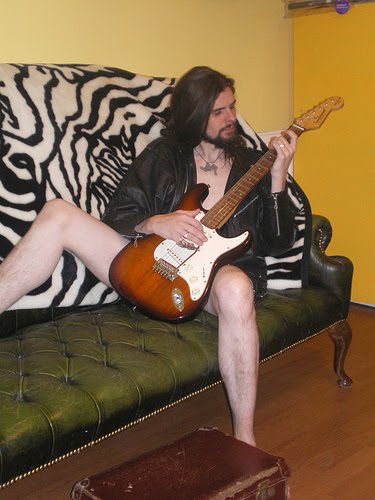
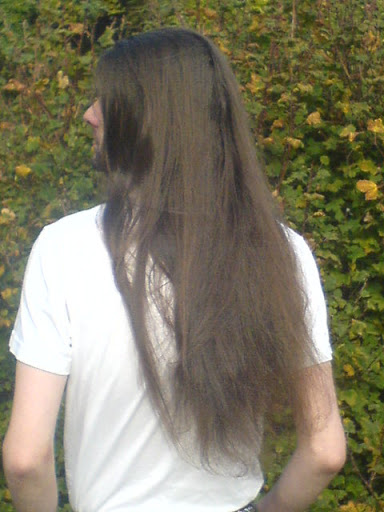
Yes, in November, this sad old rocker is having his hair cut off. Those ears haven’t seen sunlight for nearly twenty years! It’s been over a year since his last cut, and it’s almost waist-length: the ponytail is at least 16in.

His company is on board with sponsorship, and there is a raffle at work with the winner having the honour of wielding the scissors!

The charity is Little Princesses Trust, which provides wigs for children who have lost their hair due to cancer or alopecia. All hair donations are sent for wig-making, even bleached hair, as long as it’s at least 10ins long and in good condition. Hair from all ethnic groups, hair that has been stored for up to 10 years, hair in layers (min 10ins), it’s all good. And unlike some other hair-donation programmes, the hair is actually sent to wigmakers who return the wigs to the Trust for distribution – not sold to raise funds.

TH has set up a JustGiving webpage for additional cash donations to the Trust. Please consider donating, however small an amount – and, if you’re a UK taxpayer, please add GiftAid to your donation: it costs you nothing, and gets the charity an extra 28%.

GO ON GO ON GO ON GO ON GO ON GO ON GO ON GO ON GO ON
YE WILL YE WILL YE WILL YE WILL YE WILL YE WILL YE WILL

ShareThis

Posted using ShareThis

I just made some gluten-free soda farls…

and thought I should do some jotting.

Mother put me up to this the other day, mentioning that she now exclusively eats her own home-made soda farls instead of buying loaves that she can’t finish on her own. It dawned on me that I’d never made soda farls myself, ever. So I went on a quest for a gluten-free version, motivated in part by the imminent demise of my bread machine, which still bakes, but no longer heats during the proving stages. I found some good recipes, among them Living Wheat-lessly, but was hampered by the rundown of the store cupboards before we go off to Sweden on Sunday. Finally desperation drove me to knock something together yesterday lunchtime, when we ran out of bread of all varieties. Hence the following.

The first lot were white, the second “wholewheat” – not really wholewheat, obviously, otherwise I would be in a very bad way atm, but fake gluten-free whole-fibre-ish.

Anyhoo, the flour blend for the first batch was:

8oz Rice Flour
8oz Tapioca Flour
8oz Soy Flour

Sorry about the Imperial units, but this was left over from a blend in a US book, so it’s either cups or ounces I’m afraid. And I have learned to my cost (my nummy, nummy cost) that a US cup has nothing whatsoever in common with my coffee mug.

Mix 10.5 oz from this flour blend with 3/4 tsp baking powder, pinch cream of Tartar, and 1/2 tsp salt.
Rub in 3 tbsp cold butter (I use Stork).
Add 1 tbsp sugar (but see next recipe), mix and put a well in the middle.

In another large bowl, beat 2 eggs, mix in 8 fl oz natural yogurt, and add 1/2 tsp baking soda, whisking like mad.

AT THIS POINT YOU NEED TO START MOVING LIKE BUGGERY. The yogurt and baking soda mixture will start fizzing, and you need to combine it with the flour as if the very hounds of Hell were baying at your heels for the lickings.

It will be more like a batter than a bread dough, so just pour it into a preheated griddle pan (I used a wok – a frying pan would do: as long as it’s heavy-based and has a lid, it doesn’t matter). No oil, no flouring. Keep an eye on it, it should be mostly cooked through in 20mins, but flip it over anyway to finish cooking through. Now, I don’t know if this makes any difference, but it’s what my tribe does: take it out and wrap it in a dishtowel until it’s cool.

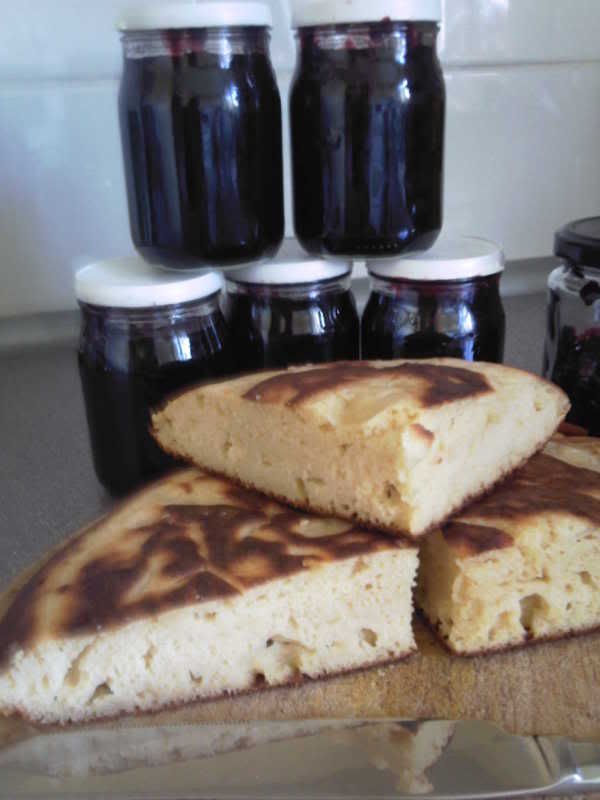
It was a bit rubbery – no doubt because I put 2 eggs in instead of one – and too sweet for my liking, although I would consider it as a basis for a fruit soda. There it is on the left – with my home-made blackberry jam in the background, made from berries picked by the Mighty Offspring himself, awww…

The second lot uses this flour blend:

8oz Rice Flour
8oz Tapioca Flour
8oz Quinoa Flour (because I was out of Soy, hah! and quinoa is also a high-protein flour)

The same method – 10.5 oz flour blend with 3/4 tsp baking powder, pinch cream of Tartar, and 1/2 tsp salt, rub in 3 tbsp butter. NO sugar, but instead add a goodly fistful of toasted soya bran, available from Holland & Barrett.

Prepare buttermilk by mixing 8 fl oz milk with 1 tbsp vinegar, then mix in 1 – not 2 – beaten egg, 1/2 tsp baking soda: this will also fizz, but a little slower. You still need to get a wriggle on.

This mix isn’t as liquid, and could probably be formed. I didn’t, though – straight into the preheated wok and away.

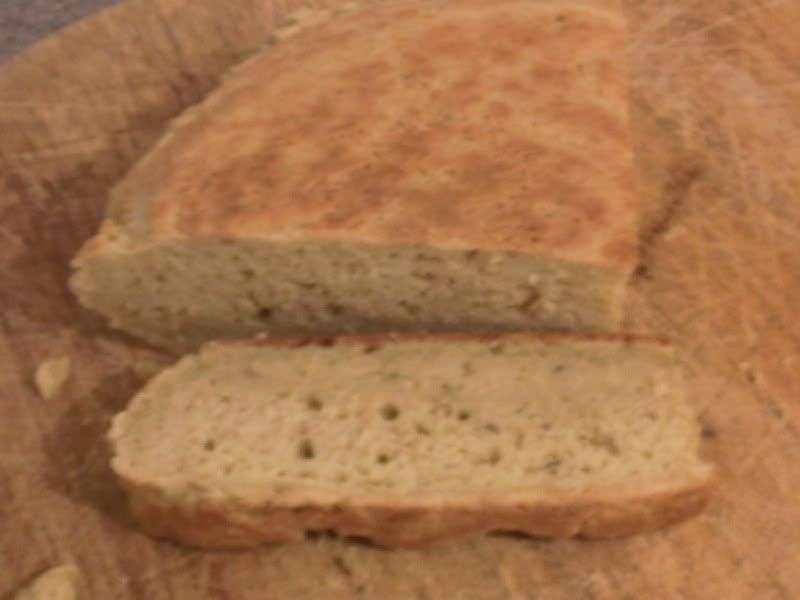
It was a little crumbly when I tried to cut it when still warm, but turned lofty and elastic when cold, just like it should be. The lack of sugar was perfect – it was just the right degree of tangy and savoury. The slight bitterness of the quinoa also works well for this faux wheaten: soy flour would be just a bit too soft and waxy. It’s not overly wholewheaty, more like the soft, spongy Ormo wheaten loaves than the nutty bricks of my childhood, but I was going easy on the soya bran for this experiment. Next time, though…

You’ll notice neither recipe uses xanthan gum, guar gum, or powdered milk, which would be quite usual in GF baking: they provide the rubbery, gluey sponginess of, well, gluten. It’s not actually essential that soda bread has this sponginess, though; it doesn’t have that character even when made with wheat. But I did wonder why the second farl wasn’t as crumbly as I’d expect. The first obviously got its extreme sponginess from the accidental egg overdose, but that wasn’t the case with the second. Then I remembered: milk + vinegar + heat = casein plastic!

Mwhahahahahaha!

We interrupt the scheduled programme…

…of joyous creativity to announce a tragedy.

At 8.00 this morning, the Clarice bag departed this world.

This beautiful, vibrant – nay, fluorescent creature went into the washing machine last night for felting. Sadly, this morning, it was found in a semifelted condition, almost completely bereft of Kool-Aid colour.

The only colour to survive, however slightly, is the one I dyed with Turmeric (yes, the spice. It’s pretty good, no need for acid, salt, nasty chemicals – just spice and boiling water. Works for cotton too).

And not one photograph did I take before I put it in the washing machine.

So, what did I do wrong? I did a fair bit of research before going into this, and all of it suggested that Kool-Aid dyed wool felted pretty well. Slight fading but not too serious, more of an advantage given how eye-wateringly bright Kool-Aid can be. A quick whizz though my sources reveals no mention the optimal wash temperature, though: my machine was set for a boil wash, which, in retrospect, was probably too hot. It was stupid o’clock in the morning, I’d stayed up to finish it ready for felting, and I was overcome with the desire to have my widdle baggie-waggie first thing in the morning: not my best chemistry thinking time.

Back to the drawing board, then. I still want to make this, but I’ll do some test swatches and try a few different temps first. I’d also like to re-jig the chart: Coss seems to assume square rather than rectangular stitches, and comes out very wide and short when knit up. It produced a lovely oblong shape for the bag, but the flowers were a bit stretched.

So, I return you to your normal scheduled programme with this cautionary bit of advice: don’t wash your Kool-Aid dyes at 90deg until further notice.

ETA: When life gives you lemons, stick ’em down your blouse to make your boobs look bigger! I’m going to use the bag to learn to steek! and maybe needle-felt! Not that I see myself making anything that ever requires either skill, but I’d imagine you could do a zombie some damage with a felting needle…

Monster Post III – Rav Rave!

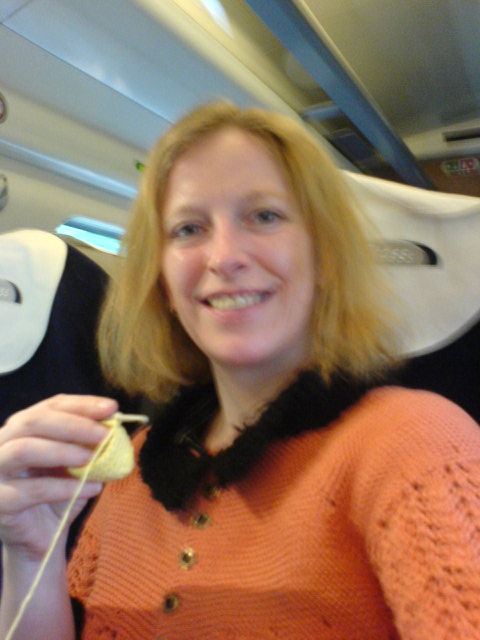
This is me, wearing my February Lady cardi, ensconced in the First Class carriage, crocheting a mobile phone sock, on my way to UK Ravelry Day 2009! It’s a bit fuzzy because the train was vibrating with speed, but it’s the best of six or eight that I took, including a charmingly smeared one of my bum as a particularly sharp jolt knocked the camera out of my hand. Nonetheless, it is proof, if such were needed, of my attendance.

I abandoned Tiny Husband and the Mighty Offspring at silly o’clock for a Saturday morning, and tore off determined to arrive for the opening. Sadly, it was not to be. The bus to the centre arrived later and took longer to travel than I had allowed for, so all was in full swing when I arrived.

It was actually a little intimidating walking into the hall knowing it was full of fibre enthusiasts. I didn’t dare take my rain coat off at first, for fear of people throwing tomatoes at me for my February Lady blasphemy. Or something equally irrational. I got a coffee and sighed over the lovely cakes I daren’t even breathe around, and checked out the competition. But despite the tight confines of the entrance hall, everyone seemed quite jolly, pushing and shoving their way round very politely. I risked putting the raincoat in my shopping trolley (for, friends, I was on a mission), sucked in a fortifying breath, and tried a little eye contact. No tomatoes. Oh good. Then I saw Rooknits, who organises the knitting meet-up that I, er, occasionally attend, helping hand out programmes, and wearing – yes! – her own FLS. Completely different to mine, barely skimming her hips in a variegated purple Malabrigo, and just looking so much lighter. Mine is, you know, heavy. Cotton. A quick word, and I went to pick up some goodies, including a Rav badge.

I had not scheduled anything for the morning to give me a chance to wander round and soak up the atmosphere. On my way into the main hall, a couple of people stopped me to look at the FLS, and one took a photo. The Knitter magazine, which was sponsoring the event, had a photographer there taking pictures of individual knitters in their finery. I made sure to walk past slowly and ostentatiously, and they totally ignored my orange and black 60s-inspired take on the world’s most popular sweater!! Which didn’t improve my misgivings about it… And as if to add insult to injury, on my final  promenade, the photographer’s assistant – or the fashion director, who knows – dived shrieking towards me – and grabbed the woman behind me. Who was wearing an ill-fitting, sangria-vomit-coloured… sack thing, that she protested she hadn’t even had time to finish seaming or weaving in on (which was very obvious) before coming to the event. It was a shambles, but the PA/FD just would not release the poor woman, dragging her kicking and screaming up on the stage and propping her up with threats and menaces as she tried to hide her face in shame inside the lopsided half-sewn collar… Maybe it was some hellishly expensive yarn – they always seem to look like some variant on puke – or a pattern by some high-flown designer. I clearly don’t have good enough taste or fashion sense to tell. Maybe – no, undoubtedly – it would have looked better properly finished and blocked. Who cares – I was miffed, insulted, ready to throw the bloody FLS in the trolley, certain it was every crappy thing I worried it was (tacky, ugly, unflattering, laughable, grannyish…). Sometimes I am a very small person.

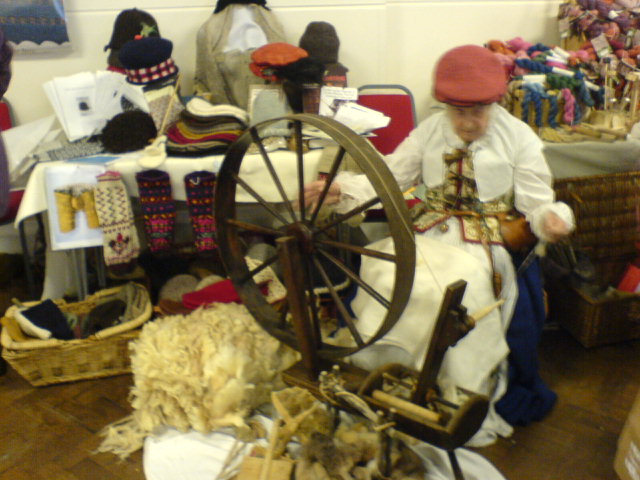
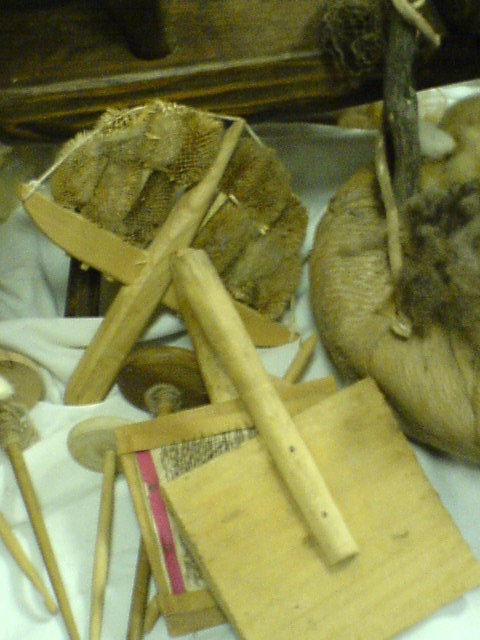
The hall was bustling quietly. Someone was doing a demo of spinning in historical costume, on a very large, very homemade looking wheel. I couldn’t place the era, and don’t know enough about spinning to identify any more than that, and was still feeling too shy to stop her and ask questions. There was a selection of fabulous felted hats, some military, on her stall, but sadly none for sale. The most amazing thing was a set of carders (?) that I didn’t even see until I was leaving the hall later. Instead of bristles, they had large burr seeds attached! That just amazed me. Of course, what would you use before manufacturing gave you the option of inserted-bristle brushes? It’s so obvious and ingenious.

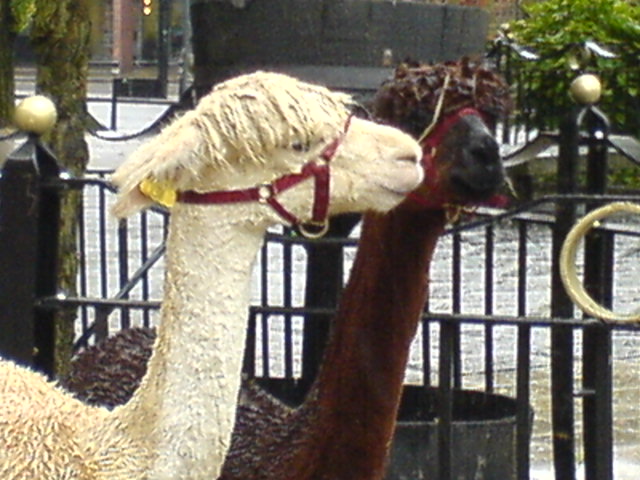
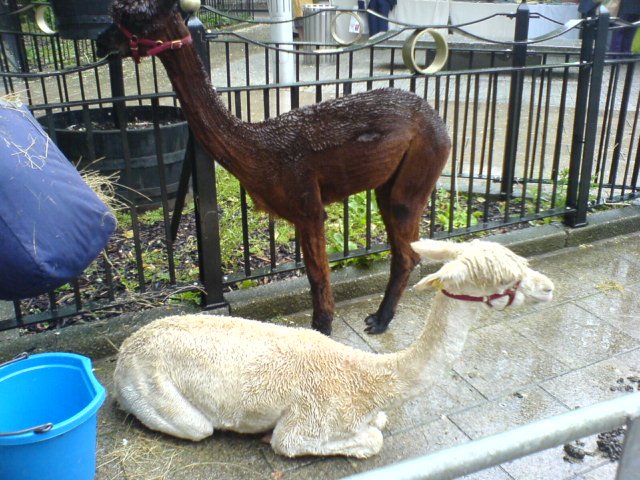
I wandered about for a bit, looked everything, then headed out into the bucketing rain to wander round the stalls. The first thing to see was this adorable pair of alpacas. There were a few people, as I passed back and forth, who bemoaned the terrible conditions the poor little things were suffering in the rain. I inadvertently sniggered the first time I heard one, earning a glare, but really? They come from the Andes (full of alloo-ARRRR!), which is Spanish for ‘some of the most extreme environmental conditions found on this planet’: Coventry must be a cake walk for them. They certainly seemed to be coping with the downpour and the crowds with typical camellid insouciance, though of course they may just have been stoned on the comparatively oxygen-rich atmosphere.

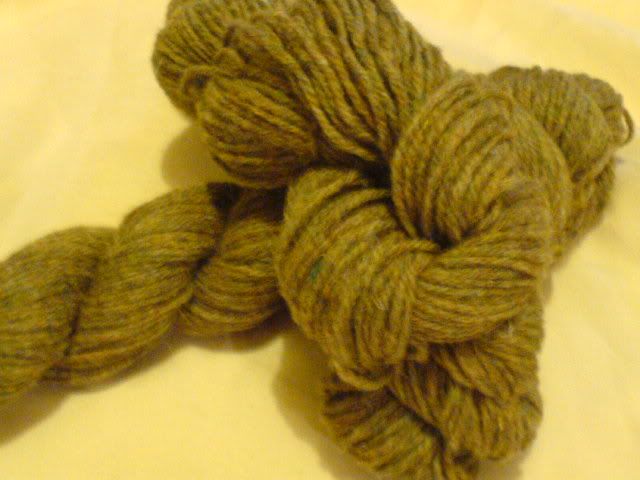
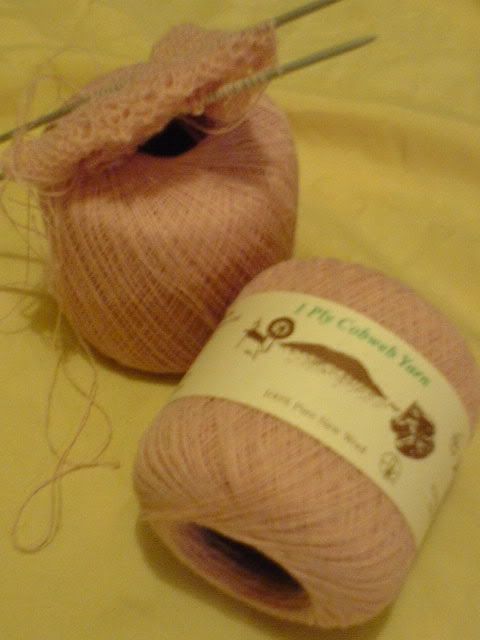
I bought some alpaca fibre at another stall, lovely deep black stuff that I will one day pluck up the nerve to spin. However, I was really after Jameson and Smith’s stall. I wanted to get a colour card (done, and then some – I think I got every colour card there!) and possibly some yarn. So I picked up 10 skeins in a lovely honey green, which I hope to run up in a Japanese pattern from Hitomi Shida’s 250 Couture Knit Stitch Patterns, to which I treated myself on YesAsia. I also somehow accidentally walked off with some 1-ply cobweb in a lace scarf kit. No idea how that happened, or how that huge sack of Shetland spinning fibre came to be in the bag with it – if you’ve been paying attention, you’ll know that lace and I are not mutually compatible. And my first response to thread is to whip out a steel crochet hook visible only under electron microscope – not big fat knitting needles! And it’s PINK!!! Gooey, sickly, sugar-pink at that. Nonetheless, I cast on Meg Swansen’s talk and did a respectable amount before having to rip back due the inevitable stitch-count issues.

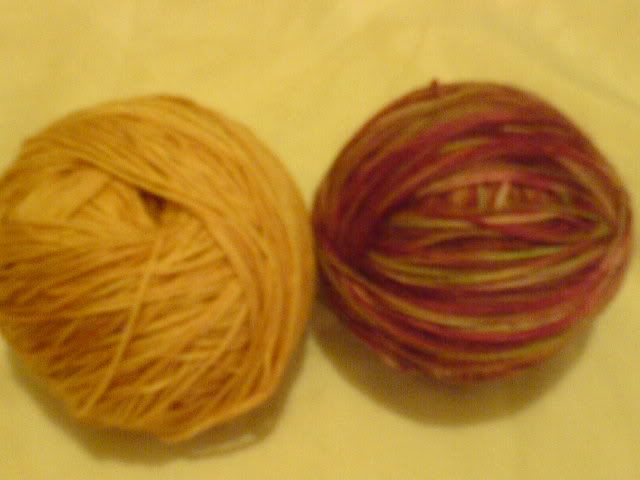
In the afternoon, I attended a natural dyeing workshop, run by Debbie… Barton? Sorry, the name is gone. There, I went a little mental, discovering previously unsuspected enthusiasm for the Madd Colorzz as long as I was in charge of the dye pots. The result is the red and green ball on the right – the ball on the left is some leftover mordanted Jamieson & Smith jumperweight that we were told to take away. I dyed it a lovely deep gold with onion skins – not terribly even but mouthwatering. I mean that btw, I’m dribbling on the keyboard just thinking about it. I call them Rhubarb and Crumble respectively. There might be enough for a faux Fair Isle tam, but I’d probably best knit it from the top/centre down just to be on the safe side.

I also picked up some smaller size KnitPicks (now Knit Pro in the UK) interchangeable tips and longer cables to go with my kit, and some of their multi-coloured Symphonie wooden cable needles – not that I need them, or will ever likely use them, as I think the scoring on them would tear up the yarn, but I can’t say no to a cable needle… Tried to get some Soak, but the only bottles left were scented and didn’t appeal. Was sorely tempted by Poems of Colour, but it was sold out too apart from the stall copy. I did finally settle on The Opinionated Knitter, and got it signed by Meg Swansen!

Meg’s talk was great fun. She read briefly a few extracts from her mother’s books – mostly The Opinionated Knitter, which at this point I hadn’t bought. I’ve always liked Elizabeth Zimmerman’s tongue-in-cheek humour, and it translated well in the talk. Most of the talk was taken up with answering questions from the floor on any and all topics related to Elizabeth, Meg herself, Schoolhouse Press, etc. I hadn’t expected any laugh out loud moments, but there were plenty. At one point, someone asked about the February Lady Sweater, and whether Elizabeth would have approved of this adaptation of the Baby Sweater on Two Needles (Knitter’s Almanac). In her reply, Meg asked for all the people in the hall wearing a FLS to stand up – and at least 20, probably more like 30, stood up! I may have lost my stitch count at this point. All different colours and fibres, on all different sizes and shapes. After the talk, when I queued up to get my new copy of The Opinionated Knitter signed, Meg was very complimentary about my fitted FLS, and asked a lot of questions about how I’d done it (yes, I know I have to put something together about that). So, sucks to the The Knitter! Validation from the foal’s mouth!

Monster Post II

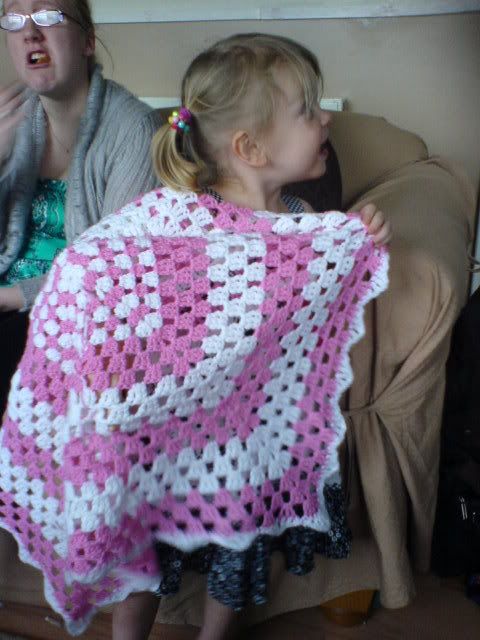
Let’s see, a good long while ago, the father of the Monstrous Offspring’s playmate at the childminder’s asked me if I could make a replacement blankie for her. He is also the Head of IT at work, so I ain’t gunna be p!ssing HIM off, with the state my laptop’s in! I had a look at the pitiful remnants of her blankie, and there was just enough left for me to make out that it was definitely crochet, three long stitches together and a chain between each group, into which the next row’s three stitches went. The long stitches might have been trebles, the number of stitches in the chain might have been 3 or 4 – the poor thing was too matted to tell. But I had a go at it for her birthday, and she was delighted. I was worried she would feel it was trying to take over, but she wrapped it round herself, twirled with it, was a butterfly, etc. Honour was satisfied.

I should really try to crochet more. It’s starting to be a little ouchy on my hand, and that’s not good. I may even have a project in mind…

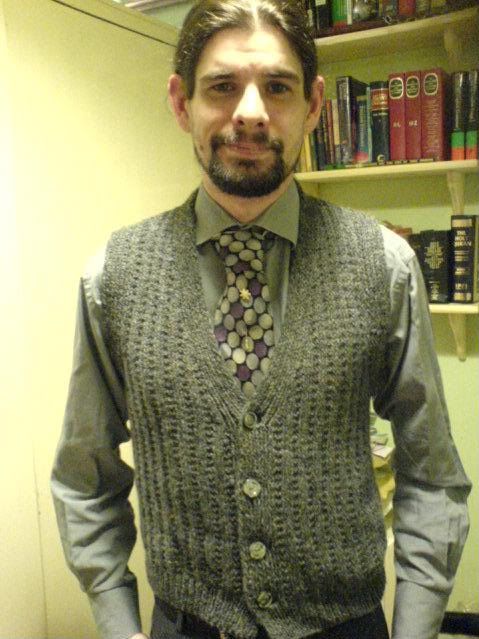
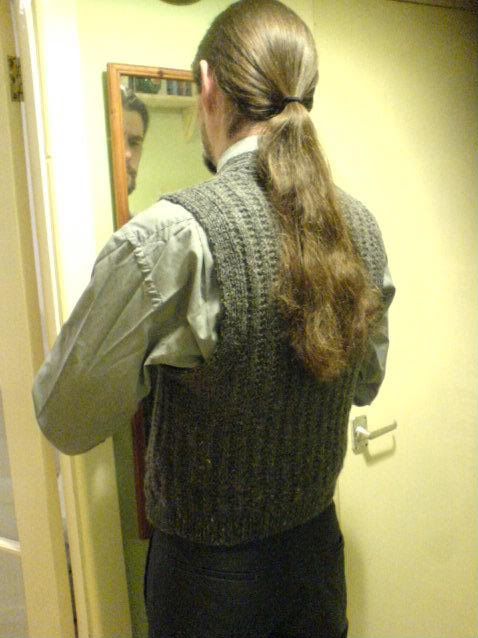
Tiny Husband has expressed an interest in tie pins and waistcoats – now that his workplace has made ties optional for all but front of shop staff. Contrary beast that he is. So I made him a 1940s knitted waistcoat! The yarn is from a massive cone of natural 100% wool – Herdwick possibly – that I bought for nothing when I was still leaving the universe of dolly-mixture acrylic – didn’t even know Herdwick was a breed! There’s probably more than enough left for Louhi, once I get the courage together for such a long project – and a decent pair of gardening gloves: that stuff is rough! Currently, I’m making a Noodle Shrug for the bridesmaid, using this wool doubled.

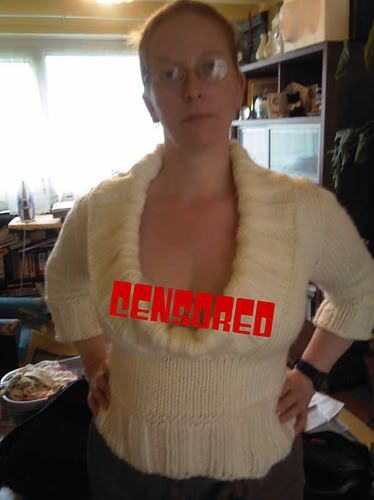
This is all by way of diverting attention from the fact that I went on a big me me me drive recently. I attempted to make this for myself using some no-name chunky wool blend from LIDL. It was a very fast knit – all done, plus other knits, on our two weeks in Ireland – but it was just too. Low-cut. And there’s just no way I was going to add even more bulk by wearing something underneath it to hide Pinky & Perky from a curious world. It awaits frogging and a possible rebirth as Owls. My Ruffled Collar Pullover continued apace, but there’s only so much time I felt like devoting to ribbed mohair. Making considerable progress is my Clarice bag. No photos, but it is almost finished, which I am quite pleased about. I’ve only been able to work on it for short periods, as the multitude of bright bobbins tends to attract cat, son and husband, to the detriment of the work.

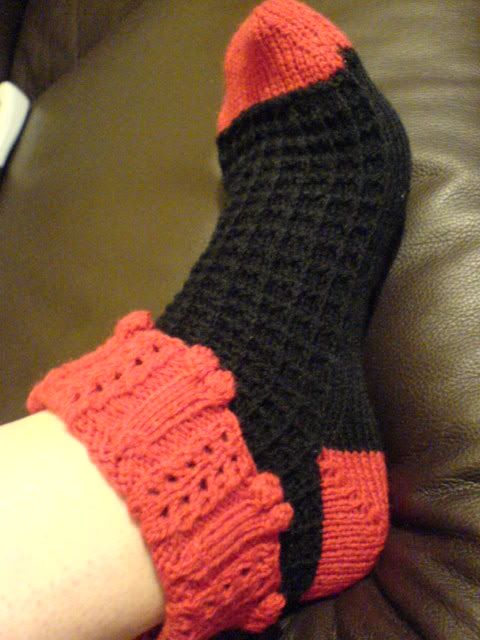
Then I saw these, and had to have them for my own. They are Penispoopcakewaffle Socks. Brainchild of one Wendy Moreland, it is a free Rav download, not available elsewhere I’m afraid.

For a time, this was all I had completed for myself to wear to UK Rav Day, and durned if I could find a pair of shoes, among the millions I own, that I could wear them with – even just a pair I could wheek off easily for showing-off purposes (why does that sound dirty now it’s in print…). I had slaved and slogged into the wee hours many a night trying to finish off my Joan Crawford (in a black variant of the mystery yarn mentioned in the previous post) for the day, only to be defeated at the last by the finishing. Sew a hem on a jumper, will ya, Biddy Ann? Aye right. I ask you.

And then, the blindingly obvious hit me. Funny how often that happens. Some time ago, I answered a plea from someone about the infamous February Lady Sweater – or as thee, me and the cat would call it, bed jacket. Cardigan if you’re being charitable. This is viral knitting as its finest. The Susan Boyle Youtube video of knitting. Now That’s What I Call Knitting #6306 (which is the number of times it’s been made so far, according to Ravelry) – you get the idea. It’s the adult version of Elizabeth Zimmermann’s Baby Sweater on Two Needles. I first came across it a good while ago, being touted as suitable for a maternity cardi, and thought good luck to it. It’s mostly lace, which is not something I’m dying about at the best of times. What with neither being pregnant nor having the prospect of pregnancy, not to mention having a very great hatred of the current fashion for looking pregnant (even though it worked in my favour when I was) I had no interest in the thing. But a plea went forth, and I answered it.

The whys escape me. I mean, it’s not like no one out there had ever made one. Some people have made – well – quite a few. They’re a bit like sock knitters: they’ve found what they were born to knit, and, well, they go to it with a will. Anyway, this is about me me me, so back to your normal service.

Her questions were quite complex, possibly made so by a difference of language, and in the end I had to cast on to check that my reading of the pattern was correct. For handiness, and because it was roughly the right weight, I started off with an apricot cotton – Paccia La Lana Cinzia – which I got in a fire (or possibly bomb) sale in Belfast about 18 years ago. I had tried doing things with it before, but nothing had quite worked. Undaunted, I plugged on with FLS to the point – at the end of the collar/start of the lace – where her questions ended, and was pleased to report that I was correct (as was she, just confused, but then this is about me me me. I don’t know why I have to keep saying it). By then I had invested a substantial amount of time on the project; I thought I might as well use up this stuff after all that time in a box, moving countries with me.

Okay fine, I just couldn’t stand the thought of ripping it out again.

So I continued. I soldiered on with the lace – it wasn’t too hard, especially after I put 15 million stitchmarkers at every repeat. I could even do it without looking, managing half a row or so (there are about 85 giblillion stitches per row…) on the bus. Then I remembered I was doing a maternity tent – sorry, smock effort. Never a good look on one so sumptuously endowed as moi, and thanks to my recent success in vanquishing the Weed, I am packing a smidge more round the waist than I like. So not just huge jugs to make it sit out, but a muffin top to keep it from sneaking back in. By jaze sez I, I’ll need to do something about this.


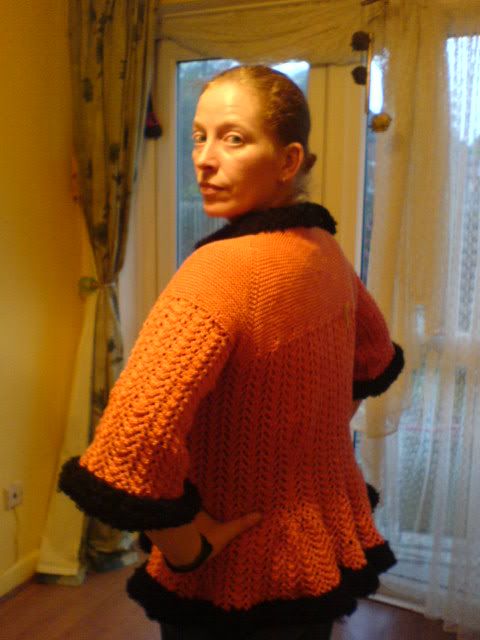
So I shaped it. Hah! Pheer my madd skillz. I narrowed it in to my waist, then widened it out again for my hips. Then along the way I thought, you know, for ages I’ve been longing for something a bit piratical, a bit Jacobean, something with booty and flounce and that certain Laurence Llewellyn Bowen sensibility – something with oomph and tra la and a fol de rol to set the cat among the curtains. So I SUPER-sized the hip increase for a bouncy little peplum, ha har! Then I added cuffs, collar and hems in a vintage Astrakhan I have about me, and some gold-and-black buttons I found in the market, and voila! The effect is not fitted, but semi-fitted: I can still wear a jumper underneath. Though part of me is tempted to unpick and re-do it, because I feel I didn’t start the decreases early enough. But whatever.

I just about finished it in time to travel to Ireland, where I wore it almost constantly. The photos had to be taken that evening, before it was finished, or blocked or anything – you can see the ball of astrakhan balanced on my shoulder. I’m not sure now why it was so urgent, but it was. One day I’ll get nice pics. Ones where I don’t get exasperated by the photographer’s fear of pressing a button on my very complicated camera phone while panicking over the location of the passports…

Next installment: UK Rav Day!

TTFN
K