Between injury and family stuff, I have not done much spinning, but I have spun something every day so I’m still meeting my TdF goal.
D+7 challenge: Glitter. And wouldn’t you know it, another delivery from WoW*, including two glittery tops from their recent Fibre Friday offerings:
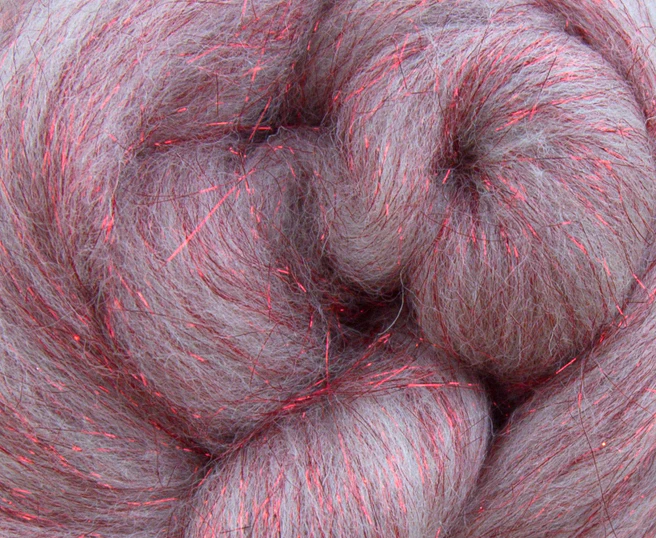

Both are 70:30 merino-stellina (polyester-nylon) blends, where the merino is white and the stellina provides the colour. What I find interesting is the overall colour of each: the red stellina results in an overall deep pink hue, and the multi-coloured stellina a soft grey.

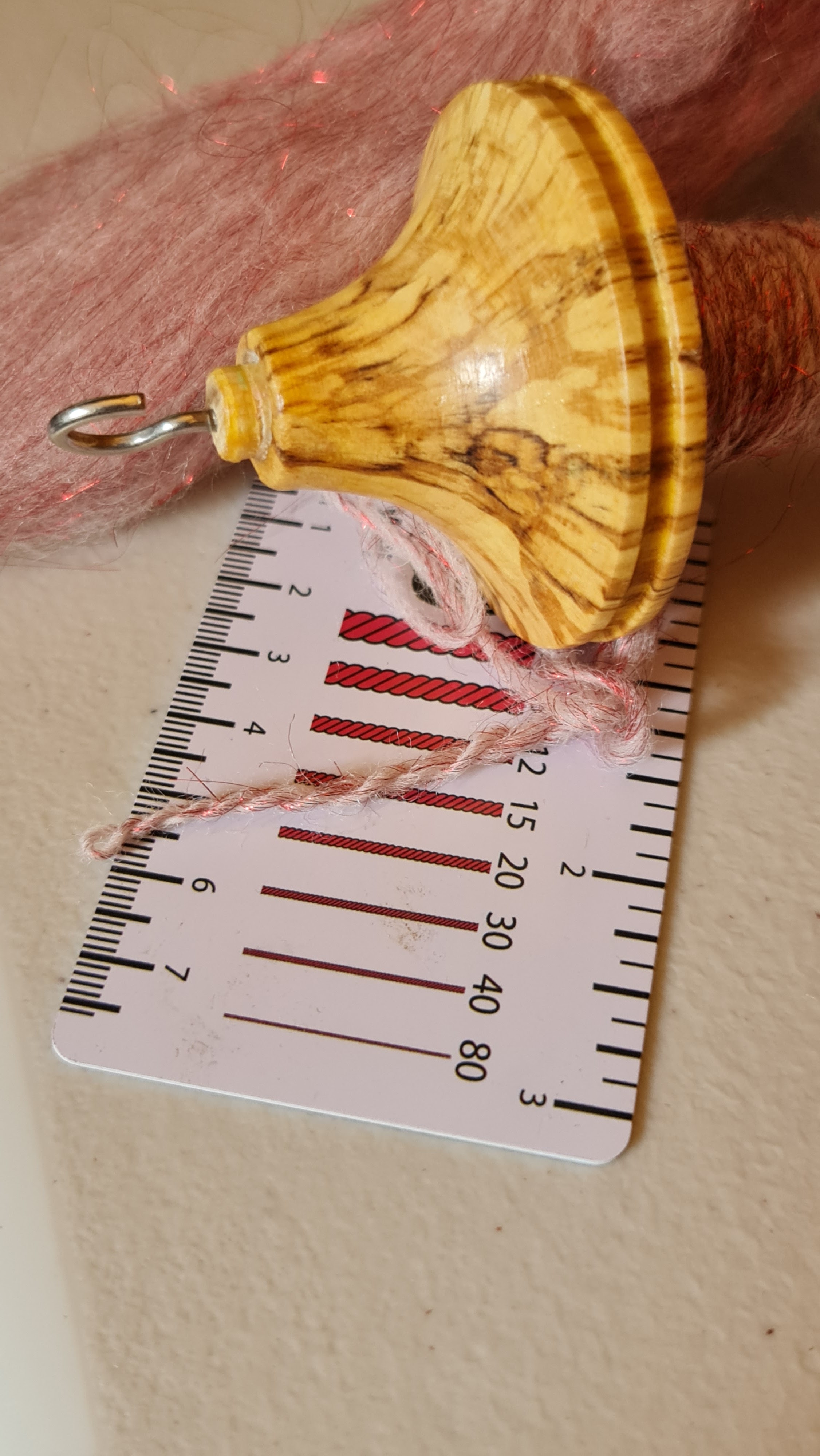
I decided to spin the white-red blend on a spalted beech drop spindle from Thomas Wood & Wool. One part of the spalting resembles Salvador Dali’s The Eye, so the spindle’s name is Dali. I remember reading somewhere that roving? top? is created by combining 3 pencil rovings into one, and that the 3 parts can quite easily be separated. I unfolded the blend and lo! it was so! Not terribly obvious, but I broke a hand-length off and divided it in 3 for spinning. Out of concern for the single getting too thin and ending up spinning just stellina, I made the effort to spin a wee bit thicker than I normally do. I also twirled the spindle slower – which meant it spun for shorter runs – and allowed it to “un-spin” until the single was only slightly twisted, just beyond the point of falling apart. The result looks like a woollen-spun single, and the 2-ply will likely be somewhere between sportweight and DK.
D+8 challenge: Fractal spinning. Sorry, no. Not only do I not have any suitable fibre, I have almost zero interested in the effect, having opinions about multi-coloured yarn. I do a fair amount of colourwork, but generally I want my colours to be solid or at most heathered (I am also a hypocrite and love more random multis – see above). I did go and look at some fractal spinning tutorials, but that’s as far as I care to go. Instead, I continued with my Herdwick/bio-nylon spinning.
Other round-ups: I finished spinning the angora bunny sample on Enola the micro Turk. I will probably follow this white rabbit down a warren of textile physics at some point, because it. took. forever. to spin, not because of the difficulty of doing so (though it was tricksy) but because the single is sooooo long. Angora fibre must be very lightweight compared to other fibres, because I swear the meterage from this teaspoon-sized sample must be comparable to that from the 25g of Shetland I spun the other day. It might even be longer. I do spin these samples extremely finely, but neither of the other two I’ve done have produced so much:

I doubt I’d be able to spin this on my wheel, certainly not at my level of what I laughingly call ‘skill’, but I wonder if I could spin a blend of Angora with something else? Where the Angora is there just to be fluff, not fibre? Possibly with a longwool?
Anyway. I also worked a wee bit more on the Seacell on my new Enid Ashcroft spindle, Enda. I’m consciously spinning it a bit thicker, around 20wpi, but keeping it worsted:

It’s quite lustrous and silky, though more like Tussah silk than the posh stuff as it has a grabbier handle. There’s a little of the feel of synthetic silks which normally have me scrubbing my hands raw, but overall it’s silky rather than squeaky. The colour is rather like the yellowing you see in vintage linens, so this would be a nice choice for an instant heirloom, woven, knit or crocheted. I’m seeing a lovely baptismal shawl, though given my track record it ain’t gonna happen!
Allons-y, there, and everywhere…
*: Including a gorgeous black and lime-ish gold Tub of Joy, 50g Angora bunny fibre, 300g scoured Wensleydale (I think my finger slipped when ordering – I meant to get the carded top…), some crystal Angelina, and a Beginner’s Dyeing Kit.
 thornmaiden.com