
Oh my giblets, what a start!
I’ll preface by saying that my vague plan for TdF23 was to spin every day – that’s all. Firming up slightly, I thought each day I’d spin a 10g sample from a World of Wool sample pack on one of my drop spindles, and then hit up the spinning wheel with something more weighty, like the 400g Herdwick ‘n’ bionylon WoW custom blend destined for sock knitting, or the Dye Candy art batt, etc. I don’t do detailed schedules and timings. I used to, but the universe has all kinds of ways of tearing up my plans and throwing them in my face, whether or not there are any plans in the first place, so nowadays I save the time and energy for the inevitable disaster management instead.
Well, first I couldn’t find the @&%$ing sample pack, but that wasn’t much of a problem. While looking for the samples, I found a remnant of some tweedy floof I picked up on a visit to Donegal Yarns. It wasn’t meant for hand-spinning – it was some intermediate stage in their processing of fleece into yarn, and by now it’s only fit for stuffing cushions. When I got my drop spindles out earlier this year, I’d spun up the rest and a brutal job it was too, basically just ripped clumps out of it and hoped for the best. And yes, it’s a lumpy bumpy yarn – but here’s the thing: I bought a cone of that same colour on my visit, and it’s not wildly different to my handspun.
So I spun up this remnant in lieu of one of the samples on my big yew Turkish spindle, whom I have named Bow Diddly:
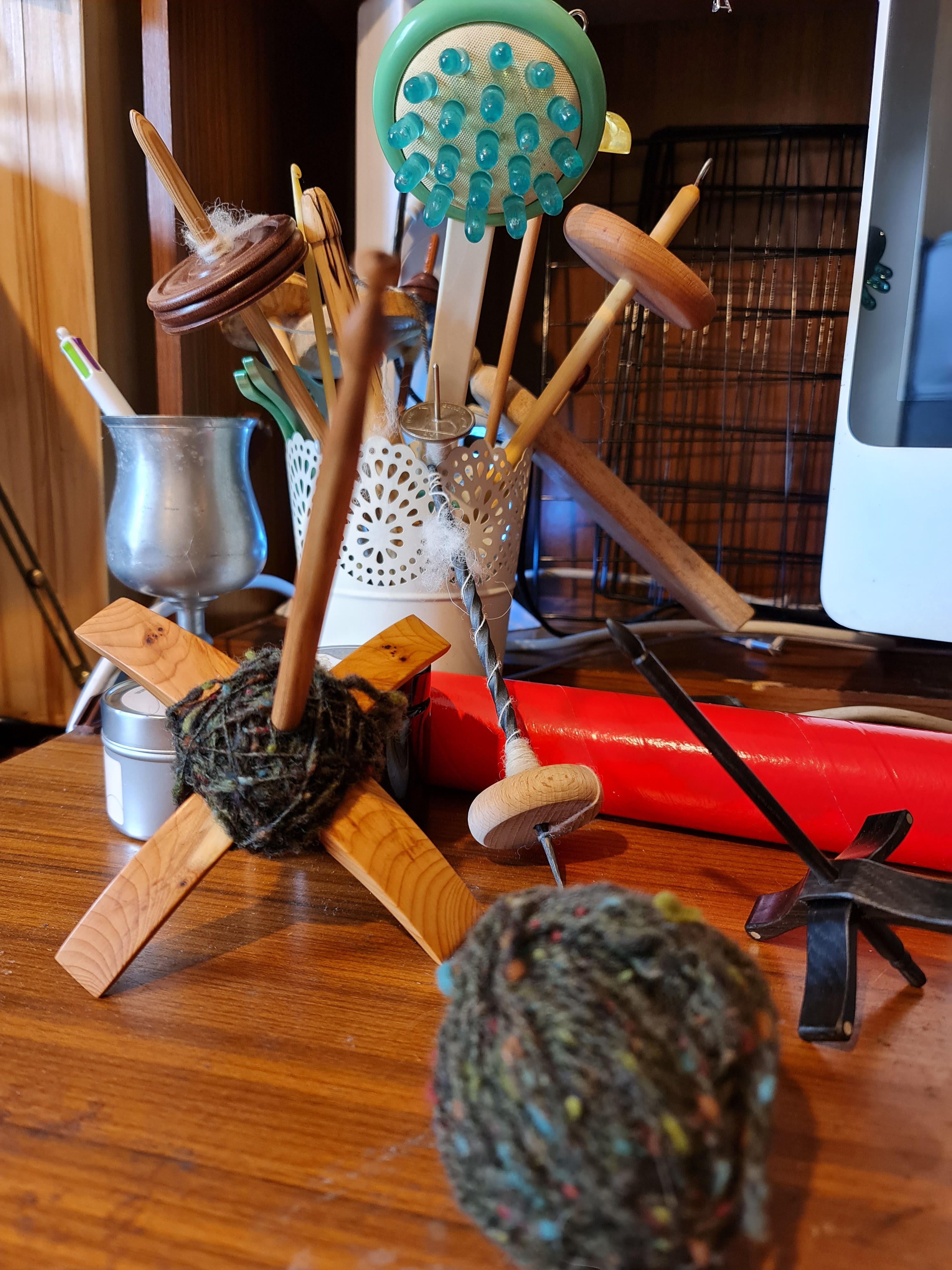
Enola stood ready for the 10g samples, which I promptly found after finishing plying the tweed. Of course. Oh well, at least they’re there for tomorrow.
So then I hied me the 50cm or so to my spinning wheel, and this is where the trouble really began. And begat more problems. And then some. The wheel is one I got on Freecycle at least 10 years ago. I never actually used it. Although I’d taken it along to a spinning workshop a few years ago, it misbehaved, even flummoxing the instructor, so I’d ended up using a borrowed wheel. I did look into finding someone who could repair it, but it would have meant shipping it over to England and then there was the whole pandemic thing so that didn’t happen. And today, sitting before it, I realised I didn’t even know what make it was anymore… And the orifice hook was gone, and the drive band kept popping off, and why is there fishing line on it…???
Onto Youtube to look for some Setting Up A Spinning Wheel For Dummies videos. No worries, I’ve done some spinning, so I’d fulfilled my obligations for the day, and isn’t this spinning-related too?
Eight hours later I picked myself off the floor where I’d fainted from hunger. But I had learned SO MUCH. Like I apparently have a Ashcroft Traditional, probably 1982, and it’s a double drive – but is set up as a single drive. And you guys, the whole maiden (?) thingy can be moved sideways! which lines up the groove on the flier with the groove on the wheel – which was the reason the drive band kept flying off – they weren’t aligned properly! It finally spun properly, but the yarn wouldn’t wind onto the bobbin, so I went down another rabbit hole where I spent an unreasonable amount of time trying to find a replacement whorl for my flyer (learning in the interim that I had a jumbo flier) before realising that Traditionals don’t have one (or at least they don’t have one that screws on after the bobbin…). Then I found a video showing how to put together a Traditional from bits of lumber without reducing it to kindling in the process as I was by then tempted to do… and this is where I learned about the fishing line thingy! Scotch tensioning! Which has nothing to do with Scotland, even though there’s an Irish tensioning which I still have to figure out.
Hmm… Irish tension… Nope. Get thee behind me, Spinning. (Laterz).
Apparently the fishing line (which is attached to a wooden knob at the front of the wheel and goes through a hook at the back) is placed over the groove in the bobbin, and secured via the spring on the end to a wee hook on the other side of the maiden assembly. The line can then be tightened by turning the wooden knob, which has the effect of of slowing the rotation of the bobbin with respect to the flier, which in turn allows the yarn to wind onto the bobbin!!
Somewhere in amongst all this the flaming drive band snapped, and if the postie hadn’t been right outside delivering a book I’ve been waiting for, I’d have hoofed the bloody thing out the window where it would have landed on top of him. But as I want him to keep bringing me books, I refrained. Luckily there is no shortage of long, fibre-y stuff about the place. Who’d have thought a knitter would have the like?!
So that was my Day 1. I think the wheel is operating correctly and and is ready to tackle the blizzard of floss awaiting…

So much fluff… Not all. Not even close to all.
Allons-y!
f
 thornmaiden.com